The Way Forward: Test-Driven Development in the AI Coding Era
Why Tests Are Your New Requirements Specification Language
TL;DR: As AI coding assistants generate code at unprecedented speed, Test-Driven Development (TDD) transforms from a development practice into a strategic requirement specification mechanism. Tests become the unambiguous contract that AI must fulfill, reducing defects by up to 53% while accelerating delivery—turning quality into a competitive advantage rather than a bottleneck.
Introduction
The software development landscape has shifted dramatically. Where teams once spent days writing boilerplate and debugging syntax errors, AI coding assistants like GitHub Copilot and ChatGPT can now generate functional code in seconds. This acceleration brings a critical question: How do you ensure AI-generated code actually solves the right problem?
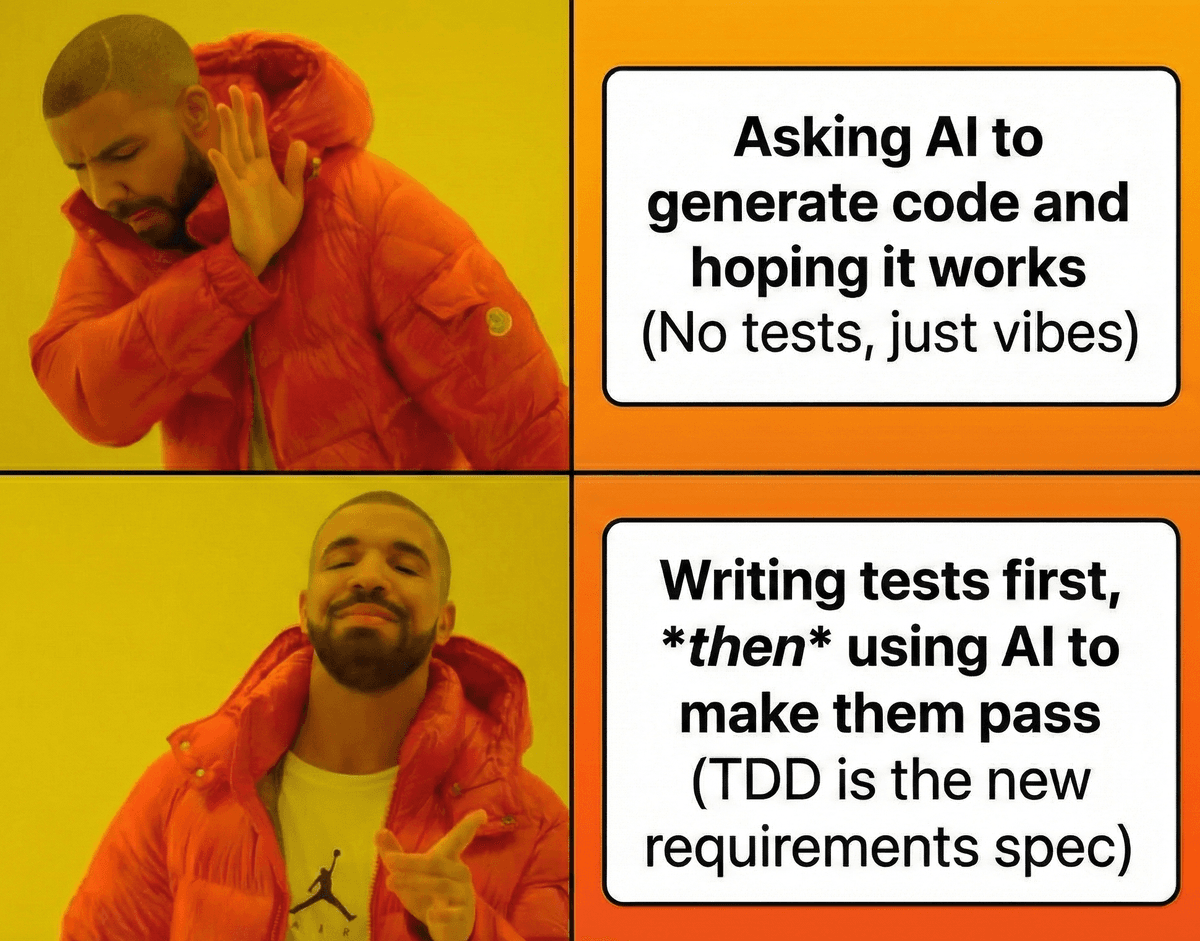
The answer lies in a practice that predates AI coding by decades: Test-Driven Development (TDD). But in the AI era, TDD isn't just about writing tests first—it's about treating tests as executable requirements that guide AI code generation toward correct, maintainable solutions.
For tech leaders, this shift represents more than a development methodology change. It's a strategic lever that directly impacts business outcomes. Research shows that fixing bugs in production costs 100x more than catching them during development [1]. When AI generates code without clear requirements, those costs compound rapidly. TDD provides the guardrails that turn AI's speed into reliable business value.
The AI Code Generation Challenge: Speed Without Direction
AI coding assistants have demonstrated remarkable capabilities. GitHub's research found that developers using Copilot had a 53.2% greater likelihood of passing all unit tests, suggesting improved code quality [2]. However, this statistic tells only part of the story.
The fundamental problem: AI models excel at generating syntactically correct code that looks right, but they struggle with understanding intent without explicit constraints. When you ask an AI to "create a user authentication function," it might generate code that works—but does it handle edge cases? Does it follow your security standards? Does it integrate correctly with your existing systems?
Without tests as requirements, AI-generated code becomes a black box. You get code faster, but you spend more time verifying it does what you actually need. This creates a paradox: AI accelerates code generation, but inadequate requirements slow down validation and increase defect rates.
Kent Beck, creator of TDD, describes AI as an "unpredictable genie" [3]. The code it generates might solve your immediate problem, but it can also introduce subtle bugs, security vulnerabilities, or architectural inconsistencies that only surface in production—where fixing them costs exponentially more.
Tests as Requirements: The TDD Advantage in AI Development
Traditional requirements documents suffer from a fundamental flaw: they're written in natural language, which is inherently ambiguous. Two developers can read the same requirement and implement it differently. When AI reads requirements, this ambiguity compounds—it has no way to verify its interpretation matches your intent.
Tests solve this problem because they're executable specifications. A test doesn't just describe what should happen—it proves what happens. When you write tests first, you're creating a precise, unambiguous contract that AI-generated code must fulfill.
How TDD Works with AI Code Generation
The TDD cycle—Red, Green, Refactor—becomes even more powerful when AI is involved:
- Red: Write a failing test that describes the desired behavior
- Green: Use AI to generate code that makes the test pass
- Refactor: Improve the code while keeping tests green
This process transforms tests from verification tools into specification tools. Instead of asking AI to "create a payment processing function," you provide a suite of tests that define:
- How payments should be validated
- What happens when a payment fails
- How refunds should be processed
- Edge cases and error handling
AI then generates code that satisfies these tests—code that's correct by construction, not by inspection.
Research Evidence: TDD Improves AI Code Quality
Recent research validates this approach. A study presented at ASE 2024 found that providing Large Language Models (LLMs) like GPT-4 and Llama 3 with test cases alongside problem statements led to higher success rates in solving programming challenges [4]. The tests acted as constraints that guided the AI toward correct solutions.
Similarly, the WebApp1K benchmark—designed to evaluate LLMs in TDD tasks—revealed that instruction following and in-context learning are critical capabilities for TDD success, surpassing the importance of general coding proficiency [5]. This suggests that when tests are present, AI models can better understand and implement requirements.
The SWE-Flow framework takes this further by automatically inferring incremental development steps from unit tests, generating structured development schedules that produce verifiable TDD tasks [6]. This approach results in fully verifiable code that integrates seamlessly with existing test suites.
Business Impact: Quality as a Revenue Driver
The business case for TDD in AI development extends beyond code quality—it directly impacts revenue and operational costs.
The Cost of Defects: Exponential Escalation
Software defects become exponentially more expensive the later they're discovered:
- Design Phase: ~$100 to fix
- Development Phase: ~$500 to fix
- Testing Phase: ~$1,500 to fix
- Production Phase: $10,000+ to fix [7]
When AI generates code without tests, defects often slip through to production. The 2022 CISQ report estimated that poor software quality cost U.S. companies $2.41 trillion [8]. Production bugs don't just cost money to fix—they damage customer trust, reduce revenue, and create operational disruptions.
Real-world examples illustrate the severity:
- Knight Capital Group (2012): A software glitch caused unintended stock trades, resulting in a $440 million loss within 45 minutes [9]
- Samsung Galaxy Note 7 (2016): Software defects in battery management led to overheating, culminating in a $17 billion loss due to recalls [10]
TDD as Risk Mitigation
TDD doesn't eliminate all bugs, but it dramatically reduces their likelihood and cost. When tests serve as requirements:
- Defects are caught early: Tests fail immediately when AI generates incorrect code
- Requirements are unambiguous: Tests specify exact behavior, reducing misinterpretation
- Refactoring is safe: Tests provide confidence when improving AI-generated code
- Documentation is automatic: Tests serve as living documentation of system behavior
For tech leaders, this translates to:
- Faster time-to-market: Less time debugging means more time shipping features
- Lower operational costs: Fewer production incidents reduce support and maintenance overhead
- Higher customer satisfaction: Quality software builds trust and reduces churn
- Reduced technical debt: Well-tested code is easier to maintain and extend
The Specification-Driven Development Model
As AI coding becomes mainstream, a new development model is emerging: Specification-Driven Development. This approach emphasizes writing precise, machine-readable specifications that AI tools can interpret to produce code adhering to corporate standards.
Red Hat's research highlights how specification-driven development improves AI coding quality by defining clear "what" and "how" aspects [11]. Tests become the primary specification mechanism—they define both the expected behavior (what) and the validation criteria (how).
Practical Implementation: TDD Workflow with AI
Here's how teams are successfully combining TDD with AI code generation:
Step 1: Define Behavior with Tests
Before generating any code, write tests that describe the desired behavior. These tests should cover:
- Happy path scenarios
- Error cases
- Edge conditions
- Integration points
Step 2: Generate Code with AI
Provide the test suite to your AI coding assistant along with a prompt like: "Generate code that makes these tests pass." The tests act as constraints that guide the AI toward correct solutions.
Step 3: Validate and Refine
Run the tests. If they pass, you have working code. If they fail, the AI's interpretation was incorrect—but you know immediately, not weeks later in production.
Step 4: Expand Coverage
As you discover new requirements or edge cases, add tests first, then use AI to update the implementation.
This workflow turns AI from an unpredictable code generator into a predictable requirement implementer. The tests provide the guardrails that ensure AI-generated code aligns with business needs.
Overcoming Common Objections
Some teams resist TDD with AI, citing concerns about speed or complexity. These objections often stem from misconceptions:
"Writing tests slows down development"
While writing tests takes time upfront, it saves time overall. AI can generate tests just as quickly as it generates code. More importantly, tests prevent costly debugging sessions and production incidents that consume far more time.
"AI should understand requirements without tests"
Current AI models, while impressive, lack true understanding. They pattern-match based on training data, which can lead to plausible but incorrect solutions. Tests provide the verification that ensures correctness.
"We'll write tests after AI generates code"
Post-hoc testing is less effective. Without tests as requirements, you're verifying that AI did something rather than verifying it did the right thing. Tests written first serve as both specification and validation.
The Strategic Imperative
For tech leaders evaluating AI coding tools, TDD isn't optional—it's essential. The question isn't whether to adopt AI coding assistants (they're already here), but how to harness their speed without sacrificing quality.
The strategic framework:
- Treat tests as requirements: Invest in test-first development practices
- Train teams on TDD: Ensure developers understand how to write effective tests
- Integrate TDD into AI workflows: Use tests to guide and validate AI-generated code
- Measure quality metrics: Track defect rates, test coverage, and production incidents
Teams that master TDD with AI gain a significant competitive advantage. They ship faster and more reliably, reducing costs while increasing customer satisfaction. In an era where software quality directly impacts business outcomes, this combination becomes a strategic differentiator.
Conclusion
The AI coding era demands a fundamental shift in how we think about requirements and quality. Tests are no longer just verification tools—they're executable specifications that guide AI code generation toward correct, maintainable solutions.
For tech leaders, this represents an opportunity to turn quality into a competitive advantage. By adopting TDD practices that treat tests as requirements, teams can harness AI's speed while maintaining the reliability that customers expect. The result: faster delivery, lower costs, and higher quality—a combination that drives revenue growth and operational efficiency.
The way forward is clear: Tests first, AI second, quality always. This isn't just a development practice—it's a strategic imperative for organizations that want to thrive in the AI coding era.
References
- OK QA — "The Real Cost of Software Bugs and How to Avoid Them." — ok-qa.com
- GitHub Blog — "Does GitHub Copilot improve code quality? Here's what the data says." — github.blog
- Khiliad — "The Real Impact of AI in Development." — khiliad.com
- ASE 2024 — "Test-Driven Development and LLM-based Code Generation." Conference paper presented at ASE 2024. — conf.researchr.org
- arXiv — "WebApp1K: A Benchmark for Evaluating LLMs in Test-Driven Development Tasks." — arxiv.org
- arXiv — "SWE-Flow: Synthesizing Software Engineering Data in a Test-Driven Manner." — arxiv.org
- OK QA — "The Real Cost of Software Bugs and How to Avoid Them." — ok-qa.com
- CIO Dive — "Software quality issues cost IT $2.41 trillion in 2022." — ciodive.com
- Test Papas — "Cost of Software Bugs: Real-World Examples." — testpapas.com
- Forbes Tech Council — "The Hidden Cost of Bad Software Practices: Why Talent and Engineering Standards Matter." — forbes.com
- Red Hat Developers — "How Spec-Driven Development Improves AI Coding Quality." — developers.redhat.com
- Thoughtworks — "TDD and Pair Programming: The Perfect Companions for Copilot." — thoughtworks.com
- GitHub Blog — "Test-Driven Development (TDD) with GitHub Copilot." — github.blog
- Tabnine — "Test-Driven Development in the AI Era." — tabnine.com
- arXiv — "Text-to-Testcase Generation Using Fine-Tuned GPT-3.5 Model." — arxiv.org
- Hacker News — Discussion thread on TDD and AI coding. — news.ycombinator.com
Related Posts
Foundation Book I: The Three-A Problem
Learn how AAA structures tests and BDD defines acceptance—essential patterns for effective TDD.
Test Wars Episode VII: Test Coverage Rebels
Join the rebellion against meaningless test coverage metrics. Learn how to build meaningful test suites that actually catch bugs.
Vibe Break Chapter VII: The Acceptance Protocol Anomaly
Learn strategic lightweight testing that protects revenue without killing velocity in AI-powered development.