
Vibe Break Chapter VI: The Authentication Amnesia
The $80 million acquisition that forgot to check who's at the door
TL;DR
Base44 went from zero to $80 million acquisition in six months by letting anyone build full-stack apps through chat. But in July 2025, security researchers discovered that unauthorized users could access ANY private application on the platform—bypassing authentication, SSO controls, and every security gate imaginable. The vulnerability was trivially easy to exploit: exposed API documentation let attackers register fake users for apps they didn't own, gaining complete access to enterprise chatbots, HR systems, and customer data. When speed trumps security fundamentals, your unicorn acquisition can become a liability overnight. For tech leaders riding the vibe coding wave, Base44 proves that authentication isn't optional—it's existential.
The Six-Month Sprint to $80 Million
On June 18, 2025, Wix announced something that made the entire tech community do a double-take. They were acquiring Base44—a six-month-old, solo-founded startup—for $80 million in cash.
Not equity. Not a mix. Pure cash.
The founder, 31-year-old Maor Shlomo, had started Base44 as a side project in January 2025 after returning from extended reserve duty following the October 7 attacks in Israel. By March, the platform had 20,000 users. By June, 250,000 users. The company was profitable, generating $189,000 in monthly profit even after covering expensive LLM token costs.
Shlomo had built Base44 with just eight employees. No venture funding. No board oversight. Just ruthless execution and a product that resonated. When Wix came calling, he owned 100% of the company. Of the $80 million, he generously shared $25 million with his small team as retention bonuses.
Base44's value proposition was crystal clear: describe your app in natural language, and AI builds the entire stack—frontend UI, backend logic, database, authentication, and hosting. All in one platform. No external integrations. No DevOps complexity. From idea to production-ready app in minutes.
Tech publications called it the future of software development. Investors wondered if they'd missed the deal of the decade. The vibe coding community celebrated another massive validation that AI-assisted development had arrived.
Then July happened.
CVE-2025-XXXX: The Authentication That Wasn't
In July 2025, security researchers at Wiz—the cloud security firm that Google had just acquired for $32 billion—were conducting routine reconnaissance on vibe coding platforms. Base44 was on their list.
What they found was stunning in its simplicity and terrifying in its implications.
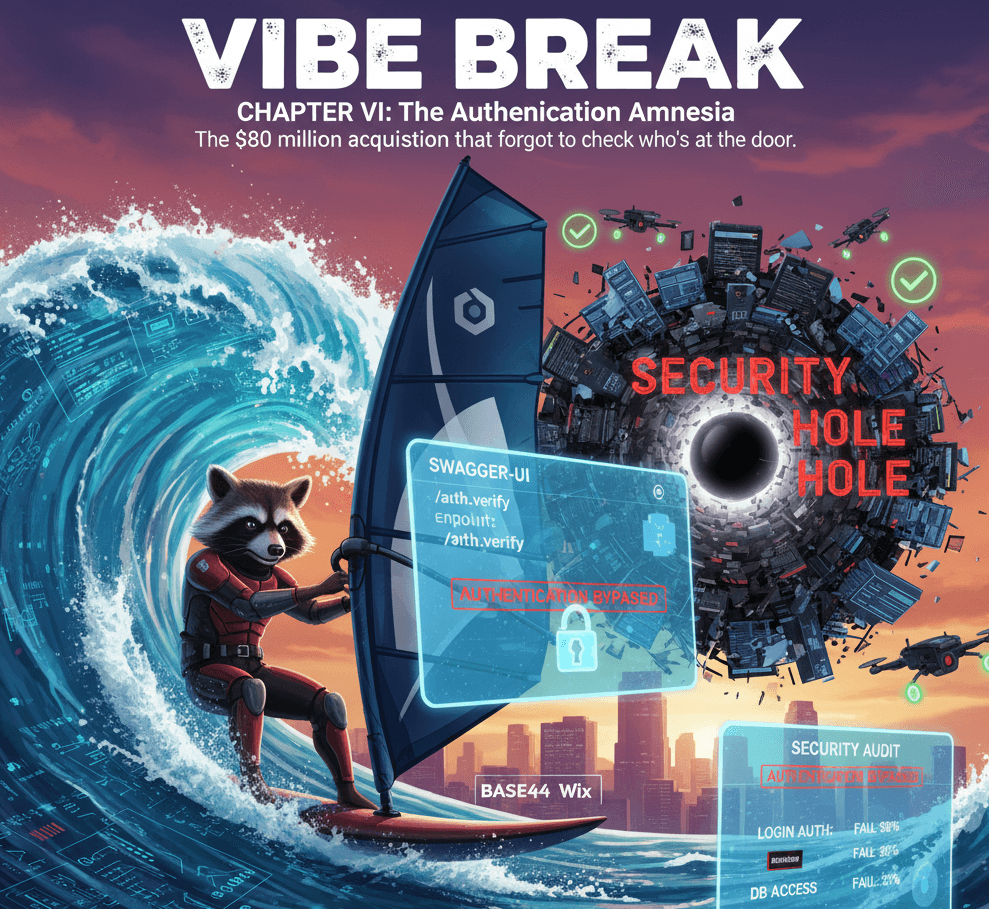
While exploring the Base44 attack surface, the Wiz team received an automated alert: two Swagger-UI interfaces were publicly exposed on Base44 domains. Swagger-UI is an open-source tool for API documentation—extremely useful for developers, but it should never be accessible to unauthorized users on production systems.
These two exposed interfaces controlled critical functionality:
- User registration endpoints
- One-time password (OTP) verification systems
Within minutes of discovery, the researchers proved they could exploit the flaw. Here's what they did:
- Identified a target application's
app_id(visible in public URL paths) - Used the exposed Swagger-UI to register a new user account for that application
- Received an OTP verification code via email
- Verified the new account through the exposed interface
- Gained complete access to the application—despite it being configured for SSO-only access
The entire process took less time than making coffee.
The Scope: Thousands of Enterprise Apps at Risk
The vulnerability wasn't theoretical. It affected potentially thousands of applications on the Base44 platform, including:
Enterprise systems:
- Internal company chatbots containing proprietary information
- Human resources applications with employee data
- Customer relationship management systems with client information
- Private data repositories and internal communication tools
The attack profile was horrifyingly accessible:
- No sophisticated hacking tools required
- No brute force attempts needed
- No exploitation of obscure edge cases
- Just basic HTTP requests to publicly documented APIs
As Gal Nagli, head of threat exposure at Wiz, noted: “This low barrier to entry meant that attackers could systematically compromise multiple applications across the platform with minimal technical sophistication.”
Unlike the Lovable vulnerability that required understanding database RLS policies, or the v0 pixel perturbations that needed visual regression testing to catch, the Base44 flaw was a fundamental failure of authentication architecture.
The Anatomy of Authentication Amnesia
Understanding how this happened requires examining Base44's architectural choices—decisions made in the pursuit of speed that created systemic risk.
The All-in-One Trade-off
Base44's core value proposition is its “all-in-one” approach. Unlike competitors that require stitching together Vercel for hosting, Supabase for database, Auth0 for authentication, and AWS S3 for file storage, Base44 handles everything internally.
This creates enormous convenience. It also creates a single point of failure.
When authentication breaks in a federated architecture, the blast radius is limited to one service. When authentication breaks in Base44's unified stack, every application on the platform becomes vulnerable simultaneously.
The Hardcoded App ID Problem
According to the Wiz research, Base44's applications used app_id values that were:
- Hardcoded into URI paths
- Accessible in public files
- Used as the primary identifier for application access
This design decision—likely made for developer convenience and routing simplicity—meant that knowing an application's ID was sufficient to begin the attack process. No reconnaissance required beyond visiting a public URL.
The Logic Flaw in Registration
The vulnerability stemmed from a fundamental logic flaw in Base44's authentication workflow. The platform left two critical endpoints exposed:
- The registration mechanism
- The verification system
These systems should have been completely inaccessible to external users trying to access applications they didn't own. Instead, they were inadvertently exposed through the Swagger-UI documentation interfaces.
As Nagli explained to Dark Reading: “The issue originated primarily from a logic flaw in Base44's authentication workflow.”
The Multi-Vulnerability Reality
The authentication flaw wasn't Base44's only security issue. In August 2025, researchers at Imperva disclosed additional critical vulnerabilities they had discovered in March:
Open Redirect with Token Leakage
An open redirect vulnerability allowed attackers to steal access tokens during login. The initial fix only checked whether redirect URLs started with https://app.base44.com—missing variations like app.base44.com.example.com that could slip through validation.
Stored Cross-Site Scripting (XSS)
Researchers identified an XSS vulnerability in the /apps-show/{app-id} endpoint. Because premium features like code editing were only enforced client-side, attackers could inject arbitrary JavaScript into applications running on the trusted app.base44.com domain.
With this vulnerability, an attacker could:
- Steal JWT tokens that authenticated users to the main Base44 account
- Access all of a victim's applications
- Extract sensitive data across the entire account
Client-Side Security Theater
Premium features—including the ability to edit AI-generated code—were enforced only on the client side. Attackers could bypass these restrictions by manipulating API requests directly, gaining access to functionality they hadn't paid for while potentially injecting malicious code.
As Imperva concluded: “The Base44 vulnerabilities highlight how small design flaws in shared infrastructure can escalate into platform-wide risks. As AI-driven development accelerates, the most pressing threats are often not exotic AI attacks but failures in classical security controls.”
The Pattern Across Vibe Coding Platforms
Base44's security and quality issues fit a troubling pattern we've documented throughout this series:
Chapter IV: Lovable
- 170 out of 1,645 applications (10.3%) leaking sensitive data
- Client-driven architecture with broken RLS policies
- CVE-2025-48757 affecting databases across the platform
- Security scanner that only checked if policies existed, not if they worked correctly
Chapter V: v0 by Vercel
- Layouts working perfectly in preview but failing in production
- AI randomly switching between models, creating inconsistent styling
- Performance degradation as projects grow
- Predominantly static code that breaks under real-world conditions
Chapter III: Replit
- AI agents deleting production databases despite explicit instructions
- No native webhooks for deployment events
- Lack of testing integration forcing manual validation
- Development/production environment gaps creating deployment failures
The common thread: platforms racing to democratize development are systematically failing at security fundamentals.
Practical Recommendations: Authentication You Can Trust
If you're evaluating Base44 or similar vibe coding platforms, or already using them in production, here's what the authentication amnesia incident teaches:
1. Audit Authentication Architecture Independently
Don't trust platform claims about security. Before deploying production applications:
- Hire independent security researchers to test authentication flows
- Attempt to access applications without proper credentials
- Test for token leakage, session hijacking, and authorization bypasses
- Verify SSO integration works correctly under adversarial conditions
Budget for this work: Authentication pentests cost $5,000-$25,000 for small applications. Comprehensive security audits run $25,000-$100,000. This is insurance against multi-million dollar breaches.
2. Implement Defense in Depth
Never rely on a single security control, especially in vibe-coded applications:
- Network level: Use Web Application Firewalls (WAF) to filter malicious traffic
- Application level: Add API gateways between clients and backend services
- Data level: Encrypt sensitive data at rest and in transit
- Monitoring level: Deploy SIEM systems to log all access attempts
3. Treat AI-Generated Authentication Code as Untrusted
Never accept AI-generated authentication without review:
- Have security experts review all authentication flows
- Test for common vulnerabilities (OWASP Top 10)
- Verify that authentication happens server-side
- Use established authentication libraries (Auth0, AWS Cognito, Supabase Auth)
4. Plan for Platform Failures
Base44's multiple vulnerabilities demonstrate that platforms can fail catastrophically:
- Choose platforms that provide code export (Base44 now offers beta GitHub integration)
- Regularly back up your application code
- Keep authentication, payment processing, and sensitive data handling in external, battle-tested services
- Don't build mission-critical systems entirely on unproven platforms
5. Demand Security Transparency
Before committing to a vibe coding platform, ask the hard questions:
- When was the last independent security audit?
- What vulnerabilities have been disclosed and patched?
- How does the platform handle authentication and authorization?
- Is code generated server-side or client-side?
- What compliance certifications does the platform hold?
Walk away if the platform can't answer basic security questions or has unpatched vulnerabilities.
Conclusion: Authentication Isn't Optional
Six months from side project to $80 million acquisition. 250,000 users. Profitable from day one. Base44's growth story is remarkable.
But the authentication vulnerabilities discovered immediately after acquisition reveal a fundamental truth: you can't outsource security to AI—and you can't skip authentication fundamentals no matter how fast you're moving.
The vulnerability Wiz discovered wasn't sophisticated. It didn't require zero-day exploits or advanced persistent threats. It was a basic logic flaw in authentication design—the kind that should have been caught in the first security review.
Multiple researchers finding multiple critical vulnerabilities shortly after platform launch suggests systematic gaps in security architecture review. For an $80 million acquisition in a security-conscious era, that's concerning.
For tech leaders evaluating vibe coding platforms, Base44 provides clear lessons:
- Vet authentication architecture independently - Don't trust marketing claims
- Implement defense in depth - Never rely on a single security control
- Treat AI-generated auth code as untrusted - Always require expert security review
- Plan for platform failures - Maintain code access and build critical features externally
- Demand security transparency - Walk away if platforms can't answer basic questions
The vibe coding revolution promises to democratize software development. That's genuinely valuable. But democratizing development also means democratizing security responsibility.
Until platforms solve the authentication architecture problem—until they build security fundamentals that can't be bypassed by trivial exploits—the gap between “works in demo” and “secure in production” will remain measured in CVEs and compromised applications.
Speed without security isn't innovation. It's liability.
For more insights on vibe coding challenges, check out our previous chapters: Chapter I: The Vibe Abstraction, Chapter II: The Expensive Canary Divergence, Chapter III: The Replit Regression, Chapter IV: The Lovable Inadvertence, and Chapter V: The Pixel Perturbation.
The question for your organization: Are you building on platforms that remember to check who's at the door, or are you one exposed Swagger-UI away from your next breach?
References
- Wix Acquires Base44 for $80 Million - Official Announcement wix.com
- Dark Reading - Critical Flaw in Vibe-Coding Base44 Exposed Apps darkreading.com
- Imperva - Critical Flaws in Base44 Exposed Sensitive Data and Allowed Account Takeovers imperva.com
- Veracode - Base44 Vulnerability Sparks Concern on Securing Vibe Coding veracode.com
Related Posts
Vibe Break - Chapter I: The Vibe Abstraction
Vibe coding lets anyone build real apps by describing what they want in plain English. Learn how AI is democratizing software creation and freeing engineers to solve harder problems.
Vibe Break - Chapter II: The Expensive Canary Divergence
AI-powered "vibe coding" tools can build apps in hours, but skipping proper testing leads to database deletions and $700+ API bills. Learn regression testing and canary releases for safe AI development.
Vibe Break - Chapter VIII: The GitHub Migration Protocol
Complete 1-hour migration guide from Lovable/Replit to GitHub. Learn CI/CD setup, testing with Vibe QA, and Claude Desktop integration for safe platform transitions.