
Why Your QA Team Isn't the Problem (Your Sprint Planning Is)
CTOs think they have a testing problem when they actually have a planning problem—and it's costing them velocity, quality, and talent retention.
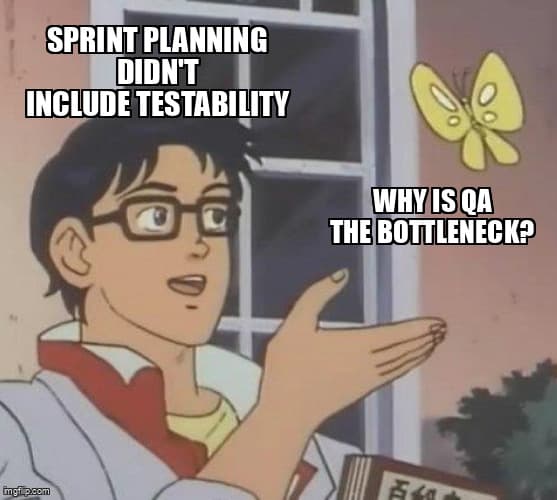
The Theater of "Ready for QA"
Every sprint planning meeting follows the same script. The product owner presents stories. Developers size them. Someone asks "is this testable?" Everyone nods. The story gets marked "ready" and the curtain falls on another performance of organizational self-deception.
Here's what actually happens: Stories marked "ready for QA" arrive like mystery boxes. Acceptance criteria that were "clear enough" during planning turn out to reference features that don't exist yet. Test data requirements weren't discussed. The API contracts changed mid-sprint. QA opens the ticket and discovers they're the first person to actually ask "how should this work when the user does X?"
Your QA team isn't slow. They're the only ones doing requirements analysis.
The Mathematical Fiction of Sprint Allocation
Let's talk about that beautiful sprint plan where development takes 8 days and QA takes 2 days. It's based on a comforting lie: that testing is a phase that starts when coding ends.
Here's the actual timeline nobody admits to:
- Day 1-3: Dev writes code (QA is idle or context-switching to other work)
- Day 4: First PR arrives, QA starts reviewing requirements they're seeing for the first time
- Day 5: QA finds environmental issues, missing test data, incomplete acceptance criteria
- Day 6-7: QA writes tests while simultaneously reporting bugs and asking clarifying questions
- Day 8: Developer fixes bugs (QA retests, updates test cases)
- Day 9-10: The "2-day QA phase" becomes frantic firefighting
The sprint ends. The story is 90% done. QA gets blamed for being the bottleneck. And the cycle repeats.
Test Debt Is Requirements Debt in Disguise
Every time you hear "we'll add tests later," what you're actually hearing is "we don't really know what this feature should do yet." Test debt isn't a testing problem—it's a requirements problem that testing exposes.
Stories marked "ready" without testability discussions are stories that haven't been thought through. When developers say "it works on my machine" and QA finds edge cases on Day 9, that's not a QA discovery—that's a planning failure surfacing late.
The test debt crisis is just your organization's inability to define "done" during planning, compounded over dozens of sprints.
The Hidden Cost of Sequential Testing
Treating QA as a phase instead of a parallel discipline creates invisible costs that destroy team efficiency:
- Context switching penalties: QA engineers idle during early sprint, then overwhelmed during late sprint
- Late defect discovery: Bugs found on Day 9 cost 10x more to fix than bugs found on Day 2
- Requirement clarification delays: Questions that could've been answered in planning now require meetings and Slack threads
- Talent attrition: Senior QA engineers leave because they're tired of being treated as a checkbox
When you calculate the true cost—including developer context switching, delayed releases, production incidents, and turnover—that "efficient" sequential model is hemorrhaging money.
How to Fix Sprint Planning (So Testing Doesn't Break It)
Here's the uncomfortable truth: you need to restructure sprint planning so that QA concerns are impossible to ignore.
1. Make "testable" a required field, not a checkbox
Before any story is marked "ready," it must answer:
- What test data is required? (and who will create it)
- What are the observable behaviors that define "working"?
- What are the integration points that need verification?
- What environmental dependencies exist?
If you can't answer these during planning, the story isn't ready—even if the designer and product owner signed off.
2. Involve QA in story grooming (actually involve them, not just invite them)
QA engineers should review stories before sprint planning, not during. Give them time to identify testability gaps, missing acceptance criteria, and environmental blockers. Their feedback should gate whether a story enters planning.
Radical idea: QA should have veto power over "ready" status. If they can't test it, it's not ready.
3. Front-load test case writing
QA should write test cases during sprint planning or immediately after—not when code arrives. Test cases are executable requirements documentation. Writing them early exposes gaps in acceptance criteria when there's still time to fix them.
Developers should see test cases before writing code. This isn't waterfall—it's TDD at the organizational level.
4. Redefine "done" to include passing tests
A story isn't "dev complete" until it passes QA verification. Period. This single change forces developers and QA to work in parallel instead of sequentially.
Yes, this means developers might need to wait for QA feedback before starting the next story. Good. That waiting time is visibility into your actual capacity.
What This Looks Like in Practice
A properly planned sprint treats QA as a parallel discipline, not a sequential phase:
- Pre-planning: QA reviews groomed stories, identifies testability gaps
- Planning: Stories include test data requirements, environmental dependencies, testability criteria
- Day 1: QA writes test cases, prepares test environments, while dev starts coding
- Day 2-4: Dev submits incremental PRs, QA provides early feedback on testability
- Day 5-7: QA runs full test suite, dev fixes issues in parallel with next story
- Day 8-10: Final verification, regression testing, story actually meets "done"
This isn't slower—it's honest about how long things actually take. And because defects are found early, the overall cycle time decreases.
The Real Problem (That Nobody Wants to Admit)
Sprint planning is broken because acknowledging QA constraints forces uncomfortable conversations about capacity, priorities, and what "ready" actually means.
It's easier to pretend that stories are "ready" and blame QA when reality intrudes on Day 9. It's easier to maintain the fiction that testing is a 2-day phase than to admit you've been chronically under-investing in quality engineering.
But every sprint that ends with scrambling, every production incident that escapes testing, every senior QA engineer who quits—those are the compounding costs of refusing to fix sprint planning.
Your Move, CTO
You don't have a QA problem. You have a planning problem that QA has been absorbing for you.
Fix sprint planning. Make testability non-negotiable. Treat QA as a parallel discipline, not a sequential phase. Give QA engineers the authority to gate "ready" status.
Or keep hiring more QA engineers and wondering why velocity doesn't improve.
The choice is yours. But please, stop blaming QA for the planning dysfunction you've institutionalized.
Ready to fix your sprint planning?
Desplega helps engineering teams in Barcelona, Madrid, Valencia, and across Spain restructure their QA processes for real velocity. We implement testability-first planning, parallel testing workflows, and automated quality gates that make sprint commitments achievable.
Contact UsRelated Posts
Hot Module Replacement: Why Your Dev Server Restarts Are Killing Your Flow State | desplega.ai
Stop losing 2-3 hours daily to dev server restarts. Master HMR configuration in Vite and Next.js to maintain flow state, preserve component state, and boost coding velocity by 80%.
The Flaky Test Tax: Why Your Engineering Team is Secretly Burning Cash | desplega.ai
Discover how flaky tests create a hidden operational tax that costs CTOs millions in wasted compute, developer time, and delayed releases. Calculate your flakiness cost today.
The QA Death Spiral: When Your Test Suite Becomes Your Product | desplega.ai
An executive guide to recognizing when quality initiatives consume engineering capacity. Learn to identify test suite bloat, balance coverage vs velocity, and implement pragmatic quality gates.