
The QA Death Spiral: When Your Test Suite Becomes Your Product
How organizations inadvertently prioritize test infrastructure over product delivery—and what executives can do about it
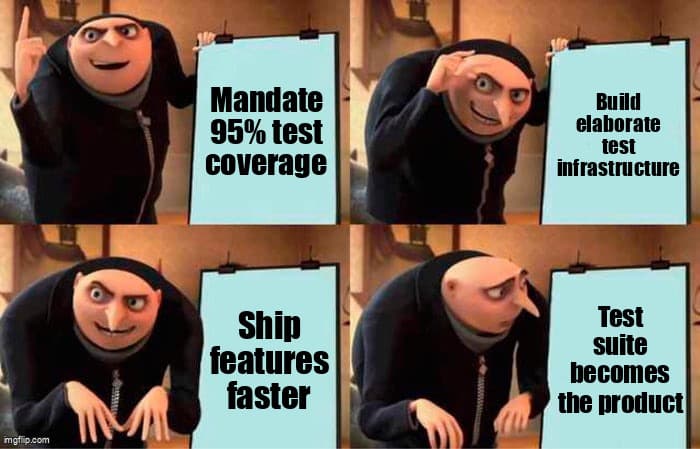
Your quarterly board meeting just revealed a disturbing trend: engineering headcount is up 40%, test coverage hit 95%, and your release velocity dropped by half. When you ask why the new feature is delayed, your VP of Engineering says, "We're refactoring the test infrastructure to support it." Congratulations—your test suite has become your product.
This is the QA Death Spiral, and it's more common than most CTOs want to admit. It starts innocently: you mandate comprehensive testing to prevent production incidents. The team complies, building elaborate test frameworks, mock servers, and data generators. Then those tests need maintenance. Then they need optimization. Then they need tests of their own. Before you realize it, you're spending more engineering hours on test infrastructure than on features that generate revenue.
The Anatomy of the Spiral
The death spiral follows a predictable pattern. It usually begins with a high-profile production incident that embarrasses leadership. In response, you institute rigorous testing requirements—80% code coverage, integration tests for every API, end-to-end tests for critical paths. Your engineers dutifully comply.
Six months later, you notice developers complaining that CI/CD pipelines take 45 minutes. A year later, they're spending entire sprints fixing flaky tests. Two years in, you have a dedicated "Testing Infrastructure" team that's larger than your product team. The original goal—shipping quality software quickly—has been replaced by a new goal: maintaining the quality apparatus itself.
Warning Signs You're in the Spiral
- More than 20% of engineering capacity goes to test maintenance
- Feature development blocked waiting for "test environment availability"
- Developers routinely skip CI checks locally because they're too slow
- Your job postings for "QA Engineers" outnumber "Software Engineers"
- You have a backlog of tests that need to be written or fixed
- The phrase "test coverage" appears more frequently in sprint reviews than "customer value"
The Hidden Business Cost of "Comprehensive" Coverage
Let's talk numbers. Imagine your engineering team costs $2M annually. If 25% of their time goes to test infrastructure, that's $500K per year. What's the return on that investment? If your test suite catches one critical bug per quarter that would have cost $50K in downtime and reputation damage, you're spending $500K to save $200K. That's not quality assurance—that's quality theater.
The real cost is opportunity cost. Every hour spent debugging a flaky Selenium test is an hour not spent building the feature that would unlock your next market segment. Every sprint dedicated to "test refactoring" is a sprint your competitor uses to ship actual functionality. The market doesn't reward you for test coverage; it rewards you for solving customer problems faster than the other guy.
// The Expensive Test Pattern
// Cost: 45 seconds per run, breaks once per week,
// catches real bugs once per quarter

describe('Complete User Journey E2E', () => {
  it('should handle every possible user flow', async () => {
    await setupCompleteTestDatabase();
    await seedWithRealisticData();
    await loginAsTestUser();
    await navigateToFeatureA();
    await fillFormWithEdgeCaseData();
    await submitAndWaitForAsyncProcessing();
    await verifyDatabaseState();
    await navigateToFeatureB();
    // ... 40 more steps ...
    await teardownAndCleanup();
  });
});

// The Pragmatic Test Pattern
// Cost: 2 seconds per run, never breaks,
// catches same bugs with surgical precision

test('createOrder validates required fields', () => {
  expect(() => createOrder({}))
    .toThrow('Missing required field: customerId');
});

test('createOrder rejects invalid quantities', () => {
  expect(() => createOrder({ quantity: -1 }))
    .toThrow('Quantity must be positive');
});
Quality Gates vs. Quality Theater
The difference between effective quality assurance and quality theater comes down to intentionality. A quality gate is a deliberate, minimal checkpoint that prevents specific, high-impact failures. Quality theater is elaborate testing infrastructure that exists primarily to create the appearance of diligence.
Ask yourself: if you removed this test, what would break? If the answer is "nothing" or "something that customers never encounter," that's theater. If the answer is "our payment processing would silently fail for international customers," that's a gate. The former exists to satisfy a coverage metric. The latter exists to protect revenue.
The Executive's Quality Framework
Essential Quality Gates (Protect These):
- Payment processing integrity tests
- Security vulnerability scans
- Data migration validation
- API contract tests for external partners
- Performance regression detection for critical paths
Quality Theater (Question These):
- Tests for internal admin tools used twice per year
- 100% coverage requirements for presentation layer code
- E2E tests that duplicate unit test coverage
- Tests for error messages and UI copy
- Mock-heavy tests that verify your mocks, not your logic
Breaking the Spiral: An Executive Playbook
Escaping the QA death spiral requires executive courage. You'll face resistance from engineers who've built careers on "testing excellence." You'll worry about regression risks. You'll fear the next production incident. But here's the truth: your current approach isn't preventing incidents—it's just making them happen in slow motion as you lose market share to faster-moving competitors.
Step 1: Audit Your Testing Investment
Pull the numbers. What percentage of engineering time goes to writing tests versus writing features? How much CI/CD infrastructure cost is dedicated to running tests? How many production incidents were prevented by automated tests in the last quarter versus caught by user reports? Most executives are shocked by what they find.
Step 2: Implement the 10x Rule
A test should provide 10x more value than it costs to maintain. If a test costs 2 hours annually to maintain (fixing occasional flakiness, updating after refactors), it should prevent problems worth at least 20 hours or $5K in incident costs. Tests that don't meet this threshold are candidates for deletion.
// Executive Metrics Dashboard

{
  "test_suite_stats": {
    "total_tests": 4_247,
    "execution_time": "43 minutes",
    "annual_maintenance_hours": 1_200,
    "cost_at_loaded_rate": "$180,000"
  },
  "value_delivered": {
    "critical_bugs_caught_last_quarter": 3,
    "estimated_incident_cost_prevented": "$75,000",
    "roi": -0.58
  },
  "red_flags": [
    "58% of tests haven't caught a bug in 6+ months",
    "Top 20 slowest tests account for 70% of CI time",
    "12 tests break monthly due to unrelated changes"
  ],
  "recommendation": "Eliminate bottom 60% of tests, reduce suite to 1,699 high-value tests, cut CI time to 15 minutes, redirect 800 hours to product work"
}
Step 3: Shift from Coverage to Risk Management
Stop measuring code coverage. Start measuring blast radius and recovery time. Which parts of your system, if they fail, cause revenue loss, security breaches, or compliance violations? Those areas deserve comprehensive testing. Everything else deserves just enough testing to catch obvious mistakes during development.
Step 4: Establish Test Deprecation Policy
Tests should have expiration dates like any other code. If a test hasn't failed in 12 months, either the code it tests is bulletproof (unlikely) or the test isn't testing anything meaningful (likely). Archive it. You can always bring it back if you were wrong.
The Cultural Shift: From Shipping to Covering
The most insidious aspect of the QA death spiral is how it changes engineering culture. When you mandate high coverage, you tell engineers that their job is to write tests, not to ship working software. The incentive structure shifts: why take on a complex refactor that might break 50 tests when you can write a simple feature that only requires 10 new tests to maintain coverage?
Your best engineers—the ones who understand that code quality comes from thoughtful design, not exhaustive testing—start to leave. They're replaced by "senior test automation engineers" whose primary skill is maintaining elaborate testing frameworks. Your architecture ossifies because every change requires updating hundreds of brittle tests. Innovation slows to a crawl.
Healthy Engineering Culture Indicators
- Feature velocity is stable or increasing - Not declining as team grows
- Engineers talk about customer problems - Not test infrastructure challenges
- New hires ship meaningful changes in first week - Not blocked by test environment setup
- Deployment frequency is high - Daily or multiple times per day
- Tests run in single-digit minutes - Fast feedback encourages frequent testing
What Actually Works: Pragmatic Quality Assurance
The alternative to the death spiral isn't no testing—it's smart testing. Focus on three high-leverage areas:
1. Contract Testing for Integration Points
Your biggest risks are at system boundaries: APIs, databases, external services. Write focused contract tests that verify agreements between components. These tests are fast, stable, and catch integration bugs that actually matter.
2. Property-Based Testing for Business Logic
Instead of writing 100 example-based unit tests, write 5 property-based tests that verify invariants. "For any valid input, the output should satisfy these properties." This catches edge cases you never thought to test while requiring minimal maintenance.
3. Observability Over Testing
Your production environment is the ultimate testing environment. Invest in monitoring, alerting, and feature flags that let you detect and roll back problems quickly. The cost of fixing a bug in production isn't the bug itself—it's the time to detection and recovery. Cut that from hours to minutes, and you can afford to test less.
// Property-Based Testing Example
// Replaces dozens of example-based tests

test('order total calculation properties', () => {
  forAll(
    arbitrary.order(),
    (order) => {
      const total = calculateTotal(order);

      // Property 1: Total is never negative
      expect(total).toBeGreaterThanOrEqual(0);

      // Property 2: Total equals sum of line items
      const lineItemSum = order.items.reduce(
        (sum, item) => sum + item.price * item.quantity,
        0
      );
      expect(total).toBe(lineItemSum + order.tax + order.shipping);

      // Property 3: Applying discount reduces total
      const discounted = calculateTotal({...order, discount: 10});
      expect(discounted).toBeLessThan(total);
    }
  );
});
The Executive Dashboard: Metrics That Actually Matter
Forget code coverage. Here are the metrics that tell you if your quality approach is working:
- Mean Time to Recovery (MTTR) - How fast do you fix production incidents? Target: <1 hour
- Deployment Frequency - How often do you ship? Target: Multiple times per day
- Change Failure Rate - What percentage of deployments cause incidents? Target: <5%
- Test Maintenance Burden - What percentage of engineering time goes to test upkeep? Target: <10%
- Feature Lead Time - How long from idea to production? Target: Days, not weeks
If your MTTR is low and deployment frequency is high, your change failure rate tells you everything about quality. A 5% failure rate with 10 deploys per day means you ship 9.5 successful changes daily and fix 0.5 problems quickly. That's better than a 1% failure rate with weekly deployments.
Key Takeaways
- The QA death spiral occurs when test infrastructure consumes more resources than product development - Warning signs include declining velocity despite increasing headcount, growing test maintenance burden, and engineers spending more time on test infrastructure than features.
- Comprehensive test coverage has hidden opportunity costs - Every dollar spent maintaining low-value tests is a dollar not spent on competitive features. The market rewards shipping speed, not coverage percentages.
- Quality gates protect revenue; quality theater protects metrics - Focus testing on payment processing, security, data integrity, and partner integrations. Question tests for internal tools, UI copy, and scenarios customers never encounter.
- Break the spiral by implementing the 10x value rule - Tests should prevent problems worth at least 10x their annual maintenance cost. Archive or delete tests that don't meet this threshold.
- Shift culture from coverage to velocity with fast feedback - Measure MTTR, deployment frequency, and feature lead time instead of code coverage. Invest in observability and feature flags to catch and fix production issues quickly.
The hardest thing about escaping the QA death spiral is admitting you're in it. Your test suite was supposed to enable speed, not prevent it. But somewhere along the way, the means became the end. Your engineers stopped shipping software and started shipping tests. Your competitors passed you while you were refactoring your mock framework.
The good news? You can fix this. Delete half your tests tomorrow. Watch deployment frequency increase and incident rates stay flat. Redirect that engineering capacity to features that differentiate you in the market. Your test suite should be a safety net, not a straightjacket. Build the minimum viable safety net, then get back to building product.
Ready to strengthen your test automation?
Desplega.ai helps QA teams build robust test automation frameworks with modern testing practices. Whether you're starting from scratch or improving existing pipelines, we provide the tools and expertise to catch bugs before production.
Start Your Testing TransformationRelated Posts
Cody's Repository Indexing: Does Cognitive Offloading Create Knowledge Gaps in Large Codebases? | Desplega AI
A practical deep dive into Cody repository indexing, context retrieval, and how indie hackers avoid AI-created knowledge gaps.
Hot Module Replacement: Why Your Dev Server Restarts Are Killing Your Flow State | desplega.ai
Stop losing 2-3 hours daily to dev server restarts. Master HMR configuration in Vite and Next.js to maintain flow state, preserve component state, and boost coding velocity by 80%.
The Flaky Test Tax: Why Your Engineering Team is Secretly Burning Cash | desplega.ai
Discover how flaky tests create a hidden operational tax that costs CTOs millions in wasted compute, developer time, and delayed releases. Calculate your flakiness cost today.