
The $2M Question: Why Your QA Team Still Can't Test in Production (And Why DevOps Won't Let Them)
When organizational politics cost more than the bugs you're trying to prevent
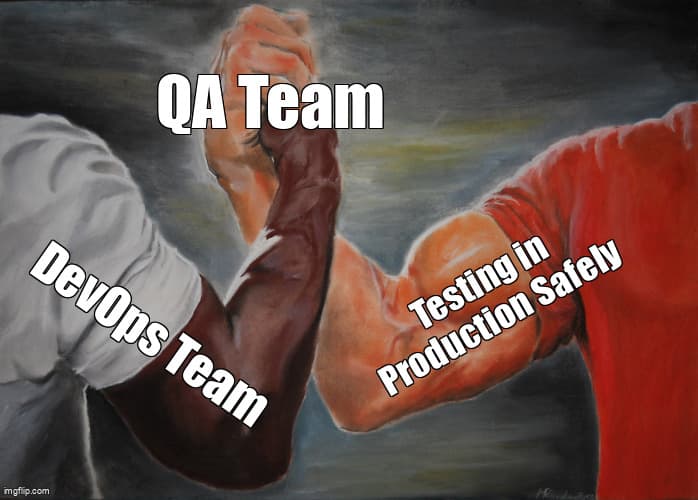
Let's talk about the elephant in the war room: your staging environment is lying to you, and everyone knows it except the person signing the incident reports.
You've got a QA team that's caught bugs in staging that somehow still make it to production. You've got a DevOps team guarding prod access like it's the nuclear codes. And you've got a CEO asking why your competitors ship faster with fewer incidents.
The answer? They test where it matters. In production. And no, not the reckless cowboy way. The calculated, observable, revenue-protecting way.
The Staging Environment Illusion
Here's the uncomfortable truth: staging environments are confidence theaters. They give everyone the warm fuzzy feeling that "we tested it" without actually testing the things that break in production.
Let's do the math on what staging environments don't catch:
- Production data volumes: Your staging DB has 10,000 records. Production has 10 million. That query optimization? Useless.
- Real user behavior: Internal testers click buttons in expected sequences. Real users? They refresh mid-checkout, spam submit buttons, and bookmark deep-linked pages.
- Third-party integrations: Staging uses sandbox APIs with perfect uptime. Production hits rate limits, has network hiccups, and returns edge cases your mocks never considered.
- Infrastructure differences: Staging runs on smaller instances with different network topology, cache configurations, and load balancer rules.
- Time-based logic: Timezone handling, scheduled jobs, session expirations—all behave differently under real production load.
A major e-commerce platform spent six months perfecting their staging environment. They deployed a checkout redesign that passed every staging test. Within 90 minutes of production deployment, they discovered that their new flow didn't handle expired payment tokens properly—something that only happened with real user sessions that had been idle for weeks. Cost of the incident? $2.3M in abandoned carts before rollback.
The real question isn't "should we test in production?" It's "why are we still pretending staging is enough?"
The "Never Touch Prod" Sacred Cow
The "never touch prod" mentality made sense in 2005 when deployments were monthly events requiring downtime windows and manual SQL scripts. Today, it's organizational PTSD masquerading as best practice.
Here's what actually happens in companies with strict prod isolation:
- Incident response theater: When prod breaks, the same people who "can't test in prod" suddenly have full access to diagnose and hotfix. Except now they're doing it under pressure with customers watching.
- Permission escalation chains: A critical test requires 3 approvals and 2 hours of security review. Meanwhile, the deployment that needs testing goes out anyway because timelines.
- Shadow testing infrastructure: Engineers spin up "prod-like" environments that consume cloud budget but still don't match actual production characteristics.
- Risk concentration: By preventing controlled testing, you ensure that every deployment is a high-risk event because you have no empirical data about production behavior.
The irony? The companies most afraid of production testing are the ones who need it most. They've accumulated so much production behavior unknown to their testing process that every release is a gamble.
How Netflix, Amazon, and Stripe Actually Do It
Let's cut through the mythology. Companies testing in production aren't cowboys. They're the most risk-averse engineers on the planet who've realized that not testing in production is the highest risk of all.
Netflix: Chaos Engineering as Testing
Netflix doesn't just test in production—they actively break production to test it. Chaos Monkey randomly terminates instances. Chaos Kong takes down entire AWS regions. Why? Because they learned that the only way to verify resilience is to observe it under real failure conditions.
Key insight: They didn't ask permission. They built the observability and safety mechanisms first, then gradually expanded chaos experiments. Now it's embedded in their deployment pipeline.
Amazon: Everyone Tests in Production, We Just Call It Friday
Amazon's approach is elegant: they assume staging is insufficient, so they deploy to production incrementally with automatic rollback based on metrics. A deployment goes to 0.1% of prod traffic first. If error rates, latency, or business metrics deviate, it automatically rolls back before humans even notice.
The testing happens in production, but the blast radius is controlled. They're not preventing production testing—they're making it safe and automatic.
Stripe: Production Replicas as First-Class Test Environments
Stripe took a different approach: they built tooling to create production-identical environments on demand, including production data volume and characteristics. But here's the key—these environments are still production infrastructure, just isolated via feature flags and traffic routing.
Engineers test payment flows with real volumes, real data distributions, and real performance characteristics. The difference is controlled exposure, not environment segregation.
The Tech Stack That Makes It Possible
Production testing isn't about granting sudo access to everyone. It's about building the right safety mechanisms. Here's what the infrastructure actually looks like:
Feature Flags (The Kill Switch)
LaunchDarkly, Split.io, Unleash—pick your poison. Feature flags let you deploy code to production in a disabled state, then enable it for specific users, percentages, or cohorts. When something breaks, you flip the switch. No deployment, no rollback coordination, no downtime.
// Enable feature for internal users only
if (featureFlags.isEnabled('new-checkout', { userId: user.id, internal: user.isInternal })) {
  return <NewCheckoutFlow />;
}
return <LegacyCheckoutFlow />;
The business case: You're not testing in production recklessly. You're verifying changes with a controlled audience before full rollout. This is more conservative than deploying to everyone at once.
Observability (The Early Warning System)
Datadog, New Relic, Honeycomb, Grafana—modern observability tools show you exactly what's happening in production in real-time. Not just error rates, but business metrics tied to technical performance.
Set up alerts like:
- If checkout completion rate drops 5% compared to baseline → auto-disable feature flag
- If API latency p99 exceeds threshold → page on-call and rollback
- If error rate for new feature exceeds 1% → instant rollback
You're not relying on users reporting bugs. You're detecting issues before they become incidents.
Progressive Delivery (The Risk Minimizer)
Instead of "deploy to all of production," you deploy to:
- Internal users (10 people)
- Beta users who opted in (1% of traffic)
- 10% of production traffic (randomly selected)
- 50% of production traffic
- 100% rollout
At each stage, you monitor metrics for 15-30 minutes. Any degradation? Automatic rollback before moving to the next stage. This is testing in production, but with mathematical risk reduction.
Synthetic Monitoring (The Continuous Tester)
Tools like Checkly and Datadog Synthetics continuously run real user flows against production. They catch issues like:
- Third-party API degradation
- Certificate expirations
- CDN misconfigurations
- Region-specific failures
These are bugs that staging will never catch because staging doesn't have real production dependencies.
Building the Business Case
Here's how you convince the risk-averse stakeholders who still think production is sacred ground:
1. Quantify the Staging Gap Cost
Pull your incident reports for the last 6 months. Calculate:
- Incidents that passed staging tests: ___%
- Average incident detection time: ___ hours
- Average revenue impact per incident: $___
- Total cost of "staging-approved" production incidents: $___
If that number is over $500K, you have a business case. If it's over $2M, you have a crisis.
2. Compare to Progressive Rollout Risk
Show the math:
- Current approach: Deploy to 100% of users. If it breaks, 100% of revenue at risk until rollback (30-90 minutes average).
- Progressive approach: Deploy to 1% of users. If it breaks, 1% of revenue at risk for 5 minutes (automatic rollback).
The progressive approach reduces blast radius by 95% and detection time by 85%. That's not reckless—that's risk management.
3. Frame It as Competitive Disadvantage
Your competitors are shipping 10x faster because they validate in production, not staging. Every week you spend waiting for "perfect staging coverage" is a week they're learning from real user behavior.
Ask your CEO: "Would you rather we ship slowly with false confidence, or ship incrementally with real feedback?"
4. Start Small and Prove Value
Don't ask permission to test payments in production. Start with:
- Non-critical UI changes feature-flagged for internal users
- Synthetic monitoring of critical flows
- Observability dashboards showing real production behavior
Once you demonstrate that controlled production testing catches issues staging missed—with zero incidents—you've built credibility to expand.
The Organizational Politics Part
Here's the real talk: the technical case is easy. The political case is hard. You're fighting institutional fear, CYA culture, and the comfort of "we've always done it this way."
DevOps Objections and How to Counter Them
"Production is too risky for testing"
Counter: "Production is where real risk lives. Staging gives us false confidence. We're proposing controlled testing with automatic rollback, which is lower risk than our current all-or-nothing deployments."
"We don't have the tooling"
Counter: "Let's start with feature flags and progressive rollout. LaunchDarkly has a 14-day free trial. We can prove the concept before we commit budget."
"Compliance won't allow it"
Counter: "Stripe, Square, and Goldman Sachs all test in production under SOC2/PCI compliance. The key is audit trails and access controls, which we should implement regardless."
QA Team Empowerment
Your QA team isn't asking for cowboy access. They're asking for the ability to verify their work where it actually matters. Give them:
- Read-only production access to observe real user flows
- Ability to enable feature flags for test accounts in production
- Synthetic monitoring tools to continuously verify critical paths
- Observability dashboards showing production metrics alongside test coverage
This isn't about breaking things. It's about validating assumptions against reality instead of staging theater.
The Real Endgame
The companies that win aren't the ones with the most comprehensive staging environments. They're the ones who've accepted that production is the only real test environment and built the safety mechanisms to test there continuously.
You're not choosing between "test in staging" and "test in production." You're choosing between:
- Optimistic deployment: Hope staging caught everything, deploy to all users, cross fingers.
- Validated deployment: Deploy incrementally, monitor real behavior, rollback automatically if anything breaks.
The first approach feels safer because it's familiar. The second approach is safer because it's empirical.
Your $2M question isn't "Can we afford to test in production?" It's "Can we afford not to?"
Next Steps
If you're ready to move beyond staging theater:
- Audit your production incidents - How many passed staging? That's your ROI.
- Implement feature flags - Start with one non-critical feature. Prove the workflow.
- Add observability - You can't test safely in production if you can't see production.
- Run a pilot - Progressive rollout for one feature. Document the risk reduction.
- Build the coalition - Show DevOps, QA, and leadership that controlled production testing reduces risk, doesn't increase it.
The war between QA and DevOps over production access isn't about who's right. It's about acknowledging that the old rules were written for a different era. The tools exist to make production testing safer than staging-only deployments. The question is whether your organization has the courage to admit that staging has been lying to you all along.
Welcome to the modern age. Production is your test environment. Build accordingly.
Ready to bridge the QA-DevOps divide?
Desplega helps teams in Barcelona, Madrid, Valencia, Spain and across Europe implement safe production testing practices with feature flags, observability, and progressive delivery. Contact us to build the confidence your team needs.
Contact UsRelated Posts
Hot Module Replacement: Why Your Dev Server Restarts Are Killing Your Flow State | desplega.ai
Stop losing 2-3 hours daily to dev server restarts. Master HMR configuration in Vite and Next.js to maintain flow state, preserve component state, and boost coding velocity by 80%.
The Flaky Test Tax: Why Your Engineering Team is Secretly Burning Cash | desplega.ai
Discover how flaky tests create a hidden operational tax that costs CTOs millions in wasted compute, developer time, and delayed releases. Calculate your flakiness cost today.
The QA Death Spiral: When Your Test Suite Becomes Your Product | desplega.ai
An executive guide to recognizing when quality initiatives consume engineering capacity. Learn to identify test suite bloat, balance coverage vs velocity, and implement pragmatic quality gates.