
The Flaky Test Mafia: Why Your Team's Worst Enemy Isn't Bugs
How unreliable tests poison development culture and why "just rerun it" are the three most expensive words in software engineering
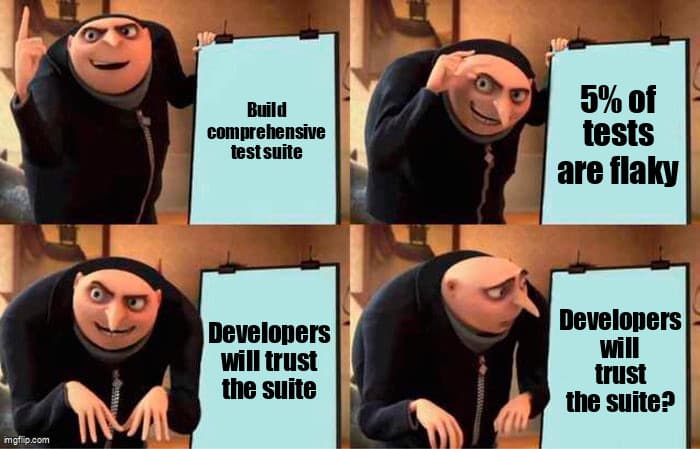
The Silent Killer in Your Pipeline
Let me tell you about a test suite I inherited. On paper, it looked impressive: 3,200 tests, 87% coverage, running in CI/CD on every commit. The engineering team had invested two years building this fortress of quality assurance. There was just one problem: nobody trusted it.
Why? Because roughly 5% of those tests were flaky. That's 160 tests that would randomly fail for no reproducible reason. "Just rerun it," became the team's mantra. Developers would hit the retry button two, three, sometimes five times before their PR went green. Senior engineers normalized this. New hires learned it as standard practice.
Here's what that actually meant: The team burned an estimated 23 hours per week waiting for test reruns. At their fully-loaded cost, that's $180,000 annually just in wasted engineering time. But that's not even the worst part.
The Real Cost: Trust Bankruptcy
Flaky tests don't just waste time—they destroy trust. And trust is the foundation of every effective QA strategy. When your test suite cries wolf 160 times, what happens when test #161 fails for a legitimate reason?
That's right: developers ignore it. They assume it's another flake. They hit retry. And sometimes, they're wrong. That's how production bugs slip through billion-dollar test infrastructures. Not because the tests didn't catch the issue—they did—but because nobody believed them anymore.
I watched this exact scenario play out. A race condition in the payment flow was caught by an integration test. It failed three times. The developer, trained by months of flaky test fatigue, kept hitting retry until it randomly passed. The bug shipped. Customers couldn't check out for four hours on a Friday afternoon. Revenue impact: $47,000. All because the organization had taught its engineers that test failures don't matter.
The Velocity Vampire
Let's talk about the second-order effects. Every time a developer hits "rerun tests," they context-switch away from their work. Maybe they grab coffee. Check Slack. Start another task. By the time the rerun completes (whether it passes or fails again), they've lost their flow state.
Research from the University of California found that it takes an average of 23 minutes to fully regain focus after an interruption. If your team is doing 3-5 test reruns per day, you're not losing minutes—you're losing entire afternoons of deep work.
But here's where it gets insidious: flaky tests create a culture of learned helplessness. Engineers stop questioning the test suite. They stop investigating failures. "It's probably just flaky" becomes the default assumption. Your carefully crafted QA process becomes background noise.
The Stakeholder Problem
Now let's put on our CTO hat. You've just pitched the board on a $300K investment in test infrastructure. New tools, dedicated QA engineers, maybe even a test platform like Desplega to orchestrate everything. You sold them on reliability, velocity, and confidence.
Three months later, the CFO asks why deployments are still taking 4 hours. Why critical features are still getting delayed. Why the engineering team is always "waiting on tests." You can't exactly say, "Well, 5% of our tests are unreliable, so we just run them multiple times until they pass."
That's not a technical problem—that's a credibility problem. You've lost the narrative. The board starts questioning whether test automation delivers ROI. Whether your engineering practices are actually best-in-class. Whether you have control over the ship.
Anatomy of a Flaky Test
Before we talk solutions, let's understand what we're fighting. Flaky tests typically fall into four categories:
- Async Race Conditions – Tests that depend on timing: "wait 2 seconds for the modal to appear" works on your laptop but not in CI where machines are slower
- External Dependencies – Tests that hit third-party APIs, databases, or services that occasionally timeout or return different responses
- State Pollution – Tests that pass in isolation but fail when run in the full suite because of shared state or ordering dependencies
- Non-Deterministic Logic – Tests that use random data, timestamps, or other unpredictable inputs without proper seeding or mocking
The common thread? All of these represent actual problems in your codebase. That async race condition in your test? It's probably also lurking in production under high load. That external API timeout? Your users experience it too. Flaky tests are symptoms, not diseases.
The War Plan: Quarantine, Fix, or Kill
Here's the unpopular truth: you cannot incrementally improve your way out of a flaky test crisis. You need a systematic, ruthless strategy. Here's what worked for that 3,200-test nightmare I mentioned:
Phase 1: Identify and Quarantine (Week 1)
Run your entire test suite 10 times in parallel. Any test that fails even once gets tagged as @flaky and moved to a separate quarantine suite. This isn't a permanent solution—it's triage. You're acknowledging the problem exists and removing its ability to block the team.
Critical implementation detail: quarantined tests still run in CI, but their failures don't block merges. They generate alerts that go to a dedicated Slack channel. This prevents them from becoming "out of sight, out of mind" while also preventing them from holding the team hostage.
Phase 2: Fix or Kill (Weeks 2-6)
Now comes the hard part. For each quarantined test, you have three options:
- Fix it properly – Replace arbitrary waits with explicit condition checks. Mock external dependencies. Isolate state. This is the ideal outcome but requires real engineering time.
- Rewrite it at a different level – Maybe your flaky E2E test should actually be a stable integration test. Different testing levels have different flakiness profiles.
- Delete it – This is where courage matters. If a test has been flaky for months and nobody can explain what unique value it provides, it's dead weight. Delete it. You'll be shocked how often this is the right answer.
Set a firm rule: any test in quarantine for more than 30 days without a fix plan gets automatically deleted. This creates urgency and prevents the quarantine from becoming a permanent dumping ground.
Phase 3: Prevention System (Week 7+)
Here's where you build the moat. Implement automatic flakiness detection: if any test fails once and then passes on retry, it gets flagged for human review. No exceptions. The moment a test shows signs of instability, you treat it as a P1 issue.
Create organizational accountability. In our case, we implemented a "test reliability score" that appeared on every team's dashboard. If your squad's score dropped below 99.5%, leadership knew about it. This wasn't about blame—it was about making reliability a visible, measurable priority.
The C-Suite Conversation
Let's bring this back to business impact. When you pitch this initiative to leadership, here's the framing that actually works:
"We're currently spending $180,000 annually on test reruns. That's money we're lighting on fire. More importantly, our test suite has lost credibility with the engineering team, which means real bugs are slipping through because developers assume test failures are noise. This isn't a technical debt problem—it's a business risk problem. I'm proposing a 6-week initiative to restore test reliability and regain that trust. The ROI is clear: faster deployments, fewer production incidents, and engineering time redirected to features instead of fighting tooling."
Notice what's missing? Technical jargon. What's included? Dollar figures, risk language, and a clear timeline. That's how you get executive buy-in.
The Cultural Shift
Here's the final piece that most teams miss: fixing flaky tests is 40% technical and 60% cultural. You need to fundamentally change how your organization thinks about test reliability.
In our post-mortem culture, we added a specific question: "Would our tests have caught this if we trusted them?" Often, the answer was yes. The test had failed during the PR, but the developer assumed it was a flake and merged anyway. That's not a developer problem—that's a systems problem you created by tolerating unreliability.
We also changed our engineering interview process. We started asking candidates: "You're reviewing a PR and the tests fail. What do you do?" The right answer isn't "investigate the failure"—it's "it depends on whether I trust the test suite." That opened conversations about test reliability as a prerequisite for effective QA, not an optional nice-to-have.
The Results
Six weeks after starting this initiative, we reduced our flaky test count from 160 to 12. Test execution time dropped by 35% because we weren't running everything three times. Deploy frequency increased by 40% because engineers stopped waiting on test reruns.
But the biggest win? Developers started trusting test failures again. When a test failed, they investigated. When they found bugs, they fixed them before merge. Our production incident rate dropped by 28% over the next quarter, directly attributable to higher-quality PRs.
The CFO noticed. In our next quarterly review, he specifically called out the velocity improvements and asked what we did differently. That's how you turn a technical problem into a business win.
Your Next Move
If you're reading this and thinking "my team has maybe a few flaky tests, but it's not that bad," I want you to run an experiment this week:
- Run your entire test suite 5 times in a row
- Count how many unique test failures you see across those 5 runs
- Ask your team: "How often do you hit retry on a failed test without investigating?"
- Calculate: How many developer hours per week are spent waiting on reruns?
The answers might surprise you. And if they don't surprise you—if you already know the problem is there—then you've got a bigger issue: you've normalized dysfunction.
Flaky tests are organizational debt disguised as technical debt. Every day you tolerate them, you're teaching your team that quality is negotiable, that tools can't be trusted, and that velocity matters more than reliability. That's not engineering culture—that's engineering malpractice.
The Flaky Test Mafia operates in the shadows of your CI/CD pipeline, extracting tribute in the form of time, trust, and team morale. It's time to take back control.
Because at the end of the day, the best test is one that runs reliably. Everything else is just expensive theater.
Ready to declare war on flaky tests? Let's talk about building a test infrastructure your team can trust—and your CFO can defend.
Build Reliability into Your DNA
At Desplega, we believe test reliability isn't optional—it's foundational. Our platform helps teams orchestrate complex test workflows with built-in flakiness detection, automatic retry logic, and clear reporting that separates signal from noise.
Let's TalkRelated Posts
Hot Module Replacement: Why Your Dev Server Restarts Are Killing Your Flow State | desplega.ai
Stop losing 2-3 hours daily to dev server restarts. Master HMR configuration in Vite and Next.js to maintain flow state, preserve component state, and boost coding velocity by 80%.
The Flaky Test Tax: Why Your Engineering Team is Secretly Burning Cash | desplega.ai
Discover how flaky tests create a hidden operational tax that costs CTOs millions in wasted compute, developer time, and delayed releases. Calculate your flakiness cost today.
The QA Death Spiral: When Your Test Suite Becomes Your Product | desplega.ai
An executive guide to recognizing when quality initiatives consume engineering capacity. Learn to identify test suite bloat, balance coverage vs velocity, and implement pragmatic quality gates.