
The $2M Bug That Passed All Tests: Why Your QA Metrics Are Lying to You
How a company with 99.8% test coverage lost millions in revenue while their CI/CD pipeline stayed green
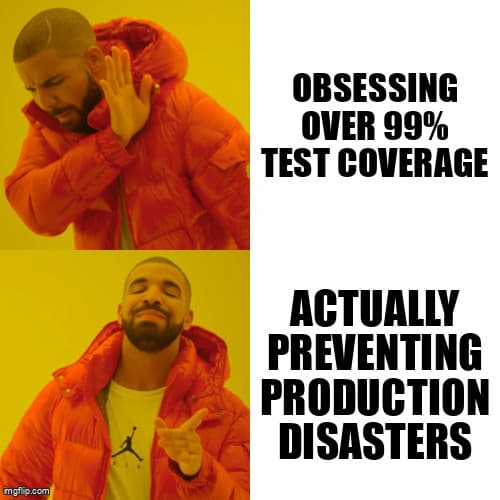
Let me tell you about the most expensive green checkmark in software history.
A fintech company—let's call them "TotallySecurePay"—had everything a CTO could dream of. Their test coverage dashboard showed a beautiful 99.8%. Their CI/CD pipeline? Green as a golf course. Their code review process? Rigorous. Their monitoring? State-of-the-art.
They deployed a "minor update" to their payment processing system on a Friday afternoon. (Yes, Friday. Because why not?)
By Monday morning, they had processed $2.1 million in duplicate charges. Every. Single. Transaction. Doubled.
The kicker? All tests passed. Every single one.
The Cult of the Green Pipeline
We've built a religion around test coverage percentages. Engineering teams wear their 95%+ coverage like a badge of honor. Managers set OKRs around increasing coverage from 87% to 92%. Code that doesn't meet the coverage threshold gets rejected in PR reviews.
And somewhere along the way, we confused "tested" with "quality."
Here's the uncomfortable truth: Test coverage measures what you remembered to test, not what actually matters.
TotallySecurePay had tests for their idempotency layer. Lots of them. They tested that duplicate API calls within 60 seconds would be deduplicated. They tested timeout handling. They tested error responses. They tested edge cases with malformed requests.
What they didn't test? Whether the idempotency cache would survive a Redis failover during a transaction. Because who thinks to test that?
(Spoiler: Your customers care a lot more about that scenario than whether you have 100% coverage on your utility functions.)
Why 100% Test Coverage Is Often a Red Flag
Let me be controversial for a moment: If your team proudly announces they've achieved 100% test coverage, I don't celebrate. I get nervous.
Here's why:
- It means someone spent time testing getters and setters. Time that could have been spent thinking about actual failure modes.
- It incentivizes gaming the metric. Suddenly you have tests that execute code but don't actually verify behavior.
- It creates false confidence. "We have 100% coverage" becomes "We don't need to worry about quality."
- It ignores what coverage can't measure. Integration points, race conditions, infrastructure failures, timing issues—the stuff that actually breaks in production.
The teams with genuinely robust quality? They usually have 70-85% coverage and spend their remaining time doing chaos engineering, load testing, and actually thinking about how their system fails.
The Three Bugs That Slip Through Your Test Suite
After analyzing hundreds of production incidents, I've found that catastrophic bugs fall into three categories that automated tests consistently miss:
1. The "Nobody Thought to Test That" Bug
These are bugs in scenarios so obvious in hindsight that nobody thought to write a test for them. Like TotallySecurePay's Redis failover issue. Or the e-commerce site that tested checkout with 1, 10, and 100 items but never tested 0 items (because "who would checkout with an empty cart?").
Turns out, customers who accidentally double-click the "Empty Cart" button, that's who. And when that happened, the system charged them for $0.00 but still deducted inventory. For every item. In every warehouse.
2. The "Works in Test, Dies in Production" Bug
Your test environment has 1,000 users. Production has 1,000,000. Your test database has 100MB of data. Production has 3TB. Your tests run on developer laptops with perfect network connections. Production runs across three continents with variable latency.
Scale reveals truth. A database query that runs in 50ms with test data can take 45 seconds in production. A retry mechanism that works fine with a dozen concurrent users creates a thundering herd with ten thousand.
Green tests on test data mean nothing if your system collapses under real-world load.
3. The "Technically Correct" Bug
My personal favorite. The system behaves exactly as designed. The tests verify that behavior. Everything is technically correct.
And customers hate it.
A SaaS company once deployed a "security improvement" that logged users out after 15 minutes of inactivity. Tests confirmed the behavior worked perfectly. Customers confirmed they would cancel their subscriptions if it wasn't reverted.
Tests can't tell you if you're building the wrong thing correctly.
From "Tests Passed" to "Customers Protected"
So if test coverage is a lie and green pipelines don't mean quality, what should we measure instead?
Here's what actually correlates with preventing production disasters:
- Mean Time to Detect (MTTD): How quickly do you notice when something breaks? If customers report bugs before your monitoring does, your tests aren't testing what matters.
- Blast Radius: When something does break, how many customers are affected? Feature flags, canary deployments, and progressive rollouts beat perfect tests every time.
- Recovery Time: Can you roll back in 2 minutes or 2 hours? The fastest path to quality is making failures cheap.
- Customer Impact Severity: Not all bugs are equal. A broken CSS animation is not the same as charging customers twice. Prioritize testing paths that cost money or trust.
The best QA teams I've worked with don't obsess over coverage percentages. They obsess over understanding failure modes and making sure the expensive mistakes are impossible.
The QA Veto: When Your Team Should Have Stop Power (And When They Shouldn't)
Here's where I'll lose some of you: I believe QA teams should have the authority to block releases. Full stop.
But—and this is critical—only for the right reasons.
Valid reasons to block a release:
- Data integrity risks (the TotallySecurePay scenario)
- Security vulnerabilities
- Regulatory compliance issues
- Confirmed customer-impacting bugs in critical paths
- Missing rollback mechanisms for risky changes
Invalid reasons to block a release:
- Test coverage dropped from 94% to 93%
- A non-critical UI element looks slightly off
- "We haven't tested edge case #247 yet"
- The release is happening on a Friday (sometimes you need to ship)
The key is giving QA teams the business context to make judgment calls. When they understand that a missed deadline costs $500K in contract penalties, they can weigh that against the risk of a minor UI bug.
But when they see a change that touches payment processing without proper idempotency tests? Veto power. Every time.
The $2M Lesson
TotallySecurePay survived their $2M mistake. Barely. They refunded customers, hired a PR firm, and watched their NPS score crater for six months.
But here's what they changed that actually mattered:
- They stopped tracking test coverage in dashboards. (It still exists, but nobody cares.)
- They started chaos engineering Fridays where they deliberately break infrastructure to see what happens.
- They gave their QA lead veto power over releases affecting payments, auth, or data integrity.
- They implemented progressive rollouts where new code hits 1% of traffic for 24 hours before wider deployment.
- They measured success by "customer-impacting incidents per quarter" instead of "test coverage percentage."
Ironically, their test coverage dropped to 87%. But their production incident rate dropped by 73%.
Turns out, green pipelines don't matter. Protected customers do.
The Uncomfortable Truth About Quality
Quality isn't something you measure with a percentage. It's not something you achieve by hitting a coverage threshold or maintaining a green pipeline.
Quality is what happens when you obsess over failure modes instead of metrics. When you ask "how does this break?" before asking "does this pass tests?" When you give your QA team the business context and authority to make real decisions.
Your test coverage can be a beautiful 100%. Your CI/CD pipeline can be emerald green. And you can still ship a $2M bug.
Or you can accept that perfection is impossible, focus on making failures cheap and reversible, and build systems that protect customers even when—especially when—things go wrong.
The choice is yours. Just don't let a green checkmark convince you that you've chosen wisely.
Stop Burning Cash on QA Theater
Desplega.ai helps teams ship quality software without the waste. Our intelligent testing platform focuses on actual risk mitigation, not vanity metrics.
- Automated E2E testing that actually catches production bugs
- ROI tracking built into every test execution
- Production monitoring that detects issues in seconds
- Smart test selection that runs what matters
Ready to move beyond vanity metrics? Schedule a strategy call and we'll help you shift from "tests passed" to "customers protected."
Related Posts
Hot Module Replacement: Why Your Dev Server Restarts Are Killing Your Flow State | desplega.ai
Stop losing 2-3 hours daily to dev server restarts. Master HMR configuration in Vite and Next.js to maintain flow state, preserve component state, and boost coding velocity by 80%.
The Flaky Test Tax: Why Your Engineering Team is Secretly Burning Cash | desplega.ai
Discover how flaky tests create a hidden operational tax that costs CTOs millions in wasted compute, developer time, and delayed releases. Calculate your flakiness cost today.
The QA Death Spiral: When Your Test Suite Becomes Your Product | desplega.ai
An executive guide to recognizing when quality initiatives consume engineering capacity. Learn to identify test suite bloat, balance coverage vs velocity, and implement pragmatic quality gates.