The Architect's Guide to LLM Agent Runtimes: Selecting Patterns for Reliable Autonomous Tasks
Reliable agents are not prompts with loops; they are runtimes with state, contracts, isolation, and observability designed before the model acts.
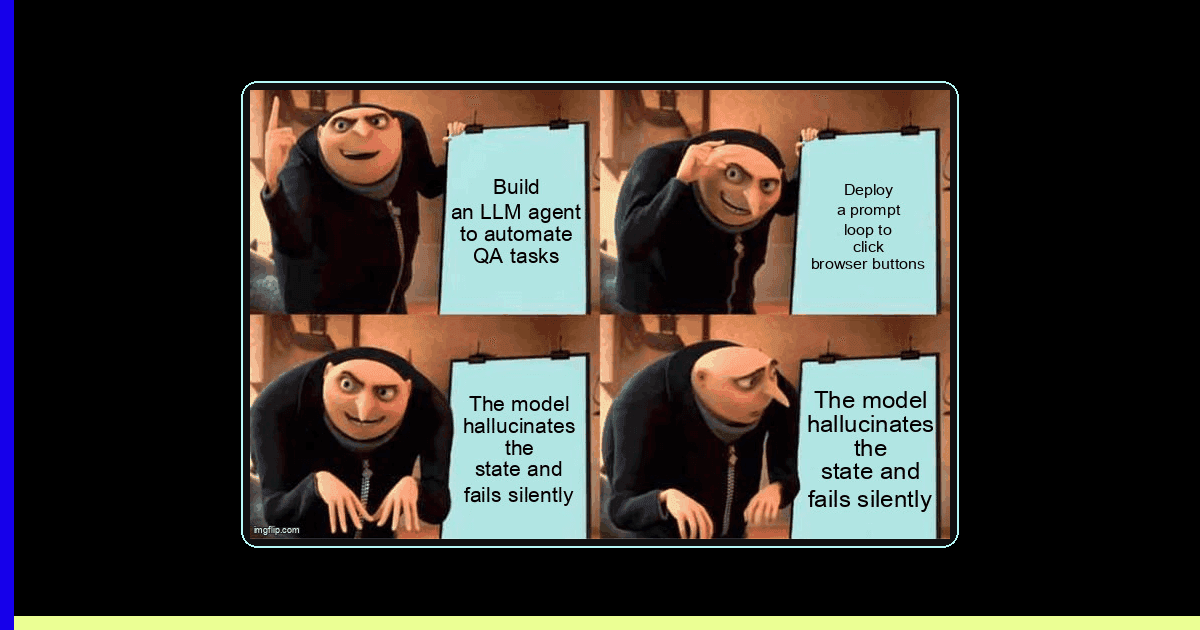
The hard part of LLM agents in QA is not getting a model to click a button. Playwright, Cypress, Selenium, and WebDriver BiDi already know how to drive browsers. The hard part is selecting a runtime pattern that can survive the boring production realities: flaky selectors, expired sessions, partial deployments, CI time limits, rate limits, secret boundaries, and a model that can explain itself convincingly even when it has lost the thread.
This guide is for teams that already know test automation and now need to decide how an LLM-powered agent should run autonomous work. Maybe the task is "investigate this failed checkout spec," "update locators after a UI migration," or "create regression coverage from a bug report." Those are useful jobs. They are also stateful, failure-prone, and expensive when they run without a runtime architecture. For adjacent test design guidance, see our Playwright browser contexts deep dive.
Real adoption pressure is already here. Stack Overflow's 2024 Developer Survey reported that 62% of professional developers were using AI tools, up from 44% the year before. PractiTest's 2026 State of Testing page reports that test coverage and automation coverage remain dominant testing KPIs at 56.4% and 40.1%. Those numbers do not prove agents are reliable; they explain why QA teams need runtime discipline before usage becomes infrastructure.
What is an LLM agent runtime?
An LLM agent runtime is the execution layer that turns model decisions into bounded work: state, tools, retries, policies, checkpoints, and evidence.
A prompt asks for a plan. A runtime decides whether that plan may run, which tools it can call, what gets persisted, how failure is classified, and when a human must review the result. In test automation terms, the runtime is closer to your CI orchestrator plus fixture system than to a test case. It is responsible for lifecycle, isolation, and evidence.
Good runtimes separate reasoning from authority. The model can propose the next browser action, but the runtime enforces tool schemas, timeout budgets, allowed domains, credential access, artifact capture, and stop conditions. That separation matters because LLMs do not execute code in a transactional memory model. They predict text, then your runtime interprets that text as actions. Every implicit assumption becomes a production risk.
Which agent-runtime pattern should QA teams choose first?
Start with durable workflows for CI tasks, use short tool loops for local triage, and reserve multi-agent systems for separable work.
Most QA teams should start with a durable workflow runtime. It is the easiest pattern to reason about because every expensive step has a checkpoint: collect failure context, classify the failure, run browser reproduction, propose a patch, run targeted tests, then hand off evidence. If the browser crashes after step three, the runtime resumes from recorded state instead of asking the model to reconstruct what happened from memory.
| Pattern | Best fit | What breaks first | Production guardrail |
|---|---|---|---|
| Single tool loop | Local failure triage | Lost context after long runs | Strict max steps and structured observations |
| Durable workflow | CI repair and regression generation | Bad checkpoint schema | Persisted state plus idempotent steps |
| Planner-worker | Large suites and shard analysis | Conflicting edits | Ownership boundaries and merge arbitration |
| Event-driven agent | Queue-based nightly maintenance | Duplicate processing | Idempotency keys and dead-letter queues |
Pattern 1: a bounded tool loop for fast triage
The bounded loop is the smallest runtime worth shipping. It gives the model a narrow set of typed tools, records every observation, and stops on budget exhaustion. This pattern fits interactive work: a QA engineer asks an agent to inspect one failing spec and return a diagnosis with screenshots, console errors, and suggested next steps. It should not silently push code.
// triage-agent.ts
// Run with: npx tsx triage-agent.ts checkout.spec.ts
import { chromium, type Browser, type Page } from 'playwright';

type Observation = { step: number; action: string; ok: boolean; detail: string };

type TriageResult = {
  status: 'diagnosed' | 'needs-human' | 'runtime-error';
  observations: Observation[];
  artifacts: string[];
};

const MAX_STEPS = 6;
const BASE_URL = process.env.BASE_URL ?? 'http://localhost:3000';

async function safeScreenshot(page: Page, name: string): Promise<string | null> {
  try {
    const path = 'artifacts/' + name + '.png';
    await page.screenshot({ path, fullPage: true, timeout: 5_000 });
    return path;
  } catch (error) {
    console.warn('screenshot failed', error);
    return null;
  }
}

async function inspectCheckout(page: Page): Promise<Observation[]> {
  const observations: Observation[] = [];
  for (let step = 1; step <= MAX_STEPS; step++) {
    try {
      if (step === 1) {
        await page.goto(BASE_URL + '/checkout', { waitUntil: 'domcontentloaded', timeout: 15_000 });
        observations.push({ step, action: 'open checkout', ok: true, detail: page.url() });
      } else if (step === 2) {
        const banner = page.getByRole('alert').first();
        const visible = await banner.isVisible({ timeout: 2_000 }).catch(() => false);
        observations.push({
          step,
          action: 'check error banner',
          ok: true,
          detail: visible ? await banner.innerText() : 'no alert visible',
        });
      } else if (step === 3) {
        const payButton = page.getByRole('button', { name: /pay|place order/i });
        const count = await payButton.count();
        observations.push({
          step,
          action: 'locate payment button',
          ok: count === 1,
          detail: 'matched ' + count + ' buttons',
        });
        if (count !== 1) break;
      } else {
        observations.push({ step, action: 'stop condition', ok: true, detail: 'bounded triage complete' });
        break;
      }
    } catch (error) {
      observations.push({
        step,
        action: 'browser operation',
        ok: false,
        detail: error instanceof Error ? error.message : String(error),
      });
      break;
    }
  }
  return observations;
}

async function main(): Promise<TriageResult> {
  let browser: Browser | undefined;
  const artifacts: string[] = [];
  try {
    browser = await chromium.launch({ headless: true });
    const page = await browser.newPage({ viewport: { width: 1366, height: 768 } });
    page.on('console', (msg) => console.log('[browser:' + msg.type() + '] ' + msg.text()));

    const observations = await inspectCheckout(page);
    const shot = await safeScreenshot(page, 'checkout-triage-final');
    if (shot) artifacts.push(shot);

    const failed = observations.some((observation) => !observation.ok);
    return { status: failed ? 'needs-human' : 'diagnosed', observations, artifacts };
  } catch (error) {
    return {
      status: 'runtime-error',
      observations: [{
        step: 0,
        action: 'runtime startup',
        ok: false,
        detail: error instanceof Error ? error.message : String(error),
      }],
      artifacts,
    };
  } finally {
    await browser?.close().catch((error) => console.warn('browser close failed', error));
  }
}

main().then((result) => {
  console.log(JSON.stringify(result, null, 2));
  process.exit(result.status === 'runtime-error' ? 1 : 0);
});
The edge case is deliberate: if the payment button matches zero or multiple elements, the runtime stops and reports ambiguity instead of guessing. That is the difference between an agent that helps QA and an agent that creates noisy changes. The model can read the observations and propose a hypothesis, but the browser driver remains deterministic.
Pattern 2: durable workflow runtime for CI repair
CI repair is not a chat session. It is a workflow with resumable steps. You want explicit state transitions because CI is full of interruption: a job is canceled, a browser dependency is missing, a test shard flakes, or the LLM provider returns a transient 429. Durable state lets the runtime retry the right step without replaying destructive actions.
// durable-ci-repair.ts
// Run with: npx tsx durable-ci-repair.ts failing-report.json
import { readFile, writeFile, mkdir } from 'node:fs/promises';
import { createHash } from 'node:crypto';
import { execa } from 'execa';

type State = {
  runId: string;
  phase: 'collect' | 'reproduce' | 'patch' | 'verify' | 'done' | 'failed';
  failure?: { spec: string; title: string; message: string };
  patch?: string;
  attempts: Record<string, number>;
  notes: string[];
};

const STATE_PATH = 'artifacts/agent-ci-repair-state.json';
const MAX_ATTEMPTS = 2;

async function loadState(inputPath: string): Promise<State> {
  try {
    return JSON.parse(await readFile(STATE_PATH, 'utf8')) as State;
  } catch {
    const raw = JSON.parse(await readFile(inputPath, 'utf8')) as {
      spec?: string;
      title?: string;
      message?: string;
    };
    if (!raw.spec || !raw.title || !raw.message) {
      throw new Error('failure report must include spec, title, and message');
    }
    const runId = createHash('sha256')
      .update(raw.spec + '|' + raw.title + '|' + raw.message)
      .digest('hex')
      .slice(0, 12);
    return {
      runId,
      phase: 'collect',
      failure: { spec: raw.spec, title: raw.title, message: raw.message },
      attempts: {},
      notes: [],
    };
  }
}

async function saveState(state: State): Promise<void> {
  await mkdir('artifacts', { recursive: true });
  await writeFile(STATE_PATH, JSON.stringify(state, null, 2));
}

async function runPhase(state: State, phase: State['phase'], fn: () => Promise<void>): Promise<void> {
  const count = state.attempts[phase] ?? 0;
  if (count >= MAX_ATTEMPTS) throw new Error('phase ' + phase + ' exceeded retry budget');
  state.attempts[phase] = count + 1;
  await saveState(state);
  await fn();
}

async function main() {
  const inputPath = process.argv[2];
  if (!inputPath) throw new Error('usage: npx tsx durable-ci-repair.ts failing-report.json');

  const state = await loadState(inputPath);
  try {
    if (state.phase === 'collect') {
      await runPhase(state, 'collect', async () => {
        state.notes.push('Collected failure: ' + state.failure!.spec + ' :: ' + state.failure!.title);
        state.phase = 'reproduce';
      });
    }

    if (state.phase === 'reproduce') {
      await runPhase(state, 'reproduce', async () => {
        const result = await execa('npx', ['playwright', 'test', state.failure!.spec, '--grep', state.failure!.title], { reject: false });
        state.notes.push(result.exitCode === 0 ? 'Could not reproduce locally; mark as flaky candidate.' : result.stderr.slice(0, 1200));
        state.phase = result.exitCode === 0 ? 'failed' : 'patch';
      });
    }

    if (state.phase === 'patch') {
      await runPhase(state, 'patch', async () => {
        state.patch = 'No automatic patch applied; attach observations for reviewer.';
        state.notes.push('Patch phase produced reviewer guidance instead of editing because confidence was low.');
        state.phase = 'verify';
      });
    }

    if (state.phase === 'verify') {
      await runPhase(state, 'verify', async () => {
        const result = await execa('npx', ['playwright', 'test', state.failure!.spec], { reject: false });
        state.notes.push('verification exit code: ' + result.exitCode);
        state.phase = result.exitCode === 0 ? 'done' : 'failed';
      });
    }
  } catch (error) {
    state.phase = 'failed';
    state.notes.push(error instanceof Error ? error.message : String(error));
  } finally {
    await saveState(state);
    console.log(JSON.stringify(state, null, 2));
    if (state.phase === 'failed') process.exit(1);
  }
}

main().catch((error) => {
  console.error(error);
  process.exit(1);
});
The important part is not the placeholder patch. It is the state model. Each phase is idempotent or intentionally bounded. The run ID is derived from the failure signature, so duplicate CI events converge on the same state file. In a production service, that state belongs in durable storage, not a local file, and the patch phase should require a schema such as { filesChanged, confidence, rationale, testsToRun } rather than free-form prose.
Pattern 3: planner-worker runtime for suite-scale analysis
Planner-worker systems become useful when the task is naturally divisible. A planner can group failures by suspected cause, then workers inspect separate shards. The trap is letting every worker edit the same files. In QA automation, ownership boundaries are the architecture: one worker can own selectors, another network traces, another test data, but a reducer must merge evidence before code changes are allowed.
// planner-worker-runtime.ts
// Run with: npx tsx planner-worker-runtime.ts failures.json
import { readFile } from 'node:fs/promises';

type Failure = { spec: string; title: string; error: string; browser?: string };
type WorkItem = { group: string; failures: Failure[]; owner: 'selectors' | 'network' | 'data' | 'unknown' };
type WorkerReport = { group: string; owner: WorkItem['owner']; confidence: number; summary: string; blockers: string[] };

function classify(failure: Failure): WorkItem['owner'] {
  const text = (failure.title + ' ' + failure.error).toLowerCase();
  if (/strict mode|locator|selector|not visible|timeout/.test(text)) return 'selectors';
  if (/net::|fetch|request|response|500|401|cors/.test(text)) return 'network';
  if (/fixture|seed|user|tenant|database|not found/.test(text)) return 'data';
  return 'unknown';
}

function plan(failures: Failure[]): WorkItem[] {
  if (failures.length === 0) throw new Error('no failures supplied');
  const groups = new Map<string, Failure[]>();
  for (const failure of failures) {
    if (!failure.spec || !failure.title || !failure.error) {
      throw new Error('invalid failure payload: ' + JSON.stringify(failure));
    }
    const owner = classify(failure);
    const key = owner + ':' + (failure.browser ?? 'all');
    groups.set(key, [...(groups.get(key) ?? []), failure]);
  }
  return [...groups.entries()].map(([group, grouped]) => ({
    group,
    failures: grouped,
    owner: classify(grouped[0]),
  }));
}

async function worker(item: WorkItem): Promise<WorkerReport> {
  try {
    const first = item.failures[0];
    const summary = item.owner === 'selectors'
      ? 'Inspect locator drift around ' + first.spec + '; prefer role locators before test ids.'
      : item.owner === 'network'
        ? 'Correlate failed browser requests with API logs for ' + first.spec + '.'
        : item.owner === 'data'
          ? 'Validate seeded tenant/user assumptions before changing assertions in ' + first.spec + '.'
          : 'Escalate ambiguous failure; runtime should collect trace and console evidence.';
    return { group: item.group, owner: item.owner, confidence: item.owner === 'unknown' ? 0.35 : 0.72, summary, blockers: [] };
  } catch (error) {
    return { group: item.group, owner: item.owner, confidence: 0, summary: 'worker failed', blockers: [error instanceof Error ? error.message : String(error)] };
  }
}

function reduceReports(reports: WorkerReport[]) {
  const conflictingOwners = new Set(reports.map((report) => report.owner));
  const lowConfidence = reports.filter((report) => report.confidence < 0.6);
  return {
    mergeAllowed: lowConfidence.length === 0 && conflictingOwners.size <= 2,
    reports,
    requiredHumanReview: lowConfidence.map((report) => report.group),
  };
}

async function main() {
  const file = process.argv[2];
  if (!file) throw new Error('usage: npx tsx planner-worker-runtime.ts failures.json');
  const failures = JSON.parse(await readFile(file, 'utf8')) as Failure[];
  const work = plan(failures);

  const reports = await Promise.all(work.map((item) => worker(item)));
  const result = reduceReports(reports);
  console.log(JSON.stringify(result, null, 2));
  if (!result.mergeAllowed) process.exitCode = 2;
}

main().catch((error) => {
  console.error(error);
  process.exit(1);
});
The reducer is where many agent systems are too casual. Parallelism improves throughput, but it also creates conflicting evidence. A worker that finds selector drift and another that finds a 401 may both be right. The reducer should return a review plan, not average the two into a confident patch. This is especially important for cross-browser failures where Chromium, WebKit, and Firefox expose timing and accessibility-tree differences differently.
Runtime contracts: the part that makes agents testable
QA engineers should treat agent tools like public APIs. Every tool needs a schema, a timeout, an authorization policy, and an error taxonomy. A browser action that returns "failed" is not enough. Was the selector ambiguous? Did the action timeout because the app was slow? Did the runtime lose authentication? Did the assertion fail because the backend returned a valid business error?
- Prefer typed observations over raw logs: selector count, URL, role name, status code, retry count, and artifact path.
- Keep model prompts out of the trusted boundary; validate the model's proposed action before the tool executes it.
- Make destructive actions opt-in. Agents should not delete users, reset shared data, or merge patches without policy checks.
- Persist enough state to resume, but redact secrets and personal data before observations enter prompts.
- Fail closed when confidence is low. A useful agent can say "needs human review" with excellent evidence.
If you are adapting an existing suite, start with read-only investigation and generated pull request suggestions. The fastest way to lose trust is to let an agent make sweeping locator changes without showing the failing trace, the diff rationale, and the verification command. For teams comparing automation approaches, our QA tools cover where generated tests need deterministic review.
Troubleshooting: how to debug an agent runtime when it behaves strangely
Debugging an agent runtime is different from debugging a normal failing test because there are two execution paths: the deterministic tool path and the probabilistic decision path. Separate them first. Re-run the browser operation without the model. Then replay the model decision from the same observation payload. If the tool fails deterministically, fix the automation. If the model chooses a bad action from good observations, fix the prompt, schema, or policy.
Practical debug checklist: capture the exact observation sent to the model, the validated tool call, the tool result, artifacts, retry count, model name, prompt version, and checkpoint ID. Without those, every incident becomes archaeology.
- Symptom: the agent loops on the same action. Diagnose: compare consecutive observations; if they are identical, add a no-progress detector and terminate.
- Symptom: the agent fixes the wrong test. Diagnose: check whether the failure signature included spec path, project/browser, grep title, and commit SHA.
- Symptom: CI repair works locally but not in the pipeline. Diagnose: diff environment variables, browser versions, dependency cache, and base URL routing.
- Symptom: the model invents unavailable tools. Diagnose: enforce a tool registry and reject unregistered calls before execution.
- Symptom: costs spike. Diagnose: inspect retry storms, oversized traces, unbounded screenshots, and prompts that include full test reports instead of summarized evidence.
Edge cases and gotchas architects should design for
The edge cases are not rare in test automation. Auth expires midway through a workflow. A test passes on retry because the app warmed a cache. A locator becomes ambiguous after an A/B experiment. A model sees a trace from staging and recommends changing production-only behavior. A generated test depends on seeded data that only exists in one tenant. Each of these is a runtime concern before it is a prompt concern.
Browser automation adds another subtle gotcha: actionability checks. Playwright, for example, waits for elements to be visible, stable, enabled, and able to receive events before many actions. Selenium and Cypress have their own timing semantics. When an agent reads "timeout," it needs structured context about which actionability condition failed. Otherwise it may recommend a longer timeout when the real fix is removing an overlay or using a role locator.
Secrets are another boundary. Do not paste `.env` values, cookies, bearer tokens, customer names, or raw production payloads into prompts. Redaction belongs in the runtime because a model cannot reliably redact information it has already seen. If the agent needs authenticated browser state, issue short-lived credentials scoped to the target environment and log when they are used.
A practical selection model
Choose the runtime pattern by asking four questions. First, can the task be resumed safely? If yes, prefer durable workflows. Second, can work be partitioned without overlapping files or data? If yes, consider planner-worker. Third, does the task need immediate human steering? If yes, use a bounded interactive loop. Fourth, does the task react to events over time? If yes, use an event-driven queue with idempotency keys.
The winning architecture is usually hybrid. A chat surface starts the task. A durable workflow owns execution. Browser workers collect evidence. A reducer summarizes findings. Humans approve code changes. CI verifies deterministic tests. That sounds less magical than an autonomous agent, but it is the architecture that can survive real QA workflows.
Closing guidance
Do not evaluate an agent runtime by the best demo it can produce. Evaluate it by the worst failure it can contain. Can it stop before destructive action? Can it explain exactly what it observed? Can it resume after interruption? Can it prove which tests it ran? Can it hand a QA engineer a concise artifact trail instead of a wall of confident prose?
For QA and software engineering teams, the goal is not to replace test automation discipline with LLM reasoning. The goal is to wrap LLM reasoning in the same engineering controls that made browser automation valuable: isolation, repeatability, evidence, review, and fast feedback. Pick the runtime pattern that makes those controls explicit, and your agents will become part of the quality system instead of another source of flaky work.
Ready to strengthen your test automation?
Desplega.ai helps QA teams build robust test automation frameworks that combine deterministic checks, browser automation, and AI-assisted investigation.
Get StartedFrequently Asked Questions
Should QA teams let LLM agents create tests directly?
Use agents to draft, repair, and investigate tests, but keep merges behind review, deterministic assertions, CI evidence, and a clear ownership path.
Which runtime pattern is safest for browser automation?
A durable workflow that checkpoints state and delegates browser steps to isolated workers is usually safer than a single long-running loop.
How much autonomy should a test agent get?
Give the agent autonomy over bounded tasks: inspect a failure, propose a fix, or rerun a shard. Require approval for credentials, data changes, and merges.
What is the most common agent-runtime failure?
The common failure is not the model being wrong; it is missing runtime state, weak tool contracts, unbounded retries, or no trace of what changed.
Related Posts
When I Reject v0 Code: Pattern-Matching Rules for Safer UI Generation
A practical v0 review gate for safer generated React UI: AST checks, Playwright smoke tests, accessibility rules, and rejection signals.
Cody's Repository Indexing: Does Cognitive Offloading Create Knowledge Gaps in Large Codebases? | Desplega AI
A practical deep dive into Cody repository indexing, context retrieval, and how indie hackers avoid AI-created knowledge gaps.
Hot Module Replacement: Why Your Dev Server Restarts Are Killing Your Flow State | desplega.ai
Stop losing 2-3 hours daily to dev server restarts. Master HMR configuration in Vite and Next.js to maintain flow state, preserve component state, and boost coding velocity by 80%.