Agentic Coding and Playwright Test Architecture for AI-Generated PRs
AI can open pull requests faster than teams can safely review them, so the test architecture has to carry more engineering judgment.
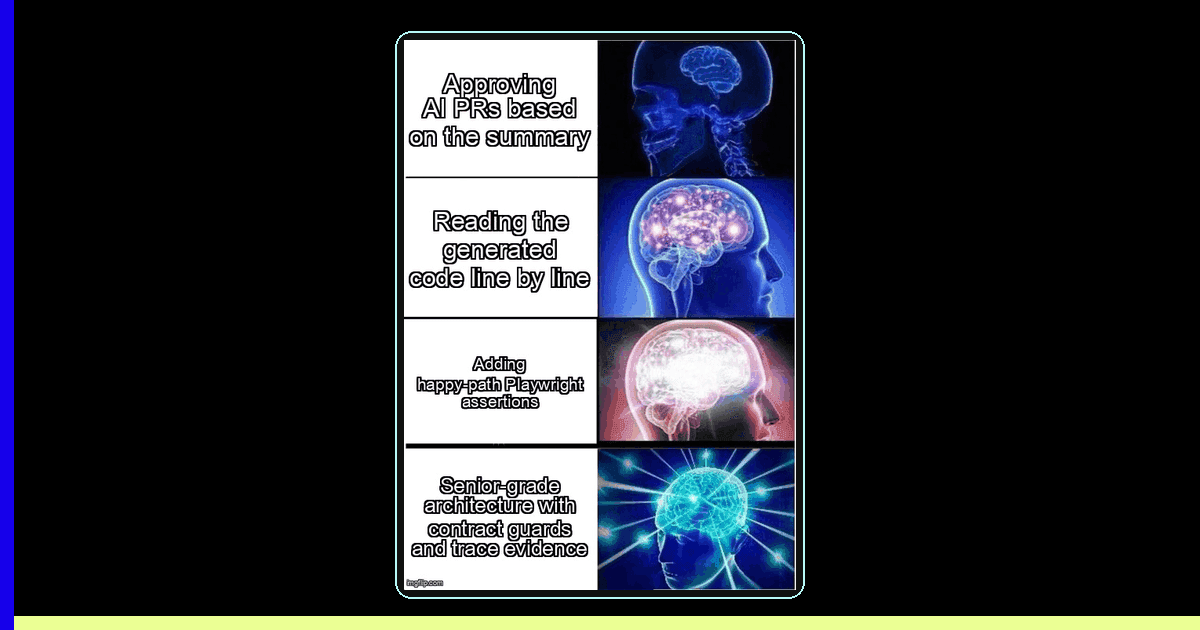
Agentic coding changes the shape of quality risk. The risky part is not that an AI assistant can generate a component, migration, or test. The risky part is that it can generate a plausible pull request with a plausible explanation, and that plausibility can arrive faster than a human reviewer can reconstruct the full product context.
That is why AI-generated PRs create persistent returns to expertise. Senior engineers do not become less useful because a model writes code. They become more useful because the bottleneck moves from typing syntax to designing evidence. Test automation has to answer the questions a reviewer no longer has time to answer manually: which contract changed, which user journey is protected, which browser behavior is being exercised, and which failure mode would prove this PR unsafe?
The adoption pressure is real. Stack Overflow's 2025 Developer Survey reports that 84% of respondents are using or planning to use AI tools in their development process, up from 76% in 2024. Google Cloud's 2024 DORA writeup reports a more uncomfortable finding: a 25% increase in AI adoption was associated with an estimated 1.5% decrease in delivery throughput and a 7.2% reduction in delivery stability. Those numbers do not prove AI makes teams worse. They do show that faster code generation does not automatically create safer delivery.
What changes when AI opens the pull request?
The review problem shifts from reading code to validating evidence: contracts, journeys, data setup, failure paths, selector strategy, and artifacts should be clear before style.
A human-authored PR usually carries social context. The author knows why they touched the checkout serializer, which customer reported the bug, and which tests were intentionally skipped because they were irrelevant. An agentic PR may carry a generated summary, but the summary is not accountability. It is an artifact to verify.
In a senior-grade test architecture, automated tests do not merely confirm that the UI still renders. They defend the review boundary. The goal is to make the cheapest checks answer the highest-risk questions before a reviewer spends attention on style, naming, or local maintainability. For a related quality engineering baseline, see our agentic AI quality framework.
The practical rule: every AI-generated PR should arrive with executable evidence for the risk it claims to solve. If it changes a contract, test the contract. If it changes a journey, test the journey. If it changes recovery behavior, test the failure path.
Why senior-grade test architecture beats more generated tests
AI assistants are very good at producing tests that look familiar. That is useful, but it is not enough. The failure pattern we see most often in AI-written tests is shallow confidence: selectors that match the current DOM, assertions that prove the happy path, and fixtures that depend on whatever data happened to exist when the test was generated.
| AI-generated anti-pattern | Senior-grade alternative | What it catches |
|---|---|---|
| Assert text after a click | Assert API contract and UI state | Serializer drift, stale cache, bad copy |
| Reuse shared login state | Per-test browser context and seeded user | Cross-test leakage and role confusion |
| Retry until green | Trace, classify, then quarantine flakes | Race conditions hidden by retries |
Example 1: Playwright contract guard for generated API changes
A common agentic PR pattern is a UI change plus a small API serializer change. The UI may still render, but downstream code may break because a field changed type, a nullable value disappeared, or a generated fixture covered only one SKU. The test below validates response shape, handles bad HTTP states, checks duplicate identifiers, and records the raw payload when parsing fails.
import { test, expect, APIResponse } from '@playwright/test'
import { mkdir, writeFile } from 'node:fs/promises'
import path from 'node:path'

type Product = {
  sku: string
  name: string
  priceCents: number
  availability: 'in_stock' | 'backorder' | 'discontinued'
}

async function parseJson(response: APIResponse, artifactName: string) {
  const body = await response.text()
  if (!response.ok()) {
    throw new Error('Expected 2xx from catalog API, got ' + response.status())
  }

  try {
    return JSON.parse(body) as unknown
  } catch {
    await mkdir('test-results/contracts', { recursive: true })
    await writeFile(path.join('test-results/contracts', artifactName), body)
    throw new Error('Catalog API returned invalid JSON; raw body was saved')
  }
}

function assertProduct(value: unknown, index: number): Product {
  if (!value || typeof value !== 'object') throw new Error('Product ' + index + ' is invalid')
  const product = value as Record<string, unknown>
  if (typeof product.sku !== 'string' || product.sku.trim() === '') {
    throw new Error('Product ' + index + ' has missing sku')
  }
  if (!Number.isInteger(product.priceCents) || Number(product.priceCents) < 0) {
    throw new Error('Product ' + product.sku + ' has invalid priceCents')
  }
  if (!['in_stock', 'backorder', 'discontinued'].includes(String(product.availability))) {
    throw new Error('Product ' + product.sku + ' has invalid availability')
  }
  return product as Product
}

test('catalog API contract supports product grid rendering', async ({ request }) => {
  const response = await request.get('/api/catalog?market=es&limit=25')
  const payload = await parseJson(response, 'catalog-market-es.json')
  if (!Array.isArray(payload) || payload.length === 0) {
    throw new Error('Catalog API must return a non-empty array')
  }

  const seen = new Set<string>()
  const products = payload.map(assertProduct)
  for (const product of products) {
    if (seen.has(product.sku)) throw new Error('Duplicate sku found: ' + product.sku)
    seen.add(product.sku)
  }
  expect(products.some((product) => product.availability === 'in_stock')).toBe(true)
})
The important detail is that this test defends a consumer contract, not a page screenshot. Playwright's APIRequestContext runs outside the page, so it can cheaply validate backend shape before the browser work starts.
Example 2: Playwright fixture isolation for realistic review evidence
Browser tests for agentic PRs should isolate state aggressively. Playwright gives each test a BrowserContext, which means cookies, localStorage, permissions, and service workers do not have to leak across tests. The fixture below creates a real user through the API, signs in through the UI, handles an existing-user edge case, and cleans up even when the assertion fails.
import { test as base, expect, request as requestFactory } from '@playwright/test'

type User = { email: string; password: string; role: 'buyer' | 'admin' }
type Fixtures = { buyer: User }

export const test = base.extend<Fixtures>({
  buyer: async ({ page }, use) => {
    const apiBaseUrl = process.env.E2E_API_BASE_URL
    if (!apiBaseUrl) throw new Error('E2E_API_BASE_URL is required')

    const api = await requestFactory.newContext({ baseURL: apiBaseUrl })
    const buyer = {
      email: 'buyer+' + Date.now() + '@example.test',
      password: 'Str0ng-test-password!',
      role: 'buyer' as const,
    }

    try {
      const create = await api.post('/test/users', { data: buyer })
      if (![201, 409].includes(create.status())) {
        throw new Error('Could not create buyer fixture: HTTP ' + create.status())
      }

      await page.goto('/login')
      await page.getByLabel('Email').fill(buyer.email)
      await page.getByLabel('Password').fill(buyer.password)
      await page.getByRole('button', { name: 'Sign in' }).click()
      await expect(page.getByTestId('account-menu')).toBeVisible()
      await use(buyer)
    } finally {
      const cleanup = await api.delete('/test/users/' + encodeURIComponent(buyer.email))
      if (![200, 204, 404].includes(cleanup.status())) {
        console.warn('Buyer fixture cleanup failed with HTTP ' + cleanup.status())
      }
      await api.dispose()
    }
  },
})

test('buyer sees resilient order history empty state', async ({ page, buyer }) => {
  await page.goto('/account/orders')
  await expect(page.getByRole('heading', { name: 'Orders' })).toBeVisible()
  await expect(page.getByText(buyer.email)).toBeHidden()
  await expect(page.getByTestId('orders-empty-state')).toContainText('No orders yet')
})
How should senior engineers review AI-generated PRs?
Review the risk model first: changed contracts, data setup, failure paths, selector strategy, and artifacts should be clear before style.
- For schema or serializer changes, require contract tests near the API boundary.
- For user journeys, require deterministic data and one negative path.
- For async UI, require actionability-safe locators and artifact capture.
- For migrations, require rollback or compatibility evidence.
- For generated tests, reject selectors coupled to CSS layout or translated copy unless copy is the behavior.
Example 3: Cypress idempotency check for checkout edge cases
Cypress is effective when the application under test benefits from framework-level visibility and fast local feedback. This example validates a checkout edge case that AI-generated PRs often miss: duplicate submission from a double click or impatient user.
describe('checkout idempotency', () => {
  beforeEach(() => {
    cy.task('seedCart', { sku: 'qa-course-pro', quantity: 1 }).then((result) => {
      if (!result || result.status !== 'ok') {
        throw new Error('Cart seed failed; checkout test cannot run safely')
      }
    })
  })

  it('creates one order when the payment button is clicked twice', () => {
    const idempotencyKeys = new Set<string>()

    cy.intercept('POST', '/api/orders', (req) => {
      const key = req.headers['idempotency-key']
      if (typeof key !== 'string' || key.length < 12) {
        req.reply({ statusCode: 400, body: { error: 'missing idempotency key' } })
        return
      }
      idempotencyKeys.add(key)
      req.continue()
    }).as('createOrder')

    cy.visit('/checkout')
    cy.findByRole('button', { name: /pay now/i }).as('payButton')
    cy.get('@payButton').click()
    cy.get('@payButton').click({ force: true })

    cy.wait('@createOrder').its('response.statusCode').should('eq', 201)
    cy.get('@payButton').should('be.disabled')
    cy.findByText(/payment received/i).should('be.visible')

    cy.task('findOrdersForCurrentCart').then((orders) => {
      if (!Array.isArray(orders)) throw new Error('orders task must return an array')
      expect(orders).to.have.length(1)
      expect(idempotencyKeys.size).to.eq(1)
    })
  })
})
The code intentionally fails fast when seeding fails, asserts the network protocol, and checks persistent state through a task. For a broader comparison of automation tradeoffs, compare this with our flaky test cost calculator.
Troubleshooting AI-generated PR test failures
The fastest way to debug agentic PRs is to classify failures by boundary. Do not start by asking whether the model wrote bad code. Start by asking which layer produced contradictory evidence.
- Contract failure: compare the failing payload with the consumer's expected shape. Look for renamed fields, nullable values, enum additions, and empty arrays.
- Locator failure: inspect whether the selector encodes behavior or layout. Prefer roles, labels, and stable test IDs over CSS structure.
- Actionability failure: in Playwright, read the trace for visibility, stability, and hit-target checks. A forced click can mask a real overlay.
- Retry-only pass: treat retries as a signal, not a fix. Capture network timing, console errors, and fixture setup duration before increasing retry counts.
- Data leak: verify that the test creates and cleans its own state. Shared staging data makes generated PRs look safer than they are.
A useful review heuristic: if a failing test cannot produce enough evidence for a developer to reproduce the defect locally, improve the test before arguing about whether the PR is good.
Edge cases senior teams should force into the suite
Agentic coding tends to optimize for the visible request. Senior test architecture protects the invisible cases: the user with no data, duplicated submission, the role with partial permissions, the slow network, the re-rendered DOM node, the expired session, the backward compatible API consumer, and the migration that must run twice without damaging state.
The gotcha is that these cases are rarely hard to test once the architecture exists. They are hard to remember when a PR looks complete. That is why the best teams encode them into fixtures, helpers, review checklists, and merge gates instead of relying on individual vigilance.
A practical PR gate for agentic coding
A strong gate does not mean running every test on every commit. It means choosing checks that match the risk profile of the change. For an AI-generated PR, the minimum gate should include static checks, a contract or unit boundary check, a smoke journey, and artifact capture. Deeper suites can run on merge queues or nightly builds, but the PR must prove it did not break the boundary it touched.
Ready to strengthen your test automation?
Desplega.ai helps QA teams build robust test automation frameworks that catch real regressions while keeping delivery fast.
Get StartedFrequently Asked Questions
Should AI-generated PRs require different tests?
They need the same product risk model, but stronger automation gates: contract checks, deterministic data, artifacts, and reviewer-visible failure evidence.
Is Playwright better than Cypress or Selenium for this?
Playwright is strong for isolation, Cypress for app-level feedback, and Selenium for broad WebDriver coverage. Architecture matters more than tools.
How do we keep tests from blocking AI-assisted delivery?
Split checks by risk: fast contract and smoke tests on every PR, deeper journeys on merge queues, and quarantined diagnostics for suspected flakes.
What is the biggest gotcha with AI-written tests?
They often assert the happy path only. Senior review should look for negative states, stale data assumptions, and selectors tied to layout or copy.
Related Posts
When I Reject v0 Code: Pattern-Matching Rules for Safer UI Generation
A practical v0 review gate for safer generated React UI: AST checks, Playwright smoke tests, accessibility rules, and rejection signals.
Cody's Repository Indexing: Does Cognitive Offloading Create Knowledge Gaps in Large Codebases? | Desplega AI
A practical deep dive into Cody repository indexing, context retrieval, and how indie hackers avoid AI-created knowledge gaps.
Hot Module Replacement: Why Your Dev Server Restarts Are Killing Your Flow State | desplega.ai
Stop losing 2-3 hours daily to dev server restarts. Master HMR configuration in Vite and Next.js to maintain flow state, preserve component state, and boost coding velocity by 80%.