
Level Up Your SDLC: From Isolated Agents to an Agentic Mesh for Automated Testing
Keep the creative speed that got you shipping, then add contracts, evidence, and guardrails so your test agents can collaborate without guessing.
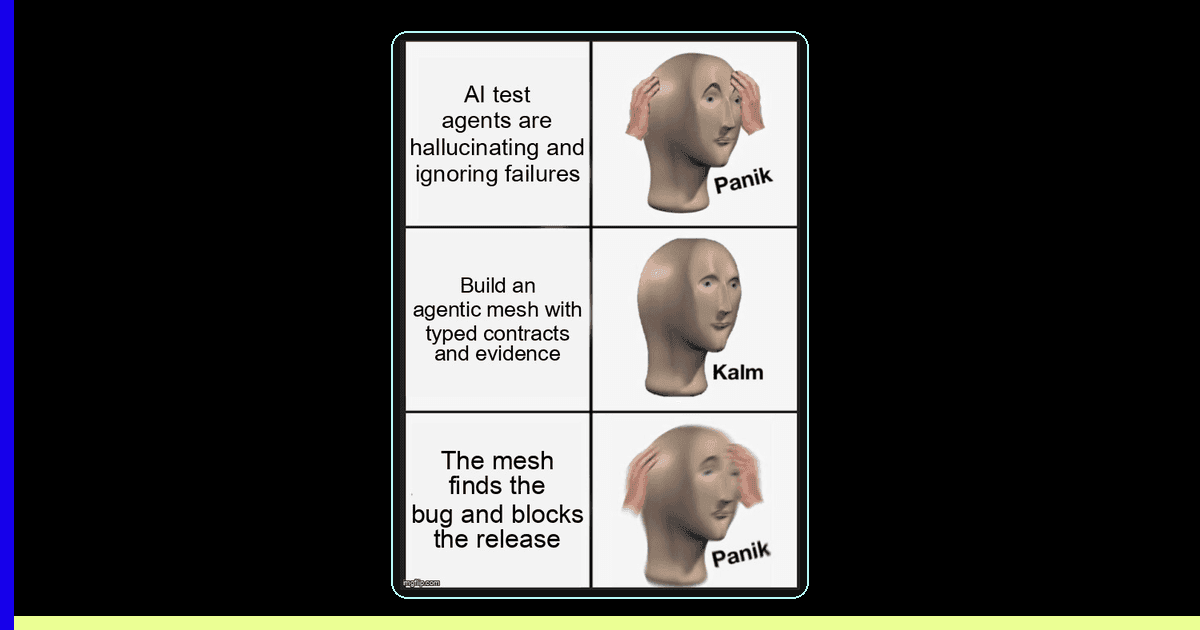
You have been shipping fast with an AI coding assistant. That skill translates. You already know how to turn intent into a working feature, steer a model with constraints, and iterate when the first answer misses. The next bottleneck appears when one agent writes a change, another generates tests, and a third reviews failures—but none of them agree on what happened.
The usual result is not intelligence; it is coordination debt. A test generator invents a fixture that the browser runner cannot create. A debugging agent reruns a flaky suite until it passes. A release agent reads the final green line but never sees that two required suites timed out. Each agent looks useful in isolation while the delivery decision becomes less trustworthy.
An agentic mesh fixes that concrete problem. It connects narrow agents through explicit contracts, durable evidence, bounded execution, and one deterministic release policy. This is not a jump from “vibe coder” to distributed-systems expert. It is a staged migration that preserves your velocity while unlocking new capabilities.
What is an agentic mesh for automated testing?
An agentic mesh coordinates specialized test agents through typed events, shared evidence, bounded retries, and deterministic quality gates.
Think of the mesh as a small control plane for your SDLC. A planner maps a code diff to risks. Executors run API, browser, accessibility, and security checks. A triage agent explains failures. A gate—not an LLM—decides whether the evidence satisfies release policy. Agents may propose work, but contracts and policy decide what work counts.
This distinction matters because adoption is already ahead of trust. The 2024 Stack Overflow Developer Survey reported that 76% of respondents used or planned to use AI development tools, while 45% of professional developers rated AI tools bad or very bad at complex tasks. Orchestration should assume useful but fallible workers.
DORA’s Impact of Generative AI in Software Development found that a 25% increase in AI adoption was associated with a 1.5% decrease in delivery throughput and a 7.2% decrease in delivery stability. Those are associations, not proof that AI caused the declines, but DORA’s interpretation is practical: faster code generation can create larger batches, so small changes and robust testing still matter.
The mental-model upgrade
A prompt is a request. A contract is an enforceable boundary. A chat transcript is context. An evidence artifact is auditable input. An agent opinion is a signal. A quality gate is a decision.
What skills from vibe coding transfer to agent orchestration?
Your prompting, rapid feedback, and product judgment transfer directly; add typed handoffs, scoped permissions, and reproducible verification.
Many successful developers started with vibe coding. You do not discard that workflow—you make its implicit decisions visible. The prompt that says “test checkout” becomes a risk-planning role. The moment you inspect a screenshot becomes an evidence-review step. The instinct to undo a suspicious edit becomes a rollback policy.
| What you already know | Mesh equivalent | Code-level upgrade |
|---|---|---|
| Ask one assistant to test a feature | Planner emits bounded test jobs | prompt → TestJob[] with schema validation |
| Paste an error into chat | Runner publishes immutable evidence | stderr → ArtifactRef with hash and timestamp |
| Tell the assistant to try again | Orchestrator applies retry policy | retry → bounded backoff, never an open loop |
| Decide whether the result looks safe | Gate evaluates required evidence | opinion → deterministic verdict |
Architecture: separate the control plane from the test plane
The test plane performs work: launch Playwright, call an API, scan dependencies, save traces. The control plane assigns jobs, limits concurrency, records state, and applies policy. Mixing them makes recovery dangerous. If the same model both runs a test and decides whether its missing report is acceptable, it can rationalize away its own failure.
- Typed jobs: versioned payloads with IDs, deadlines, dependencies, and requested evidence.
- At-least-once delivery: assume queues may redeliver; every handler needs an idempotency key.
- Immutable evidence: store reports, traces, logs, commit SHA, environment, and hashes outside model context.
- Least privilege: planners cannot execute shell commands; runners cannot approve releases; reviewers cannot mutate artifacts.
- Fail-closed policy: missing, stale, malformed, or contradictory required evidence blocks the release.
If your browser checks are the first workload, pair this architecture with our Playwright Docker sharding guide. To prioritize the first checks your mesh should orchestrate, use the QA risk assessment.
Production example 1: a dependency-aware orchestrator
This runnable Node.js/TypeScript example executes independent test jobs concurrently, respects dependencies, times out hung agents, deduplicates repeated jobs, and detects a cycle or missing dependency. Save it as mesh.ts and run it with npx tsx mesh.ts.
type Job = {
  id: string;
  dependsOn: string[];
  timeoutMs: number;
  run: (signal: AbortSignal) => Promise<string>;
};

type Result = { id: string; ok: boolean; evidence?: string; error?: string };

const completed = new Map<string, Result>(); // Replace with durable storage in CI.

async function execute(job: Job): Promise<Result> {
  const previous = completed.get(job.id);
  if (previous) return previous; // Edge case: queue redelivery.

  const controller = new AbortController();
  const timer = setTimeout(() => controller.abort(), job.timeoutMs);
  try {
    const evidence = await job.run(controller.signal);
    if (!evidence.trim()) throw new Error("Agent returned empty evidence");
    const result = { id: job.id, ok: true, evidence } satisfies Result;
    completed.set(job.id, result);
    return result;
  } catch (error) {
    const message = error instanceof Error ? error.message : "Unknown agent error";
    const result = { id: job.id, ok: false, error: message } satisfies Result;
    completed.set(job.id, result);
    return result;
  } finally {
    clearTimeout(timer);
  }
}

async function runMesh(jobs: Job[]): Promise<Result[]> {
  const pending = new Map(jobs.map((job) => [job.id, job]));
  if (pending.size !== jobs.length) throw new Error("Duplicate job IDs");
  const results: Result[] = [];

  while (pending.size > 0) {
    const ready = [...pending.values()].filter((job) =>
      job.dependsOn.every((id) => completed.get(id)?.ok === true),
    );

    for (const job of [...pending.values()]) {
      const failedDependency = job.dependsOn.find((id) => completed.get(id)?.ok === false);
      if (failedDependency) {
        const result: Result = { id: job.id, ok: false, error: "Dependency failed: " + failedDependency };
        completed.set(job.id, result);
        results.push(result);
        pending.delete(job.id);
      }
    }

    if (ready.length === 0 && pending.size > 0) {
      const unresolved = [...pending.values()].map((job) => job.id + "<-" + job.dependsOn.join(","));
      throw new Error("Cycle or missing dependency: " + unresolved.join("; "));
    }

    const batch = await Promise.all(ready.map(execute));
    for (const result of batch) {
      results.push(result);
      pending.delete(result.id);
    }
  }
  return results;
}

const delay = (ms: number, signal: AbortSignal) => new Promise<void>((resolve, reject) => {
  const timer = setTimeout(resolve, ms);
  signal.addEventListener("abort", () => {
    clearTimeout(timer);
    reject(new Error("Agent timed out"));
  }, { once: true });
});

const jobs: Job[] = [
  { id: "api", dependsOn: [], timeoutMs: 2_000, run: async (s) => { await delay(50, s); return "api-report.json"; } },
  { id: "browser", dependsOn: [], timeoutMs: 2_000, run: async (s) => { await delay(80, s); return "playwright-report/"; } },
  { id: "triage", dependsOn: ["api", "browser"], timeoutMs: 2_000, run: async (s) => { await delay(20, s); return "triage.json"; } },
];

runMesh(jobs)
  .then((results) => {
    console.log(JSON.stringify(results, null, 2));
    if (results.some((result) => !result.ok)) process.exitCode = 1;
  })
  .catch((error) => {
    console.error("Mesh failed closed:", error);
    process.exitCode = 1;
  });
Why it works: readiness is derived from stored results, not conversational memory. A redelivered job returns the same decision, a failed prerequisite prevents dependent work, and an unresolved graph stops loudly. In a real system, use a transactional database or queue-specific deduplication rather than the in-memory map.
Production example 2: verify callbacks before they enter the mesh
Tool runners often return asynchronously through webhooks. The boundary must reject forged, oversized, stale, malformed, and replayed messages. This Node 20 server uses only built-in modules. Save as callback-server.ts, set WEBHOOK_SECRET, and run with npx tsx callback-server.ts.
import { createHmac, timingSafeEqual } from "node:crypto";
import { createServer, IncomingMessage } from "node:http";

const secret = process.env.WEBHOOK_SECRET;
if (!secret) throw new Error("WEBHOOK_SECRET is required");
const seen = new Map<string, number>(); // Use Redis with TTL across replicas.
const MAX_BODY = 1_000_000;
const MAX_AGE_MS = 5 * 60_000;

async function readBody(request: IncomingMessage): Promise<Buffer> {
  const chunks: Buffer[] = [];
  let size = 0;
  for await (const chunk of request) {
    const buffer = Buffer.from(chunk);
    size += buffer.length;
    if (size > MAX_BODY) throw new Error("Payload too large");
    chunks.push(buffer);
  }
  return Buffer.concat(chunks);
}

function validSignature(body: Buffer, timestamp: string, supplied: string): boolean {
  const expected = createHmac("sha256", secret).update(timestamp).update(".").update(body).digest("hex");
  const left = Buffer.from(expected, "hex");
  const right = Buffer.from(supplied, "hex");
  return left.length === right.length && timingSafeEqual(left, right);
}

const server = createServer(async (request, response) => {
  try {
    if (request.method !== "POST" || request.url !== "/agent-callback") {
      response.writeHead(404).end("Not found");
      return;
    }
    const timestamp = String(request.headers["x-mesh-timestamp"] || "");
    const signature = String(request.headers["x-mesh-signature"] || "");
    const eventId = String(request.headers["x-mesh-event-id"] || "");
    const sentAt = Number(timestamp);
    if (!signature || !eventId || !Number.isFinite(sentAt)) throw new Error("Missing callback headers");
    if (Math.abs(Date.now() - sentAt) > MAX_AGE_MS) throw new Error("Stale callback");

    const body = await readBody(request);
    if (!validSignature(body, timestamp, signature)) throw new Error("Invalid signature");
    if (seen.has(eventId)) {
      response.writeHead(200).end("Duplicate accepted"); // Edge case: safe retry.
      return;
    }

    const event: unknown = JSON.parse(body.toString("utf8"));
    if (!event || typeof event !== "object" || !("jobId" in event) || !("artifact" in event)) {
      throw new Error("Invalid event shape");
    }
    seen.set(eventId, Date.now());
    console.log("Verified callback", eventId, event);
    response.writeHead(202).end("Accepted");
  } catch (error) {
    const message = error instanceof Error ? error.message : "Unknown error";
    const status = message === "Payload too large" ? 413 : 400;
    console.error("Rejected callback:", message);
    response.writeHead(status).end(message);
  }
});

server.on("clientError", (error, socket) => {
  console.error("HTTP client error:", error.message);
  socket.end("HTTP/1.1 400 Bad Request\r\n\r\n");
});

server.listen(8080, () => console.log("Callback server listening on :8080"));
Sign the raw bytes before parsing JSON; re-serializing can change whitespace or key order and break valid signatures. Persist the event ID before acknowledging in a production handler, ideally in the same transaction that enqueues downstream work. Otherwise a crash between the 202 response and persistence can lose evidence.
Production example 3: keep the final gate deterministic
An LLM can summarize why a suite failed, but it should not decide that missing evidence is probably fine. This runnable gate reads an evidence manifest, verifies the commit and freshness, requires named suites, and blocks failures or quarantined tests. Save as quality-gate.ts and run npx tsx quality-gate.ts evidence.json $GIT_SHA.
import { readFile } from "node:fs/promises";

type Suite = { name: string; status: "passed" | "failed"; quarantined: number };
type Manifest = { commit: string; createdAt: string; suites: Suite[] };
const REQUIRED = ["unit", "api", "browser"];
const MAX_AGE_MS = 30 * 60_000;

function validate(input: unknown): Manifest {
  if (!input || typeof input !== "object") throw new Error("Manifest must be an object");
  const value = input as Partial<Manifest>;
  if (!value.commit || !value.createdAt || !Array.isArray(value.suites)) {
    throw new Error("Manifest is missing commit, createdAt, or suites");
  }
  for (const suite of value.suites) {
    if (!suite || typeof suite !== "object" || !suite.name || !["passed", "failed"].includes(suite.status) || !Number.isInteger(suite.quarantined)) {
      throw new Error("Malformed suite record: " + JSON.stringify(suite));
    }
    if (suite.quarantined < 0) throw new Error("Quarantine count cannot be negative");
  }
  return value as Manifest;
}

async function main(): Promise<void> {
  const [path, expectedCommit] = process.argv.slice(2);
  if (!path || !expectedCommit) throw new Error("Usage: quality-gate.ts <manifest> <commit>");
  const manifest = validate(JSON.parse(await readFile(path, "utf8")));
  const createdAt = Date.parse(manifest.createdAt);
  if (!Number.isFinite(createdAt)) throw new Error("createdAt is not a valid ISO timestamp");
  if (manifest.commit !== expectedCommit) throw new Error("Evidence belongs to a different commit");
  if (Date.now() - createdAt > MAX_AGE_MS || createdAt > Date.now() + 60_000) {
    throw new Error("Evidence is stale or timestamped in the future");
  }

  const byName = new Map(manifest.suites.map((suite) => [suite.name, suite]));
  if (byName.size !== manifest.suites.length) throw new Error("Duplicate suite names");
  const missing = REQUIRED.filter((name) => !byName.has(name));
  if (missing.length) throw new Error("Missing required suites: " + missing.join(", "));
  const failed = manifest.suites.filter((suite) => suite.status !== "passed");
  const quarantined = manifest.suites.filter((suite) => suite.quarantined > 0);
  if (failed.length) throw new Error("Failed suites: " + failed.map((suite) => suite.name).join(", "));
  if (quarantined.length) throw new Error("Quarantined tests require review: " + quarantined.map((suite) => suite.name).join(", "));
  console.log("QUALITY_GATE=passed commit=" + manifest.commit);
}

main().catch((error) => {
  console.error("QUALITY_GATE=blocked", error instanceof Error ? error.message : error);
  process.exitCode = 1;
});
The gate deliberately treats quarantine as unresolved work. Your policy may allow a reviewed quarantine budget, but encode that policy explicitly and attach an owner plus expiry. Never let a triage agent quietly rewrite failed to passed; it may produce a diagnosis, while only a fresh rerun produces new evidence.
A weekend migration plan that does not boil the ocean
For a small Node.js application, the first useful mesh is a weekend-sized project if CI and tests already exist. The quick wins are typed jobs, immutable artifact paths, and a fail-closed gate. Durable queues, distributed tracing, policy-as-code, and multi-tenant isolation take longer to master.
- Inventory one pull-request path. Draw the current triggers, test commands, artifacts, credentials, and final decision. Do not migrate release automation yet.
- Choose narrow roles. Begin with planner, runner, triage, and gate. A role needs one purpose and the minimum tools required for it.
- Version the envelope. Include
schemaVersion,jobId,commit,deadline,dependencies, and expected artifact types. - Make handlers idempotent. Run the same job twice intentionally. Confirm it returns or references the same evidence instead of duplicating side effects.
- Add observability. Propagate a correlation ID through every job, log state transitions, and record model/tool versions without storing secrets.
- Run in shadow mode. Let the mesh produce a verdict beside your existing CI gate. Compare disagreements before granting authority.
- Grant one permission at a time. Start with read-only test environments. Keep deploy credentials and production data outside the mesh.
How do you confirm it worked? Replay the same event and observe one logical result. Kill a runner mid-job and observe recovery. Send an expired callback and observe rejection. Remove a required artifact and observe a blocked gate. Finally, trace one commit from planner output to the exact evidence used for its verdict.
Troubleshooting and debugging the mesh
Distributed failures often look like model failures because the model is the visible part. Debug from the control plane outward: event identity, state transition, dependency, permission, tool execution, artifact, then model reasoning.
| Symptom | Likely cause | Diagnostic and fix |
|---|---|---|
| The same suite runs repeatedly | At-least-once delivery without durable idempotency | Search by job ID; add a unique database constraint and return the stored result on conflict. |
| Jobs remain pending forever | Cycle, unknown dependency, or lost terminal event | Render the dependency graph; validate references before enqueue; reconcile timed-out jobs. |
| A green gate uses old results | Artifacts are not bound to commit and environment | Require SHA, timestamp, environment, and content hash; reject stale or future-dated evidence. |
| An agent says a tool succeeded, but no report exists | Natural-language claims replaced tool receipts | Require exit code plus artifact URI and hash. Treat absent evidence as failure. |
| Retries amplify an outage | Unbounded retries and no shared budget | Add exponential backoff, jitter, a per-workflow deadline, and a circuit breaker for the failing dependency. |
A practical trace query
For one correlation ID, list every accepted event in timestamp order with producer, consumer, attempt, state transition, artifact hash, and error. If you cannot reconstruct the verdict from that list, the system is not yet auditable.
Edge cases and gotchas to design before autonomy
- Cancellation races: a runner may finish while cancellation is in flight. Define which timestamp wins and whether its artifact remains admissible.
- Partial success: ten shards can pass while one times out. Aggregate from the declared shard set, not only from reports that arrived.
- Clock skew: timestamps from separate machines drift. Use server receipt time for ordering and allow a small documented tolerance.
- Prompt injection in test data: pages, logs, and issue text are untrusted input. Do not let their instructions expand an agent’s tools or permissions.
- Schema evolution: producers and consumers deploy separately. Reject unknown major versions and tolerate optional fields within a supported major version.
- Non-deterministic environments: bind evidence to container image, browser version, feature flags, seed, locale, and timezone when those affect behavior.
- Poison jobs: after the retry budget is exhausted, move work to a dead-letter queue with enough context to reproduce it safely.
When to migrate now—and when to wait
Migrate now if you already run two or more AI-assisted test steps, manually copy results between them, or cannot explain why a release was approved. The mesh will replace coordination work you are already doing. Wait if you lack stable test commands, disposable environments, or a clear release policy. Orchestration multiplies the behavior beneath it; it does not repair an undefined testing strategy.
Your best first milestone is intentionally modest: one pull request enters, specialized workers produce verifiable evidence, and one deterministic gate explains why it passed or stopped. Once that loop survives duplicates, timeouts, malformed results, and runner crashes, add another role. Professional tooling is not about having more agents. It is about making every handoff trustworthy.
Ready to level up your dev toolkit?
Desplega.ai helps developers transition to professional tools smoothly, without losing the speed and experimentation that made vibe coding productive.
Get StartedFrequently Asked Questions
Do I need multiple AI models to build an agentic testing mesh?
No. Start with one model behind several narrow roles. Separate contracts, permissions, evidence, and failure policies matter more than model variety during your first migration.
Should agents be allowed to deploy or change production?
Not initially. Give test agents read-only environments and scoped credentials. Require a deterministic quality gate and human approval before any production-changing action.
How is an agentic mesh different from running tests in parallel?
Parallel jobs share a clock; a mesh shares typed evidence and dependencies. Agents can react to findings, while one policy layer controls retries, budgets, and release decisions.
What is the safest first workflow to migrate?
Migrate pull-request testing first: plan impacted suites, run them in a disposable environment, inspect failures, and let a deterministic gate produce the final verdict.
Related Posts
When I Reject v0 Code: Pattern-Matching Rules for Safer UI Generation
A practical v0 review gate for safer generated React UI: AST checks, Playwright smoke tests, accessibility rules, and rejection signals.
Cody's Repository Indexing: Does Cognitive Offloading Create Knowledge Gaps in Large Codebases? | Desplega AI
A practical deep dive into Cody repository indexing, context retrieval, and how indie hackers avoid AI-created knowledge gaps.
Hot Module Replacement: Why Your Dev Server Restarts Are Killing Your Flow State | desplega.ai
Stop losing 2-3 hours daily to dev server restarts. Master HMR configuration in Vite and Next.js to maintain flow state, preserve component state, and boost coding velocity by 80%.