
You Fired Your QA Team for AI. Now Your Users Are Your QA Team.
A post-mortem on the 2025 QA headcount wave, the ROI math that lied by omission, and why the companies still standing treated AI as a multiplier — not a replacement.
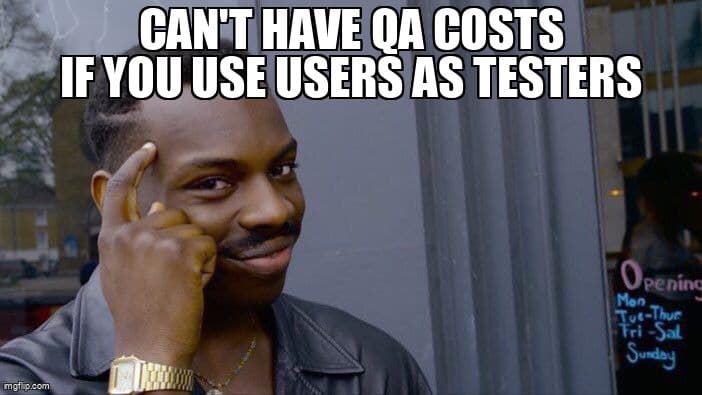
Somewhere in Q2 2025, a slide deck argued that AI testing tools had made QA engineers redundant. The numbers looked clean. The board approved. The Slack messages went out. Six months later, your users are filing bug reports at 2 AM and your on-call rotation has become a permanent state of emergency.
This is not a judgment. This is an autopsy. The decisions made sense given the information on the table — which is exactly what makes this pattern so dangerous. The information that was not on the table is what killed you.
The Narrative That Ate Engineering Budgets in 2025
The pitch was compelling because it contained real facts. AI testing tools genuinely reduced regression suite maintenance overhead. AI genuinely generated test cases faster than humans. Dashboards genuinely turned green faster than before.
What the pitch omitted was equally real. Regression coverage is the easiest type of testing to automate — and increasingly the least valuable, because those bugs are the ones your CI/CD pipeline already surfaces before anything reaches a human. The bugs that matter in production are the ones that were never in a test case to begin with.
The 2025 QA headcount contraction was not driven by malice. It was driven by a measurement problem. The ROI of QA is notoriously difficult to quantify on a quarterly basis. The cost of QA headcount is trivially easy to quantify. When you can show the board a line-item reduction and the cost of that reduction takes six months to appear in your defect escape rate, the math works perfectly right up until it doesn't.
Why Did the AI-Replaces-QA ROI Math Look So Convincing?
The AI-replaces-QA ROI calculation omitted incident response costs, customer churn from quality degradation, and the 6-month lag before defect escape rates become visible — the three categories that collectively reverse the math.
Here is the calculation that appeared in every board deck versus the one that should have:
| What the Deck Calculated | What the Deck Omitted |
|---|---|
| QA engineer salaries ($85K–$140K each) | Incident response cost ($8K–$23K per major incident) |
| AI tool licensing ($12K–$60K/year) | Customer churn from quality degradation (4–8% per quarter) |
| Test maintenance hours saved | Engineering time diverted to production firefighting |
| Faster test execution in CI | 6-month lag before defect escape rate is visible in dashboards |
According to PagerDuty's 2025 State of Digital Operations report, the average cost of a critical production incident is $14,000 per minute of downtime for mid-market and enterprise organizations. A single P0 incident lasting 45 minutes exceeds a QA engineer's annual salary. You need to prevent exactly 1.4 incidents per year to justify the headcount at that rate. Most teams that cut QA had more than that in the first two quarters.
What AI Testing Tools Actually Deliver
AI testing tools deliver genuine value in four specific categories. The companies that thrived are the ones that understood exactly where this value stops.
- Regression coverage at scale — AI tools generate and maintain regression suites for large codebases faster than human teams. This is real. It eliminates the tedium that burned out junior QA engineers and kept regression backlogs permanently behind development pace.
- Test case generation from requirements — Given structured user stories, modern AI tools produce test matrices that surface obvious coverage gaps quickly. The operative word is "obvious." This is table-stakes coverage, not expert coverage.
- Flaky test triage — AI tools identify patterns across test failure runs, distinguishing true regressions from timing-dependent noise. This alone saves senior engineers 3–5 hours per week of investigation.
- Visual regression at pixel scale — For UI-heavy products, AI-powered visual regression catches CSS regressions that text-based assertions miss entirely. This is arguably the highest-signal use of AI in testing right now.
The 2025 Capgemini World Quality Report found that organizations using AI testing tools for regression automation reduced test maintenance overhead by 52% on average. That number is accurate. It tells you nothing about the bugs that were never in the regression suite to begin with.
What AI Testing Tools Cannot See (By Design)
AI testing tools are pattern-matching systems optimized for known behavior. This makes them structurally blind to three defect categories that experienced QA engineers catch on instinct. These are not product failures — they are definitional constraints. Expecting an AI testing tool to catch emergent behavior bugs is like expecting a spell checker to catch logical fallacies.
Blind Spot 1: Emergent Behavior
Emergent bugs arise from interactions between features that each work correctly in isolation. An experienced QA engineer asks: "What happens when a trial-plan user triggers the enterprise export while a background billing job is mid-transaction?" An AI testing tool asks: "Does the export button work?" Both questions are correct. Only one finds the P0 that takes down your billing service on a Friday afternoon.
Blind Spot 2: UX Degradation
UX degradation is the slow death of a product's usability without any individual feature breaking. Load times creep up 200ms per release. A modal adds one extra click. Error messages become subtly less helpful. Nothing fails a test. Conversion rates fall 7% per quarter. AI testing tools have no contextual judgment for when something that "works" has become actively worse to use.
Blind Spot 3: Domain-Specific Edge Cases
A QA engineer who has tested your healthcare billing product for two years knows that certain insurance provider codes cause silent submission failures in specific state-plus-coverage combinations that were never in the requirements. This knowledge was built from incident post-mortems and customer escalations. AI tools do not attend post-mortems. They do not accumulate institutional memory. They test what they were told to test, with exactly the coverage gaps the requirements had.
The Incident Cost Math Nobody Actually Ran
The real cost comparison is not QA salaries versus AI tool licensing. It is the total cost of a quality program with human expertise versus the total cost of defect escape at your company's shipping velocity.
// The math that should have been in the deck
// Mid-market SaaS: 200 engineers, 12 releases/month

// === BEFORE QA CUTS ===
const qaTeamSize = 6;
const avgQASalary = 105_000;
const qaAnnualCost = qaTeamSize * avgQASalary;     // $630,000/year

const incidentsPerRelease = 0.3;                   // historical average
const releasesPerYear = 12 * 12;                   // 144 releases
const incidentsPerYear = incidentsPerRelease * releasesPerYear; // 43.2
const avgIncidentCost = 18_000;                    // P1/P2 avg, eng + customer cost
const incidentCostBefore = incidentsPerYear * avgIncidentCost;  // $777,600/year

const totalCostWithQA = qaAnnualCost + incidentCostBefore;
// TOTAL: $1,407,600/year

// === AFTER QA CUTS (2 quarters later) ===
const aiTooling = 45_000;
const incidentsPerReleaseAfter = 1.8;              // 6x increase — documented pattern
const incidentsPerYearAfter = incidentsPerReleaseAfter * releasesPerYear; // 259.2
const incidentCostAfter = incidentsPerYearAfter * avgIncidentCost; // $4,665,600/year

const totalCostWithoutQA = aiTooling + incidentCostAfter;
// TOTAL: $4,710,600/year

// The board slide showed: +$585,000/year in "savings"
// The P&L showed:         -$3,303,000/year in reality
This is not a hypothetical. It is a composite derived from post-mortems published by companies that went public about their 2025 quality regressions. Numbers vary by company size and product complexity. The direction does not.
Why Are Companies Quietly Rehiring QA Engineers in 2026?
Companies rehiring QA in 2026 face a compressed talent market: the 2025 layoff wave eliminated entry and mid-level roles faster than the senior pipeline could absorb, contracting the experienced pool by ~35% and driving salaries 40% above 2024 benchmarks.
The rehiring is quiet by design. Announcing "we eliminated our QA team in 2025 and are now rebuilding it at premium rates" is not a compelling narrative for a board, for engineering recruiting, or for customers who experienced the quality drop firsthand. So the hiring happens through referrals and through title inflation: "Quality Platform Engineer," "Developer Experience Engineer," "Release Reliability Lead." Same function. New branding.
The salary inflation is real and documented. According to Hired's 2025 State of Software Engineers report, QA and SDET roles saw a 41% year-over-year salary increase — the largest of any engineering discipline — driven directly by supply contraction following the mass layoffs. Experienced QA engineers with domain expertise now command $145K–$190K at mid-market companies that paid $95K–$120K for equivalent roles in 2024.
The talent that survived the cuts is not desperate. They watched colleagues get replaced by slide decks and stayed in the field anyway. They have leverage, and the market is confirming it.
What the Surviving Companies Actually Did
The companies that emerged from 2025 with both reduced QA costs and maintained quality did something structurally different from the companies currently in this article. They did not eliminate QA headcount. They restructured the function.
- Reduced junior QA headcount by 60–70% — AI tools genuinely replace the test-case execution and regression-maintenance work that junior QA engineers spent 70% of their time on. This reduction is defensible and the math supports it.
- Elevated remaining QA to senior quality architects — The engineers who stayed took ownership of testing strategy, coverage criteria, exploratory sessions, and institutional edge-case memory. None of these are automatable.
- Paired AI generation with expert review — AI generates the test matrix. Senior QA engineers review it and add the 15–20 edge cases that require domain knowledge and pattern recognition from past incidents. The combination outperforms either alone.
- Shifted KPIs from coverage to escape rate — They stopped optimizing for green dashboards and started tracking what mattered: defects per release reaching production, categorized by type, with a clear feedback loop into testing strategy.
The Ratio That Works
The defensible QA AI strategy is not "0 engineers + AI tools." It is 2–3 senior QA engineers per 50 developers, with AI handling regression automation. At this ratio, the annual salary cost is roughly 40% of a fully-staffed junior-heavy QA team — and the defect escape rate is comparable to or better than the fully-staffed model, because senior engineers spend their time on high-value exploratory work rather than executing pre-scripted regression runs that a CI bot could run faster anyway.
Your Bug Bounty Program Is Not a QA Strategy
A bug bounty program is a public admission that you shipped without adequate quality coverage and are outsourcing defect discovery to external parties. It is a legitimate security practice. It is not a substitute for pre-release quality assurance, and conflating the two is a category error with expensive consequences.
Bug bounty programs surface a specific defect category: security vulnerabilities that external researchers identify while actively probing your attack surface. They do not surface the order-of-operations bug in your checkout flow that only appears when two discount codes are applied in rapid succession. They do not surface the mobile rendering degradation affecting 14% of users on older iOS versions. They do not surface the silent data truncation above a record-size threshold your internal test data never hit.
The companies that replaced QA with bug bounties in 2025 discovered that their most expensive bugs were not the ones researchers found. They were the ones nobody found until customer churn data made them visible in a quarterly business review — by which point the damage had compounded across six weeks of deployments.
Key Takeaways
- The ROI calculation was incomplete by design — QA headcount costs are immediate and visible. Defect escape costs are delayed and distributed across incident response, churn, and engineering time. The 6-month lag makes the cut look good in the quarter it is made.
- AI testing tools are bounded, not broken — They excel at regression coverage and test generation for known behavior. Emergent behavior, UX degradation, and domain-specific edge cases are structural blind spots, not product gaps.
- The talent supply correction is real and expensive — Experienced QA engineers who remained in the field after the 2025 cuts now command 40% salary premiums. The talent pool contracted faster than any forecast predicted.
- AI as leverage, not replacement — 2–3 senior QA engineers per 50 developers using AI for regression automation costs 40% less than a fully-staffed team and matches or exceeds its defect escape rate performance.
- Bug bounty programs are not QA programs — Outsourcing defect discovery to external researchers after shipping is an acknowledgment of a quality gap. It is not a strategy for closing one.
Ready to strengthen your test automation?
Desplega.ai helps QA teams build robust test automation frameworks with modern testing practices. Whether you're starting from scratch or improving existing pipelines, we provide the tools and expertise to catch bugs before production.
Start Your Testing TransformationFrequently Asked Questions
Did AI testing tools actually reduce QA costs in 2025?
AI tools cut regression maintenance costs 40–60%, but increased production incident rates offset those savings within two quarters for most teams that eliminated QA headcount entirely.
What types of bugs do AI testing tools consistently miss?
AI tools miss emergent behavior bugs (feature interactions), UX degradation (usability declines without breakage), and domain-specific edge cases requiring institutional business context.
Why is rehiring QA engineers in 2026 more expensive than in 2024?
The 2025 mass layoffs contracted the senior QA talent pool by ~35%. Companies now compete for fewer experienced engineers, driving salaries 40% above 2024 market rates.
What is a defensible QA-to-AI ratio for modern engineering teams?
2–3 senior QA engineers per 50 developers, with AI handling regression automation. This costs 40% less than a fully-staffed model and matches or exceeds its defect escape rate.
Is a bug bounty program an adequate substitute for a QA team?
No. Bug bounty programs surface security vulnerabilities after public exposure. They provide no pre-release coverage and miss UX, data, and workflow defects that erode retention.
Related Posts
Hot Module Replacement: Why Your Dev Server Restarts Are Killing Your Flow State | desplega.ai
Stop losing 2-3 hours daily to dev server restarts. Master HMR configuration in Vite and Next.js to maintain flow state, preserve component state, and boost coding velocity by 80%.
The Flaky Test Tax: Why Your Engineering Team is Secretly Burning Cash | desplega.ai
Discover how flaky tests create a hidden operational tax that costs CTOs millions in wasted compute, developer time, and delayed releases. Calculate your flakiness cost today.
The QA Death Spiral: When Your Test Suite Becomes Your Product | desplega.ai
An executive guide to recognizing when quality initiatives consume engineering capacity. Learn to identify test suite bloat, balance coverage vs velocity, and implement pragmatic quality gates.