
Codex Maxxing for Long-Running Agentic Test Infrastructure
The move from vibe-coded scripts to professional agent workflows starts when your tests can survive time, failure, and partial progress.
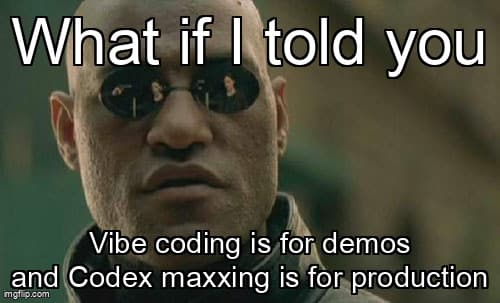
Vibe coding gets you to the first working demo fast. Codex maxxing gets you through the next twelve hours: the interrupted refactor, the Playwright suite that needs a real browser, the migration that fails on the third tenant, the agent that needs to come back tomorrow and know exactly what it already tried.
That is the professional jump. You are no longer asking an AI coding tool for a function. You are giving an agent a job with state, permissions, timeouts, tests, and evidence. The infrastructure around that job matters as much as the prompt. Stack Overflow's 2025 Developer Survey says 84% of respondents use or plan to use AI tools, while the same survey reports that developers are frustrated by answers that are almost right. In 2024, Stack Overflow also found that developers expected AI tools to be integrated into testing code at an 80% rate. The direction is obvious: AI is moving into test work, but trust depends on the rails.
This guide is for the indie developer or vibe coder who already uses AI to write code and is ready to run longer, safer workflows. We will build the rails for Codex-style work: a durable run queue, resumable checkpoints, Playwright evidence, CI budgets, and debugging habits that make the agent useful instead of mysterious. For a companion view on why testing rails matter for agent output quality, read our AI test infrastructure deep dive.
What problem does Codex maxxing actually solve?
Codex maxxing means turning an AI coding assistant into a durable worker: stateful, test-gated, resumable, observable, and constrained by production-grade rails.
The core problem is not code generation. It is unattended execution. A beginner workflow says, "write my login test." A professional workflow says, "claim this task, inspect the app, edit the smallest necessary files, run the relevant tests, capture failure artifacts, retry only known-transient operations, summarize the diff, and stop before making risky product decisions."
Long-running work fails differently from chat. A browser session expires. A CI runner kills a process after sixty minutes. A flaky selector passes locally and fails in Chromium. A model forgets that it already tried a patch. An API returns 429 after the agent has already created three external resources. If your only state is the conversation, you cannot reliably recover.
The upgrade path is simple but not casual: make every agent run a job in a system, not a wish in a chat box. Jobs need leases, checkpoints, artifacts, health checks, and review boundaries.
The architecture: four rails for long-running agent work
A strong agentic testing setup has four rails. First, a durable queue records what should be done and who owns the current lease. Second, a checkpoint store records progress in a shape that another worker can resume. Third, an evidence layer stores test output, traces, logs, screenshots, and videos. Fourth, a policy layer decides which failures can be retried and which require review.
| Vibe script | Professional agent rail | What breaks without it |
|---|---|---|
| One terminal command | Durable run queue with lease expiry | A crashed process leaves work stuck or duplicated |
| Prompt history as memory | Structured checkpoints per step | The next run repeats edits or misses partial state |
| Console output | Trace, video, screenshot, junit, and diff artifacts | Failures become arguments instead of evidence |
| Retry everything | Classified retry policy with hard stops | Agents hide real regressions behind noisy reruns |
This is also where testing moves from "does it pass" to "can I trust the run." Google's DORA 2024 research summarized that AI adoption improves individual productivity and flow, but can negatively affect delivery stability and throughput when fundamentals such as small batches and robust testing are weak. GitHub's Octoverse 2025 reports that nearly 80% of new developers on GitHub use Copilot within their first week. The lesson is not that agents are bad. It is that the default starting point now includes AI, so your testing infrastructure has to mature sooner.
How do you make an agent resume safely after a crash?
Resume safely by storing leases and checkpoints outside the agent process, then making every step idempotent before it touches code, browsers, or external systems.
The first production pattern is a durable run queue. The agent should not own work because a shell process exists. It should own work because a row says it has a lease until a concrete timestamp. If the process dies, another worker can reclaim the job after the lease expires. If the same worker wakes up, it reads the last checkpoint and continues from the next safe step.
// scripts/claim-agent-run.ts
import { mkdir, readFile, rename, writeFile } from "node:fs/promises";
import { dirname } from "node:path";
import crypto from "node:crypto";

type RunStatus = "queued" | "in_progress" | "completed" | "failed";

type AgentRun = {
  id: string;
  task: string;
  status: RunStatus;
  leaseOwner?: string;
  leaseExpiresAt?: string;
  checkpoint?: {
    step: "claimed" | "patched" | "tested" | "reported";
    branch?: string;
    lastError?: string;
    artifacts?: string[];
  };
};

const queuePath = process.env.AGENT_QUEUE_PATH ?? ".agent-runs/queue.json";
const workerId = process.env.WORKER_ID ?? crypto.randomUUID();
const leaseMs = Number(process.env.LEASE_MS ?? 15 * 60 * 1000);

async function readQueue(): Promise<AgentRun[]> {
  try {
    return JSON.parse(await readFile(queuePath, "utf8")) as AgentRun[];
  } catch (error) {
    if ((error as NodeJS.ErrnoException).code === "ENOENT") return [];
    throw new Error(`Could not read queue at ${queuePath}: ${(error as Error).message}`);
  }
}

async function writeQueue(runs: AgentRun[]) {
  await mkdir(dirname(queuePath), { recursive: true });
  const tmp = `${queuePath}.${process.pid}.tmp`;
  await writeFile(tmp, JSON.stringify(runs, null, 2));
  await rename(tmp, queuePath); // atomic on the same filesystem
}

function expired(run: AgentRun, now: Date) {
  return !run.leaseExpiresAt || Date.parse(run.leaseExpiresAt) <= now.getTime();
}

async function claimNextRun() {
  const now = new Date();
  const runs = await readQueue();
  const run = runs.find((candidate) => {
    if (candidate.status === "queued") return true;
    return candidate.status === "in_progress" && expired(candidate, now);
  });

  if (!run) {
    console.log(JSON.stringify({ claimed: false, reason: "no eligible runs" }));
    return;
  }

  const previousOwner = run.leaseOwner;
  run.status = "in_progress";
  run.leaseOwner = workerId;
  run.leaseExpiresAt = new Date(now.getTime() + leaseMs).toISOString();
  run.checkpoint ??= { step: "claimed" };

  await writeQueue(runs);

  console.log(
    JSON.stringify({
      claimed: true,
      runId: run.id,
      resumed: Boolean(previousOwner && previousOwner !== workerId),
      checkpoint: run.checkpoint,
    })
  );
}

claimNextRun().catch((error) => {
  console.error(JSON.stringify({ level: "error", message: error.message, workerId }));
  process.exitCode = 1;
});
The edge case in this example is a stale in-progress run. A naive script ignores it forever, so one crash blocks the queue. A safer worker treats expired leases as reclaimable and emits whether the run was resumed. The atomic rename matters too: if the process dies while writing, readers see either the old complete file or the new complete file, not half JSON.
Production-ready Playwright rails for agent edits
Once an agent can resume, it needs a narrow test contract. Long-running agents should not always run your entire suite. They should run a fast affected-test set first, then escalate to broader tests when the diff touches shared flows. For browser work, Playwright gives you the evidence primitives that agents need: traces, screenshots, videos, retries, and projects for multiple engines.
The next example is a realistic checkout smoke test designed for agent-generated patches. It handles three common edge cases: missing credentials, a slow payment iframe, and a product seed that was not created. It also records artifacts that another agent or reviewer can inspect without rerunning the test.
// tests/checkout.agent.spec.ts
import { expect, test } from "@playwright/test";

const baseURL = process.env.E2E_BASE_URL;
const email = process.env.E2E_BUYER_EMAIL;
const password = process.env.E2E_BUYER_PASSWORD;

test.describe("agent checkout smoke", () => {
  test.beforeAll(() => {
    const missing = [
      ["E2E_BASE_URL", baseURL],
      ["E2E_BUYER_EMAIL", email],
      ["E2E_BUYER_PASSWORD", password],
    ].filter(([, value]) => !value);

    if (missing.length) {
      throw new Error(
        `Missing required e2e env vars: ${missing.map(([name]) => name).join(", ")}`
      );
    }
  });

  test("guest-to-buyer checkout keeps cart state after agent patch", async ({ page }, testInfo) => {
    page.setDefaultTimeout(15_000);

    await test.step("open seeded product", async () => {
      const response = await page.goto(`${baseURL}/products/agent-smoke-sku`, {
        waitUntil: "domcontentloaded",
      });

      if (!response || response.status() === 404) {
        testInfo.attach("seed-debug", {
          body: Buffer.from(
            "Product agent-smoke-sku is missing. Run: pnpm seed:e2e -- --sku agent-smoke-sku"
          ),
          contentType: "text/plain",
        });
        throw new Error("Required checkout smoke product is missing");
      }

      expect(response.ok()).toBeTruthy();
      await expect(page.getByRole("heading", { name: /agent smoke product/i })).toBeVisible();
    });

    await test.step("add item and authenticate", async () => {
      await page.getByRole("button", { name: /add to cart/i }).click();
      await expect(page.getByTestId("cart-count")).toHaveText("1");

      await page.getByRole("link", { name: /checkout/i }).click();
      await page.getByLabel(/email/i).fill(email!);
      await page.getByLabel(/password/i).fill(password!);
      await page.getByRole("button", { name: /continue/i }).click();
      await expect(page.getByText(/shipping address/i)).toBeVisible();
    });

    await test.step("payment iframe reaches ready state", async () => {
      const frame = page.frameLocator('iframe[title="Secure payment"]');
      await expect(frame.getByLabel(/card number/i)).toBeVisible({ timeout: 30_000 });
      await frame.getByLabel(/card number/i).fill("4242424242424242");
      await frame.getByLabel(/expiry/i).fill("12/30");
      await frame.getByLabel(/cvc/i).fill("123");
    });

    await test.step("submit order and preserve evidence", async () => {
      await page.getByRole("button", { name: /place order/i }).click();
      await expect(page.getByRole("heading", { name: /thank you/i })).toBeVisible();
      await testInfo.attach("final-url", {
        body: Buffer.from(page.url()),
        contentType: "text/plain",
      });
    });
  });
});
The key is that the test tells the agent what failed. "Timeout 30000ms exceeded" is not enough. "Product seed is missing; run this seed command" is recoverable. "Payment iframe never reached ready state" points toward network, sandbox, or third-party isolation. When agents have precise failure contracts, they stop guessing at selectors and start fixing the actual environment.
CI budgets: let agents run long, not forever
A long-running workflow still needs a budget. CI is the right place to enforce that budget because it has clocks, cancellation, artifacts, and branch protection. Your goal is not to make agents pass by rerunning until the dashboard turns green. Your goal is to separate deterministic failures from transient infrastructure failures and make both visible.
# .github/workflows/agentic-e2e.yml
name: agentic-e2e

on:
  pull_request:
    paths:
      - "app/**"
      - "components/**"
      - "tests/**"
      - "playwright.config.ts"

concurrency:
  group: agentic-e2e-${{ github.event.pull_request.number || github.ref }}
  cancel-in-progress: true

jobs:
  affected-browser-tests:
    runs-on: ubuntu-latest
    timeout-minutes: 35
    env:
      E2E_BASE_URL: ${{ secrets.E2E_BASE_URL }}
      E2E_BUYER_EMAIL: ${{ secrets.E2E_BUYER_EMAIL }}
      E2E_BUYER_PASSWORD: ${{ secrets.E2E_BUYER_PASSWORD }}
    steps:
      - uses: actions/checkout@v4

      - uses: pnpm/action-setup@v4
        with:
          version: 9

      - uses: actions/setup-node@v4
        with:
          node-version: 22
          cache: pnpm

      - name: Install dependencies
        run: pnpm install --frozen-lockfile

      - name: Install browsers
        run: pnpm exec playwright install --with-deps chromium

      - name: Validate required secrets
        run: |
          missing=0
          for name in E2E_BASE_URL E2E_BUYER_EMAIL E2E_BUYER_PASSWORD; do
            if [ -z "${!name}" ]; then
              echo "::error::Missing required secret $name"
              missing=1
            fi
          done
          exit "$missing"

      - name: Run agent smoke tests
        id: tests
        run: pnpm exec playwright test tests/checkout.agent.spec.ts --project=chromium --reporter=line,junit

      - name: Upload Playwright report
        if: always()
        uses: actions/upload-artifact@v4
        with:
          name: playwright-agentic-report
          path: |
            playwright-report
            test-results
            junit.xml
          if-no-files-found: warn
          retention-days: 14

      - name: Explain next action on failure
        if: failure()
        run: |
          echo "Agentic E2E failed. Inspect trace.zip and junit.xml before asking an agent to patch selectors."
          echo "If the error is missing secrets or seed data, fix the environment instead of changing app code."
The edge case here is cancellation. Without a concurrency group, an agent can push three commits and leave three expensive browser jobs racing each other. With cancellation, the newest commit owns the check. The workflow also fails fast on missing secrets, which prevents the agent from interpreting an environment problem as an application regression.
Give the agent a failure classifier, not unlimited retries
Retries are useful only when they encode judgment. Browser disconnected? Retry once. Missing secret? Stop. Assertion mismatch? Stop and patch only if the diff explains the expected behavior. Third-party 502? Retry with backoff and mark the run as infrastructure-sensitive.
// scripts/classify-agent-failure.ts
import { readFile } from "node:fs/promises";

type Classification =
  | { action: "retry"; reason: string; maxAttempts: number; backoffMs: number }
  | { action: "stop"; reason: string; requiresHuman: boolean };

const transientPatterns = [
  /browser has been closed/i,
  /net::ERR_CONNECTION_RESET/i,
  /ECONNRESET/i,
  /502 Bad Gateway/i,
  /503 Service Unavailable/i,
];

const hardStopPatterns = [
  /Missing required .* env vars/i,
  /Missing required secret/i,
  /Product .* is missing/i,
  /expect\(.*\)\.toHaveText/i,
  /strict mode violation/i,
];

export function classifyFailure(log: string): Classification {
  if (hardStopPatterns.some((pattern) => pattern.test(log))) {
    return {
      action: "stop",
      reason: "Deterministic test or environment failure. Do not hide it with retries.",
      requiresHuman: /strict mode violation|toHaveText/i.test(log),
    };
  }

  if (transientPatterns.some((pattern) => pattern.test(log))) {
    return {
      action: "retry",
      reason: "Likely transient browser, network, or upstream service failure.",
      maxAttempts: 2,
      backoffMs: 10_000,
    };
  }

  return {
    action: "stop",
    reason: "Unknown failure class. Preserve artifacts and ask for review before patching.",
    requiresHuman: true,
  };
}

async function main() {
  const logPath = process.argv[2];
  if (!logPath) {
    throw new Error("Usage: tsx scripts/classify-agent-failure.ts <log-file>");
  }

  const log = await readFile(logPath, "utf8");
  const result = classifyFailure(log.slice(-80_000)); // edge case: huge CI logs
  console.log(JSON.stringify(result, null, 2));

  if (result.action === "stop") process.exitCode = result.requiresHuman ? 2 : 1;
}

main().catch((error) => {
  console.error(JSON.stringify({ action: "stop", reason: error.message, requiresHuman: true }));
  process.exitCode = 2;
});
This classifier is intentionally conservative. It does not pretend to understand your whole app. It gives the agent a default posture: retry known transient infrastructure, stop for deterministic product or environment failures, and preserve evidence when the failure is unknown. That is how you avoid the classic AI testing gotcha where a tool "fixes" a red test by weakening the assertion that protected the user.
Troubleshooting long-running agentic tests
Debugging agentic workflows is mostly about locating the broken rail. Did the job disappear from the queue? Did the lease expire while the browser was still running? Did Playwright fail because the app changed, the seed changed, or the agent changed a selector? Treat every failure as a system failure first, then narrow it to code.
- Symptom: duplicated pull requests. Check whether your claim step is idempotent and whether lease expiry is shorter than the longest test phase. Renew leases during long browser runs.
- Symptom: agent keeps changing selectors. Inspect trace screenshots and strict mode violations. Add stable role names or test ids before letting the agent rewrite tests.
- Symptom: CI passes on retry but fails locally.Compare browser versions, seed data, timezone, locale, and feature flags. Record them in the test output, not in a private note.
- Symptom: agent resumes from the wrong step. Store checkpoints after completed effects, not before them. A checkpoint that says "patched" before the file write commits is a lie.
- Symptom: useful artifacts are missing. Upload on `if: always()` and set `if-no-files-found: warn`. A failing test path often skips report generation unless you design for failure.
A practical debugging loop is: read the queue row, read the last checkpoint, open the CI artifact, classify the failure, then decide whether the next action is environment repair, product patch, test repair, or human review. For more hands-on setup guidance, use this Playwright AI testing guideas a baseline before adding multi-agent orchestration.
Edge cases that catch teams moving from scripts to agents
The first edge case is partial external state. If an agent creates a Stripe customer, sends a webhook, or opens a GitHub issue, rerunning the step can duplicate real-world effects. Store idempotency keys and external resource ids in the checkpoint. The second edge case is hidden global state: timezone, locale, viewport, cookies, and feature flags. Browser tests need to pin or report them because agents will otherwise chase nondeterminism in app code.
The third edge case is security. A long-running agent often needs secrets to test realistic flows, but it should not print them, write them into artifacts, or paste them into comments. Validate that secrets exist without echoing their values. Mask tokens in logs. Prefer short lived credentials for preview environments. The fourth edge case is cost: browser tests, model calls, and retries all compound. Put hard ceilings on runtime, attempts, and artifact retention.
The professional move is not trusting the agent more. It is making trust cheaper to verify: smaller scopes, better artifacts, explicit stop rules, and checkpoints another worker can read.
A practical migration plan from vibe scripts to agentic infrastructure
Start with one workflow that already hurts: a browser test suite, a dependency migration, or a repetitive bug-fix queue. Do not begin by building a platform. Put the work item in a JSON or database queue. Give each run a lease. Store the last completed step. Require the agent to upload artifacts before it reports success. Add one failure classifier. Then move the same pattern into CI.
Once that is stable, add affected-test selection. For frontend apps, map changed files to smoke tests and shared flows. For backend work, map changed modules to integration tests and contract tests. For migrations, map changed schemas to seed, rollback, and compatibility checks. The point is not perfect coverage. The point is a trustworthy first gate that gives the agent fast feedback without spending an hour on every edit.
Finally, separate authority from execution. Agents can run tests, collect evidence, make narrow patches, and explain tradeoffs. They should not silently relax assertions, delete coverage, rotate secrets, or merge code because a retry passed. Codex maxxing is powerful because it turns time into leverage. Testing rails make sure that leverage pushes in the right direction.
Ready to level up your dev toolkit?
Desplega.ai helps developers transition to professional tools smoothly with practical testing infrastructure for AI-assisted workflows.
Get StartedFrequently Asked Questions
Do I need Kubernetes before running agentic test workflows?
No. Start with one durable queue, one artifact directory, and one CI workflow. Add Kubernetes only when isolated browsers, concurrency, or tenant boundaries require it.
How long should a Codex-style agent run before checkpointing?
Checkpoint after every irreversible action: branch creation, file edit, test run, artifact upload, and external API call. Time-based checkpoints alone miss the real risk.
Should agents automatically fix every failing Playwright test?
No. Let agents propose or patch clear application defects, but require human review for selector rewrites, auth shortcuts, flaky waits, and behavior-changing fixes.
What is the first metric to track for long-running agents?
Track resumable completion rate: the percentage of runs that finish correctly after interruption. It exposes fragile state handling faster than raw runtime averages.
Related Posts
Cody's Repository Indexing: Does Cognitive Offloading Create Knowledge Gaps in Large Codebases? | Desplega AI
A practical deep dive into Cody repository indexing, context retrieval, and how indie hackers avoid AI-created knowledge gaps.
Hot Module Replacement: Why Your Dev Server Restarts Are Killing Your Flow State | desplega.ai
Stop losing 2-3 hours daily to dev server restarts. Master HMR configuration in Vite and Next.js to maintain flow state, preserve component state, and boost coding velocity by 80%.
The Flaky Test Tax: Why Your Engineering Team is Secretly Burning Cash | desplega.ai
Discover how flaky tests create a hidden operational tax that costs CTOs millions in wasted compute, developer time, and delayed releases. Calculate your flakiness cost today.