
Contract Testing: The Missing Link Between Unit and E2E Tests
Stop letting integration bugs slip through until E2E tests catch them—verify API contracts earlier, faster, and more reliably
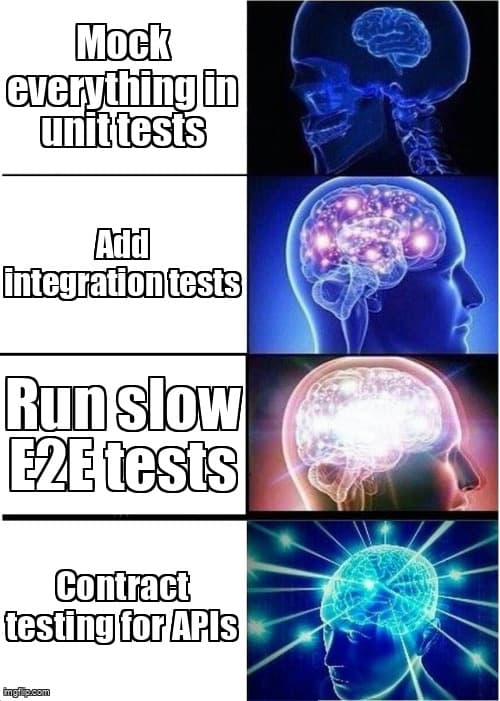
You've probably experienced this: your unit tests pass with flying colors using mocked dependencies, your E2E tests take 20 minutes to run and fail randomly, and somehow integration bugs still make it to production. The problem? There's a massive gap between testing components in isolation and testing the entire system end-to-end. Contract testing fills that gap.
Contract testing verifies that services can communicate with each other by testing the agreements (contracts) between them—without needing to spin up all your services or navigate through UI flows. It catches integration issues earlier than E2E tests while being far more reliable than mocked unit tests. Let's explore how this works and why it might be the missing piece in your testing strategy.
What Is Contract Testing?
Contract testing is a technique for testing integrations between services by verifying that both sides of an API boundary honor their agreement about request/response formats, status codes, headers, and data structures. Unlike integration tests that require running multiple services together, contract tests verify each service independently against a shared contract.
Think of it like this: when two teams agree to integrate their services, they're making promises about how their APIs will behave. The consumer team promises to send requests in a certain format, and the provider team promises to return responses matching an expected structure. Contract testing verifies both sides keep their promises—without requiring both teams to coordinate test environments.
The Testing Pyramid Gap
Traditional testing pyramids show unit tests at the base, integration tests in the middle, and E2E tests at the top. But there's often a missing layer between mocked unit tests and full integration tests. Contract testing occupies this critical middle ground: it tests integration points without the complexity and flakiness of running full integration environments.
When Contract Testing Provides Maximum Value
Contract testing shines in specific architectural contexts. Here's where you'll see the biggest benefits:
- Microservices architectures - Multiple teams own different services that communicate via APIs. Contract testing lets each team verify their service independently while ensuring compatibility.
- API-driven applications - Frontend consuming backend APIs, mobile apps calling REST/GraphQL endpoints, or third-party integrations where you control one side of the contract.
- Cross-team dependencies - When you depend on another team's API or when multiple consumers use your API, contract tests catch breaking changes before deployment.
- Frequent deployments - CI/CD pipelines benefit from fast contract tests that verify integrations without spinning up entire environments or running slow E2E suites.
Contract testing is less valuable when you have a monolithic application where all components deploy together, or when you have full control over both sides of an integration and can test them together easily. In those cases, integration tests might be simpler.
Consumer-Driven Contract Testing with Pact
The most popular approach to contract testing is consumer-driven contracts (CDC), where the consumer defines expectations and the provider verifies it can meet them. Pact is the leading framework for this pattern. Here's how it works in practice:
Step 1: Consumer Defines Expectations
The consumer (e.g., a frontend app or another microservice) writes tests that define what they expect from the provider's API:
// consumer/tests/user-service.pact.test.ts
import { PactV3 } from '@pact-foundation/pact';
import { getUserById } from '../api/userService';

const provider = new PactV3({
  consumer: 'FrontendApp',
  provider: 'UserService',
});

describe('User Service Contract', () => {
  it('retrieves a user by ID', () => {
    provider
      .given('user 123 exists')
      .uponReceiving('a request for user 123')
      .withRequest({
        method: 'GET',
        path: '/api/users/123',
        headers: { Accept: 'application/json' },
      })
      .willRespondWith({
        status: 200,
        headers: { 'Content-Type': 'application/json' },
        body: {
          id: 123,
          name: 'John Doe',
          email: 'john@example.com',
          status: 'active',
        },
      });

    return provider.executeTest(async (mockServer) => {
      const user = await getUserById(mockServer.url, 123);
      expect(user.id).toBe(123);
      expect(user.name).toBe('John Doe');
    });
  });
});
Running this test generates a contract file (a JSON pact) that describes the expected interaction. This is the agreement between consumer and provider.
Step 2: Publish the Contract
The consumer publishes the contract to a Pact Broker (a shared repository for contracts). This makes the contract available to the provider team:
# In your CI pipeline
pact-broker publish ./pacts \
  --consumer-app-version=${GIT_COMMIT} \
  --broker-base-url=https://pact-broker.mycompany.com \
  --broker-token=${PACT_BROKER_TOKEN}
Step 3: Provider Verifies the Contract
The provider (the User Service in this example) runs verification tests that replay the contract against their actual API:
// provider/tests/pact-verification.test.ts
import { Verifier } from '@pact-foundation/pact';
import { startServer, stopServer } from '../server';

describe('Pact Verification', () => {
  let server;

  beforeAll(async () => {
    server = await startServer();
  });

  afterAll(async () => {
    await stopServer(server);
  });

  it('validates the contract with FrontendApp', () => {
    return new Verifier({
      provider: 'UserService',
      providerBaseUrl: 'http://localhost:3001',
      pactBrokerUrl: 'https://pact-broker.mycompany.com',
      pactBrokerToken: process.env.PACT_BROKER_TOKEN,
      publishVerificationResult: true,
      providerVersion: process.env.GIT_COMMIT,
      // Setup state handlers
      stateHandlers: {
        'user 123 exists': () => {
          // Insert test data or mock database
          return database.insertUser({
            id: 123,
            name: 'John Doe',
            email: 'john@example.com',
            status: 'active',
          });
        },
      },
    }).verifyProvider();
  });
});
This test fetches the contract from the broker, starts the real User Service, and makes actual HTTP requests to verify the service responds as expected. If the provider makes a breaking change (like renaming status to userStatus), this test fails before deployment.
Reducing E2E Test Dependency
One of the biggest wins from contract testing is reducing reliance on flaky, slow E2E tests. Here's how contract testing changes your testing strategy:
Before Contract Testing
- Unit tests with mocked API responses (fast but don't catch integration issues)
- E2E tests that start all services, seed databases, navigate UI flows (slow, flaky, expensive to maintain)
- Integration bugs discovered late in staging or production
After Contract Testing
- Unit tests for business logic (still fast, still mocked)
- Contract tests verifying API integrations (fast, reliable, run in CI)
- Minimal E2E tests for critical user journeys only (reduced surface area)
- Integration bugs caught during PR review, not staging
This doesn't mean eliminating E2E tests entirely—you still need them for workflows that span multiple systems or involve complex UI interactions. But contract testing lets you catch most integration issues without waiting for the E2E suite to run.
Integrating Contract Testing into CI/CD
The real power of contract testing comes from integrating it into your deployment pipeline. Here's a typical workflow:
Consumer Pipeline
# .github/workflows/consumer-ci.yml
name: Consumer CI

on: [push, pull_request]

jobs:
  contract-test:
    runs-on: ubuntu-latest
    steps:
      - uses: actions/checkout@v3

      - name: Install dependencies
        run: npm ci

      - name: Run contract tests
        run: npm run test:pact

      - name: Publish contracts
        if: github.ref == 'refs/heads/main'
        run: |
          npm run pact:publish
        env:
          PACT_BROKER_TOKEN: ${{ secrets.PACT_BROKER_TOKEN }}
          GIT_COMMIT: ${{ github.sha }}

      - name: Can I deploy?
        run: |
          npx pact-broker can-i-deploy \
            --pacticipant FrontendApp \
            --version ${{ github.sha }} \
            --to-environment production
        env:
          PACT_BROKER_TOKEN: ${{ secrets.PACT_BROKER_TOKEN }}
Provider Pipeline
# .github/workflows/provider-ci.yml
name: Provider CI

on: [push, pull_request]

jobs:
  verify-contracts:
    runs-on: ubuntu-latest
    steps:
      - uses: actions/checkout@v3

      - name: Install dependencies
        run: npm ci

      - name: Verify contracts
        run: npm run test:pact:verify
        env:
          PACT_BROKER_TOKEN: ${{ secrets.PACT_BROKER_TOKEN }}
          GIT_COMMIT: ${{ github.sha }}

      - name: Can I deploy?
        if: github.ref == 'refs/heads/main'
        run: |
          npx pact-broker can-i-deploy \
            --pacticipant UserService \
            --version ${{ github.sha }} \
            --to-environment production
        env:
          PACT_BROKER_TOKEN: ${{ secrets.PACT_BROKER_TOKEN }}
The can-i-deploy command is crucial—it checks the Pact Broker to verify that this version of your service is compatible with all consumer versions currently deployed to production. This prevents breaking changes from reaching production.
Beyond Pact: Other Contract Testing Approaches
While Pact is the most popular CDC framework, it's not the only option. Depending on your architecture and constraints, consider:
- OpenAPI/Swagger validation - Tools like Dredd or Schemathesis test your API against an OpenAPI spec. Provider-driven approach where the API spec is the contract.
- Spring Cloud Contract - JVM-focused contract testing framework with strong support for REST and messaging. Good for Java/Kotlin microservices.
- Postman Contract Testing - Use Postman collections as contracts and run them in Newman (Postman's CLI) to verify APIs.
- GraphQL schema validation - For GraphQL APIs, the schema itself is the contract. Tools like GraphQL Inspector catch breaking schema changes.
The key principle remains the same: verify integration points independently without requiring coordinated test environments.
Common Pitfalls and How to Avoid Them
Pitfall #1: Testing Implementation Details
Problem: Contract tests that are too specific break with harmless changes (like adding optional fields or changing field order in JSON).
Solution: Use matchers for flexible contracts. Pact supports type matchers, regex matchers, and array matchers that verify structure without being brittle:
body: {
  id: like(123),              // Any number
  name: like('John Doe'),     // Any string
  email: term({
    matcher: '.*@.*',         // Regex match
    generate: 'john@example.com',
  }),
  createdAt: iso8601DateTime(), // ISO date format
}
Pitfall #2: Forgetting Provider States
Problem: Provider verification fails because the required test data doesn't exist (e.g., "user 123 exists").
Solution: Implement state handlers on the provider side that set up the expected test data before verification runs. Use test databases or in-memory stores—never modify production data.
Pitfall #3: Over-Reliance on Contract Tests
Problem: Assuming contract tests cover everything and eliminating all E2E tests.
Solution: Contract tests verify the shape of API interactions, not business logic. You still need E2E tests for critical flows, especially those involving multiple services coordinating state changes or complex user journeys.
Measuring the Impact
How do you know if contract testing is working? Track these metrics before and after adoption:
- Integration bugs in production - Should decrease as contract tests catch breaking changes before deployment
- CI pipeline duration - Contract tests run in seconds vs. minutes for E2E tests, speeding up feedback loops
- E2E test suite size - Should shrink as you replace integration-focused E2E tests with contracts
- Test flakiness rate - Contract tests are deterministic (no UI, no timing issues), reducing flaky test noise
- Cross-team coordination time - Teams can verify compatibility independently without scheduling integration testing sessions
A successful contract testing implementation typically sees 30-50% reduction in E2E test runtime and catches 60-80% of integration issues that previously slipped through to staging.
Getting Started: Your First Contract Test
Ready to try contract testing? Start small with a high-value integration:
- Pick one critical API integration - Choose a consumer-provider pair that changes frequently or has caused production issues
- Set up Pact on the consumer side - Install
@pact-foundation/pact, write one contract test covering the happy path - Run it locally - Verify the contract generates correctly and your consumer code passes the test
- Add provider verification - Set up the provider to verify against the generated contract, implement necessary state handlers
- Integrate into CI - Add contract testing to both pipelines, set up a Pact Broker (use PactFlow free tier or self-hosted)
- Expand coverage - Add error cases, edge cases, and additional interactions once the basic flow works
Don't try to contract-test everything at once. Prove value with one integration, then expand to other critical API boundaries.
Key Takeaways
- Contract testing fills the gap - It catches integration issues that unit tests miss and E2E tests catch too late, without the complexity of running full integration environments
- Consumer-driven contracts work best - Let consumers define expectations and providers verify them. Pact is the leading framework for this approach with excellent language support
- Integrate with CI/CD for safety - Use can-i-deploy checks to prevent breaking changes from reaching production. Run contract tests on every PR
- Reduce E2E dependency strategically - Contract tests don't replace E2E tests, but they let you focus E2E tests on critical user journeys instead of testing every integration point
- Start small and expand - Prove value with one high-risk integration before rolling out contract testing across all APIs. Track metrics to demonstrate impact
Contract testing is particularly powerful in microservices architectures where teams need to move independently without breaking each other. By verifying contracts continuously in CI, you catch integration issues during development—when they're cheapest to fix—instead of in staging or production where they cause outages and emergency rollbacks.
Ready to strengthen your test automation?
Desplega.ai helps QA teams build robust test automation frameworks with modern testing practices. Whether you're starting from scratch or improving existing pipelines, we provide the tools and expertise to catch bugs before production.
Start Your Testing TransformationRelated Posts
Cody's Repository Indexing: Does Cognitive Offloading Create Knowledge Gaps in Large Codebases? | Desplega AI
A practical deep dive into Cody repository indexing, context retrieval, and how indie hackers avoid AI-created knowledge gaps.
Hot Module Replacement: Why Your Dev Server Restarts Are Killing Your Flow State | desplega.ai
Stop losing 2-3 hours daily to dev server restarts. Master HMR configuration in Vite and Next.js to maintain flow state, preserve component state, and boost coding velocity by 80%.
The Flaky Test Tax: Why Your Engineering Team is Secretly Burning Cash | desplega.ai
Discover how flaky tests create a hidden operational tax that costs CTOs millions in wasted compute, developer time, and delayed releases. Calculate your flakiness cost today.