
Contract Testing: The Missing Layer Between Unit and E2E Tests
How consumer-driven contracts catch integration failures early without the overhead of end-to-end tests
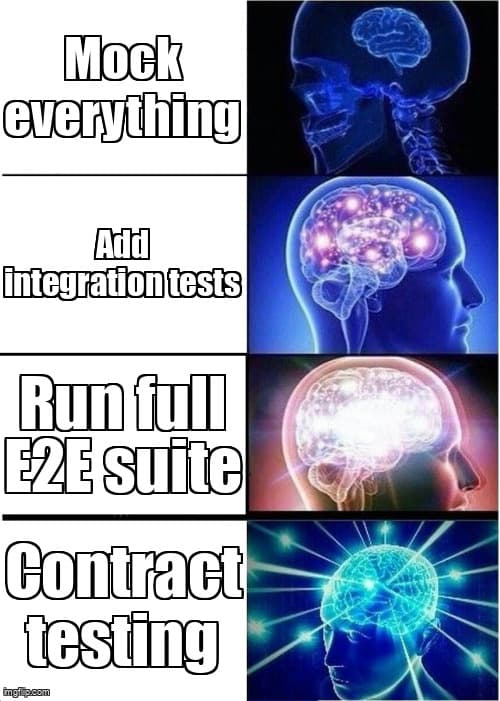
Your CI pipeline is slow. Your end-to-end tests fail randomly. You deploy a service update and three other teams report broken integrations. Sound familiar? This is the integration testing gap that contract testing was designed to solve.
Most testing pyramids show unit tests at the bottom, integration tests in the middle, and E2E tests at the top. But there's a missing piece: how do you validate API agreements between services without spinning up entire environments? Contract testing fills this gap by treating API interfaces as executable contracts that both consumers and providers must honor.
The Integration Testing Problem
Traditional integration testing approaches force you into a difficult trade-off:
- Mock everything - Fast but brittle. Your mocks drift from reality, and you miss breaking changes until production.
- Test against real services - Accurate but slow. Your test suite requires orchestrating multiple services, dealing with test data, and debugging environmental issues.
- Run full E2E tests - Comprehensive but expensive. Tests take 20+ minutes, fail unpredictably, and require dedicated infrastructure.
Contract testing offers a fourth option: validate the interface agreement without requiring both sides to run simultaneously. Think of it as a handshake protocol that can be verified independently by each party.
How Contract Testing Works
Contract testing follows a consumer-driven approach where the consumer (the service making API calls) defines its expectations as a contract. This contract is then verified against the provider (the service implementing the API).
The Contract Testing Workflow
- Consumer defines expectations - Write tests that describe what you expect from the API (structure, fields, status codes)
- Generate contract file - The testing framework captures these expectations into a JSON contract
- Share the contract - Publish to a broker or repository where providers can access it
- Provider verifies contract - Run the contract against the actual API implementation to verify compliance
- Both sides stay in sync - Any breaking change fails verification before deployment
Practical Example with Pact
Let's walk through a realistic example: an order service that calls a payment service. Here's how you'd write a consumer contract test using Pact (JavaScript):
// Consumer: Order Service
import { PactV3, MatchersV3 } from '@pact-foundation/pact';

const provider = new PactV3({
  consumer: 'OrderService',
  provider: 'PaymentService',
});

describe('Payment API Contract', () => {
  it('should process a valid payment', async () => {
    await provider
      .given('payment gateway is operational')
      .uponReceiving('a request to process payment')
      .withRequest({
        method: 'POST',
        path: '/api/payments',
        headers: { 'Content-Type': 'application/json' },
        body: {
          orderId: MatchersV3.string('order-123'),
          amount: MatchersV3.decimal(99.99),
          currency: 'EUR',
        },
      })
      .willRespondWith({
        status: 201,
        headers: { 'Content-Type': 'application/json' },
        body: {
          transactionId: MatchersV3.uuid(),
          status: 'approved',
          timestamp: MatchersV3.iso8601DateTime(),
        },
      })
      .executeTest(async (mockServer) => {
        // Your actual API client code
        const result = await paymentClient.process({
          orderId: 'order-123',
          amount: 99.99,
          currency: 'EUR',
        });

        expect(result.status).toBe('approved');
      });
  });
});
Notice what's happening here: you're not mocking the entire payment service. You're defining a contract that describes exactly what you expect from it. Pact captures this and generates a JSON file that looks like this:
{
  "consumer": { "name": "OrderService" },
  "provider": { "name": "PaymentService" },
  "interactions": [
    {
      "description": "a request to process payment",
      "request": {
        "method": "POST",
        "path": "/api/payments",
        "body": {
          "orderId": "order-123",
          "amount": 99.99,
          "currency": "EUR"
        }
      },
      "response": {
        "status": 201,
        "body": {
          "transactionId": "matching(regex, uuid)",
          "status": "approved",
          "timestamp": "matching(regex, iso8601)"
        }
      }
    }
  ]
}
Verifying the Contract on the Provider Side
Now the payment service team needs to verify they comply with this contract. They don't need to coordinate with the order service team or wait for their code. They just run verification tests:
// Provider: Payment Service
const { Verifier } = require('@pact-foundation/pact');

describe('Payment Service Contract Verification', () => {
  it('validates the contract from OrderService', async () => {
    const server = startPaymentService(); // Start your actual service

    await new Verifier({
      provider: 'PaymentService',
      providerBaseUrl: 'http://localhost:3001',
      pactUrls: ['./pacts/OrderService-PaymentService.json'],
      stateHandlers: {
        'payment gateway is operational': async () => {
          // Setup: ensure gateway is ready
          await mockPaymentGateway.enable();
        },
      },
    }).verifyProvider();

    server.close();
  });
});
This verification test runs the consumer's expectations against the real provider implementation. If the payment service makes a breaking change (like renaming transactionId to paymentId), this test fails immediately. No need for end-to-end tests to catch it.
Contract Testing vs Other Testing Approaches
| Approach | Speed | Reliability | Coverage | Best For |
|---|---|---|---|---|
| Unit Tests | ⚡ Fast | ✅ High | Business logic | Internal functions |
| Contract Tests | ⚡ Fast | ✅ High | API interfaces | Service boundaries |
| Integration Tests | 🐢 Slow | ⚠️ Medium | Multi-service flows | Critical paths |
| E2E Tests | 🐌 Very Slow | ❌ Low (flaky) | Full user journeys | Smoke tests |
Contract tests sit in the sweet spot: fast enough to run on every commit, reliable enough to trust in CI, and focused enough to pinpoint interface issues without the complexity of full integration testing.
Implementing Contract Testing in Your Pipeline
For contract testing to work effectively in a microservices architecture, you need infrastructure to share and verify contracts. Here's a typical setup:
Using a Pact Broker
The Pact Broker is a central repository where consumers publish contracts and providers verify against them. It tracks which versions are compatible and prevents breaking changes from reaching production.
# Consumer CI Pipeline (Order Service)
1. Run consumer tests → generates contract
2. Publish contract to broker:
   pact-broker publish ./pacts \
     --consumer-app-version $GIT_SHA \
     --broker-base-url https://pact-broker.company.com

# Provider CI Pipeline (Payment Service)
1. Fetch contracts from broker
2. Run verification tests against real service
3. Publish verification results:
   pact-broker publish-verification-results \
     --provider-app-version $GIT_SHA \
     --broker-base-url https://pact-broker.company.com

# Deployment Gate
- Check "can-i-deploy" before releasing:
  pact-broker can-i-deploy \
    --pacticipant PaymentService \
    --version $GIT_SHA \
    --to production
Common Pitfalls and How to Avoid Them
Contract testing is powerful, but teams often stumble on these issues:
- Over-specifying contracts - Don't verify exact values unless they're truly fixed. Use matchers (type checks, regex patterns) instead of hardcoded assertions. If your contract expects
transactionId: "abc-123"instead oftransactionId: MatchersV3.uuid(), you're making it brittle. - Forgetting provider states - Contracts often depend on preconditions ("given user exists"). Provider verification must set up these states or tests will fail unpredictably. Use state handlers to reset databases or mock external dependencies.
- Testing business logic - Contracts verify interfaces, not behavior. Don't test that payments are actually charged or orders are fulfilled—that's for integration tests. Only verify that the API response structure matches expectations.
- Skipping broker setup - Manually sharing JSON files doesn't scale. Invest in a Pact Broker (or Pactflow) from day one to enable proper versioning and deployment gates.
When to Use Contract Testing
Contract testing shines in these scenarios:
- Microservices architectures - Multiple teams owning services that talk via APIs
- API versioning challenges - Need confidence when deprecating old endpoints
- Slow integration tests - Replacing brittle E2E tests with faster, focused contract checks
- Distributed teams - Consumers and providers working independently without tight coordination
Contract testing is less useful when:
- You have a monolithic application (traditional integration tests work fine)
- APIs are tightly coupled and change together (refactoring both sides simultaneously)
- You need to test complex workflows involving data transformations across services
Alternative Tools: Spring Cloud Contract
While Pact is the most popular contract testing framework, teams using Spring Boot often prefer Spring Cloud Contract. It follows a provider-driven approach where the provider defines contracts using Groovy DSL or YAML, then generates consumer stubs automatically.
// Provider: Payment Service Contract (Groovy DSL)
Contract.make {
    description "Process a valid payment"
    request {
        method POST()
        url "/api/payments"
        headers {
            contentType(applicationJson())
        }
        body(
            orderId: "order-123",
            amount: 99.99,
            currency: "EUR"
        )
    }
    response {
        status 201
        headers {
            contentType(applicationJson())
        }
        body(
            transactionId: uuid(),
            status: "approved",
            timestamp: isoDateTime()
        )
    }
}
Spring Cloud Contract generates WireMock stubs from these contracts, which consumers can use in their tests. The trade-off: provider-driven means providers define what they offer (less consumer influence), but setup is simpler for Java teams already using Spring Boot.
Key Takeaways
- Contract testing validates API agreements independently - No need for both services to run simultaneously, eliminating orchestration complexity and environmental issues.
- Consumer-driven contracts shift left - Integration failures are caught in minutes during CI, not hours later in E2E tests or days later in production.
- Fast, reliable, focused - Contract tests run in seconds, don't require infrastructure setup, and pinpoint exact interface mismatches without the flakiness of E2E tests.
- Use a Pact Broker for production readiness - Mature teams need versioning, deployment gates, and compatibility matrices that only brokers provide at scale.
- Complement, don't replace - Contract tests belong between unit and integration tests in your pyramid. You still need some E2E smoke tests and integration tests for complex workflows.
Contract testing won't eliminate all integration issues, but it dramatically reduces the feedback loop. Instead of discovering a breaking API change when QA tests the staging environment three days later, your provider's CI pipeline fails within 10 minutes of the commit. That's the difference between a quick revert and a production incident.
Ready to strengthen your test automation?
Desplega.ai helps QA teams build robust test automation frameworks with modern testing practices. Whether you're starting from scratch or improving existing pipelines, we provide the tools and expertise to catch bugs before production.
Start Your Testing TransformationRelated Posts
Hot Module Replacement: Why Your Dev Server Restarts Are Killing Your Flow State | desplega.ai
Stop losing 2-3 hours daily to dev server restarts. Master HMR configuration in Vite and Next.js to maintain flow state, preserve component state, and boost coding velocity by 80%.
The Flaky Test Tax: Why Your Engineering Team is Secretly Burning Cash | desplega.ai
Discover how flaky tests create a hidden operational tax that costs CTOs millions in wasted compute, developer time, and delayed releases. Calculate your flakiness cost today.
The QA Death Spiral: When Your Test Suite Becomes Your Product | desplega.ai
An executive guide to recognizing when quality initiatives consume engineering capacity. Learn to identify test suite bloat, balance coverage vs velocity, and implement pragmatic quality gates.