
Contract Testing: The Missing Link in Microservices Quality Assurance
How consumer-driven contracts catch API breaking changes before deployment—without the brittleness of integration tests
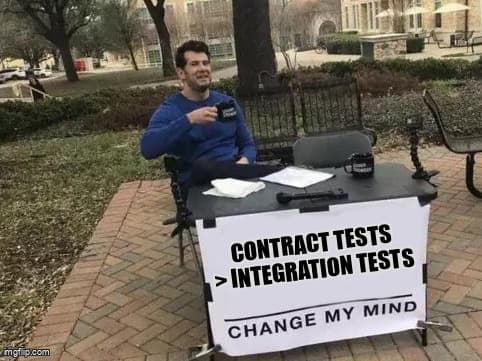
Your integration test suite takes 45 minutes to run. Half the tests fail randomly due to timing issues or environment quirks. You add retries, bump timeouts, and eventually your team starts ignoring failures. Meanwhile, a breaking API change slips through and crashes production at 3 AM.
This is the integration testing trap in microservices architectures. According to the 2025 State of DevOps Report, 58% of teams using microservices cite integration testing as their biggest quality bottleneck. The traditional pyramid model—unit tests at the base, integration in the middle, end-to-end at the top—breaks down when you have 20+ services talking to each other.
Contract testing solves this by shifting API validation left without requiring full service deployments. This guide shows you how to implement contract testing with Pact and Spring Cloud Contract, integrate it into CI/CD pipelines, and use it strategically alongside integration and end-to-end tests.
What is contract testing?
Contract testing validates service interactions by verifying that consumers and providers agree on API contracts through independent, isolated tests that run without actual service deployments.
In a microservices architecture, services interact through APIs. The consumer (service making requests) expects specific request/response formats. The provider (service handling requests) implements those endpoints. A contract is the formal agreement between them: request format, response structure, status codes, and headers.
Traditional integration testing validates this by starting both services and making real HTTP calls. Contract testing takes a different approach:
- Consumer defines expectations - The consumer team writes contract tests describing what they expect from the provider API
- Contract is published - These expectations are serialized into a contract file (usually JSON) and stored in a contract broker
- Provider verifies contract - The provider team runs tests against the contract to ensure their implementation matches consumer expectations
- Both sides run independently - No services need to be deployed together, eliminating environment complexity
According to Pact Foundation benchmarks (2025), contract tests run 15-20x faster than equivalent integration tests because they eliminate service startup time, network latency, and external dependencies.
Consumer-Driven vs Provider-Driven Contracts
Contract testing has two philosophical approaches with different trade-offs for governance and development velocity.
| Aspect | Consumer-Driven (Pact) | Provider-Driven (Spring Cloud Contract) |
|---|---|---|
| Who defines contract | Consumer teams write expectations | Provider team defines contract specification |
| Governance model | Bottom-up, consumer needs drive API | Top-down, provider controls API surface |
| Breaking change detection | Provider CI fails if consumer contracts break | Stubs distributed to consumers for testing |
| Best for | Autonomous teams, polyglot services | Spring Boot ecosystems, API governance |
| Learning curve | Steeper (Pact broker setup required) | Easier for Spring developers (DSL familiar) |
Consumer-driven contracts prioritize consumer autonomy. If your team needs a new field in the API response, you add it to your contract tests. The provider team sees the updated contract in CI and implements the field. This works well for organizations with autonomous product teams.
Provider-driven contracts prioritize API stability. The provider team defines the contract specification upfront. Consumers generate test stubs from this specification. Changes require provider approval. This works well when you need strong API governance or have many external consumers.
Implementing Contract Testing with Pact
Pact is the most widely adopted contract testing framework, supporting 10+ languages and consumer-driven workflows. Here's how to implement it for a frontend consuming a backend API.
Scenario: User Service API
Your React frontend calls a Node.js backend to fetch user profiles. You need to ensure the API contract stays stable across both teams' deployments.
Step 1: Consumer writes contract test (Frontend team)
// frontend/tests/user-service.pact.spec.ts
import { PactV3 } from '@pact-foundation/pact';
import { getUser } from '../services/userService';

const provider = new PactV3({
  consumer: 'FrontendApp',
  provider: 'UserService',
});

describe('User Service Contract', () => {
  it('retrieves user profile by ID', async () => {
    await provider
      .given('user 123 exists')
      .uponReceiving('a request for user 123')
      .withRequest({
        method: 'GET',
        path: '/users/123',
        headers: { 'Authorization': 'Bearer token' },
      })
      .willRespondWith({
        status: 200,
        headers: { 'Content-Type': 'application/json' },
        body: {
          id: 123,
          name: 'Alice',
          email: 'alice@example.com',
          role: 'admin',
        },
      });

    await provider.executeTest(async (mockServer) => {
      const user = await getUser(123, mockServer.url);
      expect(user.name).toBe('Alice');
      expect(user.role).toBe('admin');
    });
  });
});
When this test runs, Pact generates a contract file (JSON) describing the expected interaction. The consumer team publishes this contract to a Pact Broker.
Step 2: Provider verifies contract (Backend team)
// backend/tests/user-service.pact.spec.ts
import { Verifier } from '@pact-foundation/pact';
import { startServer } from '../src/server';

describe('User Service Provider Verification', () => {
  let server;

  before(async () => {
    server = await startServer(3001);
  });

  it('validates contracts from FrontendApp', async () => {
    const verifier = new Verifier({
      providerBaseUrl: 'http://localhost:3001',
      pactBrokerUrl: 'https://pact-broker.company.com',
      provider: 'UserService',
      publishVerificationResult: true,
      providerVersion: process.env.GIT_COMMIT,
    });

    await verifier.verifyProvider();
  });

  after(() => server.close());
});
The provider verification test starts the actual backend service and replays the consumer's expected requests against it. If the provider implementation matches the contract (returns correct status, headers, body structure), verification passes. If it fails, the provider CI pipeline fails, preventing deployment of breaking changes.
Step 3: Integrate with CI/CD pipeline
# .github/workflows/provider-verification.yml
name: Provider Contract Verification

on: [push, pull_request]

jobs:
  verify-contracts:
    runs-on: ubuntu-latest
    steps:
      - uses: actions/checkout@v3

      - name: Setup Node.js
        uses: actions/setup-node@v3
        with:
          node-version: '18'

      - name: Install dependencies
        run: npm ci

      - name: Run provider verification
        env:
          PACT_BROKER_URL: ${{ secrets.PACT_BROKER_URL }}
          PACT_BROKER_TOKEN: ${{ secrets.PACT_BROKER_TOKEN }}
          GIT_COMMIT: ${{ github.sha }}
        run: npm run test:pact:verify

      - name: Can I deploy?
        run: |
          npx pact-broker can-i-deploy \
            --pacticipant UserService \
            --version ${{ github.sha }} \
            --to production
The "can-i-deploy" check prevents deployment unless all consumer contracts pass verification. This is the critical safety net that catches breaking changes before production.
Spring Cloud Contract for JVM Ecosystems
Spring Cloud Contract is ideal for teams standardized on Spring Boot. It uses a provider-first approach where the provider team defines contracts using a Groovy or YAML DSL, then generates stubs for consumers.
Provider defines contract:
// src/test/resources/contracts/user-service/getUser.groovy
package contracts

import org.springframework.cloud.contract.spec.Contract

Contract.make {
    description "Should return user profile by ID"

    request {
        method GET()
        url '/users/123'
        headers {
            header('Authorization', 'Bearer token')
        }
    }

    response {
        status 200
        headers {
            contentType(applicationJson())
        }
        body([
            id: 123,
            name: 'Alice',
            email: 'alice@example.com',
            role: 'admin'
        ])
    }
}
Spring Cloud Contract auto-generates verification tests for the provider and publishes stub JARs to Maven/Artifactory. Consumer teams import these stubs as test dependencies:
// Consumer pom.xml
<dependency>
    <groupId>com.company</groupId>
    <artifactId>user-service-stubs</artifactId>
    <version>1.2.3</version>
    <classifier>stubs</classifier>
    <scope>test</scope>
</dependency>

// Consumer test using WireMock stub
@AutoConfigureStubRunner(
    ids = "com.company:user-service:+:stubs:8080",
    stubsMode = StubRunnerProperties.StubsMode.LOCAL
)
class UserServiceConsumerTest {

    @Test
    void shouldFetchUserProfile() {
        // Stub server runs on localhost:8080
        User user = userClient.getUser(123);
        assertThat(user.getName()).isEqualTo("Alice");
    }
}
This approach works exceptionally well for Spring Boot shops with centralized artifact repositories. The trade-off is less consumer autonomy compared to Pact's consumer-driven model.
When to Use Contract Tests vs Integration vs E2E
Contract testing fills a specific gap in the testing pyramid. Understanding when to use each type prevents both under-testing and over-testing.
| Test Type | What It Validates | When to Use | Typical Count |
|---|---|---|---|
| Unit | Function logic, business rules | All core logic paths | 100s-1000s |
| Contract | API interface compatibility | Every external service dependency | 8-15 per service pair |
| Integration | Database, external API behavior | Complex queries, third-party integrations | 20-50 total |
| End-to-End | Critical user workflows | Happy paths, smoke tests | 5-10 total |
Use contract tests when:
- You control both consumer and provider (internal microservices)
- You need fast feedback on API changes without deploying services
- Integration tests are flaky due to environment setup complexity
- You have polyglot services (different languages) requiring language-agnostic validation
Do NOT use contract tests when:
- Testing third-party APIs you don't control (use mocks or VCR-style recordings)
- Validating complex business logic spanning multiple services (use E2E tests)
- Testing database queries or ORM behavior (use integration tests with test databases)
- You need to verify UI rendering or browser behavior (use E2E tests like Playwright)
Real-World Example: E-Commerce Checkout
Unit tests: Validate tax calculation logic, discount application rules
Contract tests: Verify payment service API (request format, response codes, error handling)
Integration tests: Test order persistence to PostgreSQL, inventory updates via message queue
E2E tests: Complete checkout flow from cart to confirmation page (1-2 critical paths)
Common Contract Testing Pitfalls
Contract testing introduces new failure modes that teams encounter during adoption. Here are the most common issues and solutions.
1. Over-specifying contracts
Teams new to contract testing often specify every field in API responses, including fields the consumer doesn't use. This creates brittle contracts that break when providers add optional fields.
// ❌ Bad: Specifies all fields
willRespondWith({
  status: 200,
  body: {
    id: 123,
    name: 'Alice',
    email: 'alice@example.com',
    createdAt: '2026-01-15T10:00:00Z',
    updatedAt: '2026-01-30T08:30:00Z',
    lastLoginIp: '192.168.1.1',
    preferences: { theme: 'dark' }
  }
});

// ✅ Good: Specifies only what consumer needs
willRespondWith({
  status: 200,
  body: {
    id: like(123),
    name: like('Alice'),
    email: regex('.*@.*', 'alice@example.com')
  }
});
Use Pact's matchers (like(), regex(), eachLike()) to specify type expectations rather than exact values. This allows providers to add fields without breaking consumer contracts.
2. Ignoring contract versioning
When making breaking changes, teams forget to version contracts or coordinate deployments, causing production failures. Always use API versioning for breaking changes:
// Old contract (v1)
GET /users/123 → { id, name, email }

// New contract (v2) - breaking change (renamed field)
GET /v2/users/123 → { id, fullName, email }

// Support both during migration period
// Deprecate v1 after all consumers migrate
3. Forgetting provider states
Provider states set up test data before verification runs. Forgetting to implement provider states causes verification failures even when the API works correctly:
// Provider state setup
const stateHandlers = {
  'user 123 exists': async () => {
    await db.users.insert({ id: 123, name: 'Alice', email: 'alice@example.com' });
  },
  'user 999 does not exist': async () => {
    await db.users.deleteById(999);
  }
};
Measuring Contract Testing Success
Track these metrics to evaluate contract testing effectiveness:
- Contract coverage - Percentage of service-to-service interactions covered by contracts (target: 80%+ of critical paths)
- Breaking change detection rate - How many breaking changes caught in CI vs production (target: 95%+ caught pre-deployment)
- CI pipeline speed - Compare contract test execution time vs integration tests (contract tests should be 10-20x faster)
- False positive rate - Contract verification failures that aren't real issues (target: <5%)
According to the 2025 DevOps Research Assessment, teams with mature contract testing practices deploy 3.2x more frequently while reducing API-related production incidents by 67% compared to teams relying solely on integration tests.
Key Takeaways
- Contract testing validates API contracts independently - No need to deploy full service environments, making tests 10-20x faster than integration tests
- Choose consumer-driven (Pact) for autonomy, provider-driven (Spring Cloud Contract) for governance - Pact works best for polyglot microservices; Spring Cloud Contract excels in Spring Boot ecosystems
- Use contract tests for API compatibility, not business logic - Complement with unit tests for logic, integration tests for databases, and E2E tests for critical workflows
- Integrate "can-i-deploy" checks in CI/CD - Prevent deployment of breaking changes by verifying all consumer contracts pass before promoting to production
- Avoid over-specification - Use matchers to specify type expectations, not exact values, allowing providers to evolve APIs without breaking consumers
Ready to strengthen your test automation?
Desplega.ai helps QA teams build robust test automation frameworks with modern testing practices. Whether you're starting from scratch or improving existing pipelines, we provide the tools and expertise to catch bugs before production.
Start Your Testing TransformationFrequently Asked Questions
What is contract testing in microservices?
Contract testing validates that service interactions match agreed-upon API contracts. It catches breaking changes before deployment by verifying both consumer expectations and provider implementations independently.
How does contract testing differ from integration testing?
Contract tests run in isolation without starting actual services, making them 10-20x faster. Integration tests require full service deployments and external dependencies, leading to brittleness and longer CI times.
When should I use Pact vs Spring Cloud Contract?
Use Pact for polyglot microservices (different languages) with flexible consumer-driven workflows. Use Spring Cloud Contract for Spring Boot ecosystems with strong provider-first governance requirements.
How many contract tests should I write?
Cover all critical API endpoints used by consumers. Typical microservices have 8-15 contract tests per service pair. Focus on happy paths and essential error scenarios, not exhaustive edge cases.
Can contract testing replace end-to-end tests?
No. Contract tests verify service interfaces, not business workflows. Maintain 5-10 critical end-to-end tests for user journeys while using contract tests for comprehensive API coverage.
Related Posts
Hot Module Replacement: Why Your Dev Server Restarts Are Killing Your Flow State | desplega.ai
Stop losing 2-3 hours daily to dev server restarts. Master HMR configuration in Vite and Next.js to maintain flow state, preserve component state, and boost coding velocity by 80%.
The Flaky Test Tax: Why Your Engineering Team is Secretly Burning Cash | desplega.ai
Discover how flaky tests create a hidden operational tax that costs CTOs millions in wasted compute, developer time, and delayed releases. Calculate your flakiness cost today.
The QA Death Spiral: When Your Test Suite Becomes Your Product | desplega.ai
An executive guide to recognizing when quality initiatives consume engineering capacity. Learn to identify test suite bloat, balance coverage vs velocity, and implement pragmatic quality gates.