Architecting Distributed System Tests with Playwright: Event Patterns Without Flaky Integration Hells
Stop testing distributed systems as if every service were a synchronous function call; build tests around observable contracts, queues, and failure boundaries.
Distributed systems break the mental model most UI test suites were built on. A user clicks "Pay", the frontend receives a 202, the order service emits an event, the payment service consumes it, inventory reserves stock, notification sends an email, and the UI eventually shows "Confirmed". If your Playwright or Cypress test treats that chain like one synchronous controller action, the test will become a rerun machine.
The problem is not that integration tests are bad. The problem is that many teams write one browser test that verifies the UI, HTTP API, broker, database, downstream service, retry policy, and email provider in a single assertion. When any link is late, duplicated, or temporarily unavailable, the browser test owns the failure even when the product is working as designed. That is the path from useful end-to-end coverage to flaky integration hell.
The stakes are real. The Stack Overflow 2024 Developer Survey reports 65,437 respondents, and 61% said they spend more than 30 minutes a day searching for answers or solutions. The CD Foundation 2024 State of CI/CD Report says 83% of developers report being involved in DevOps-related activities. In other words: debugging time and delivery pipelines are not QA side quests. They are core engineering economics.
This article gives you a practical architecture for testing event-driven systems with Playwright, Cypress, or Selenium-style browser automation. It pairs browser tests with event contracts, durable test probes, and failure injection so you can prove the workflow without coupling every test to the live topology. For more browser-level stability work, pair this with our Cypress vs Playwright flaky test deep dive and our guide to speeding up flaky Playwright suites.
Why do distributed integration tests become flaky?
They fail when tests assert immediate consistency against systems that intentionally process work asynchronously and at least once.
Event-driven systems trade direct request-response simplicity for resilience and throughput. A producer writes an event to a broker. Consumers process independently. Delivery is commonly at least once, so duplicates are valid. Ordering may only be guaranteed inside a partition, not globally. Consumers may retry with backoff, dead-letter invalid messages, or rebuild state from an event log. These are system features, not bugs. A test that assumes the confirmation row appears immediately after clicking a button is testing against the wrong consistency model.
Good distributed test architecture separates three questions: did the user action happen, was the correct integration contract produced, and did the user-visible outcome eventually become observable? A browser test is excellent for the first and third. Contract and probe tests are better for the middle. Mixing all three into a single chain makes failures noisy because the red test cannot tell you whether the selector broke, the event schema changed, the consumer lagged, or the payment sandbox timed out.
The architecture: event contracts plus observable probes
The stable pattern is a triangle. First, the UI test performs the user action and observes a correlation ID. Second, a test harness exposes a read-only view of event flow for that correlation ID. Third, contract tests validate payloads independently of the browser. The browser does not subscribe directly to Kafka, RabbitMQ, SQS, or Pub/Sub. It asks a test-only API what the system observed. That one boundary turns a fragile sleep into a debuggable wait.
| Test concern | Flaky anti-pattern | Event-driven pattern |
|---|---|---|
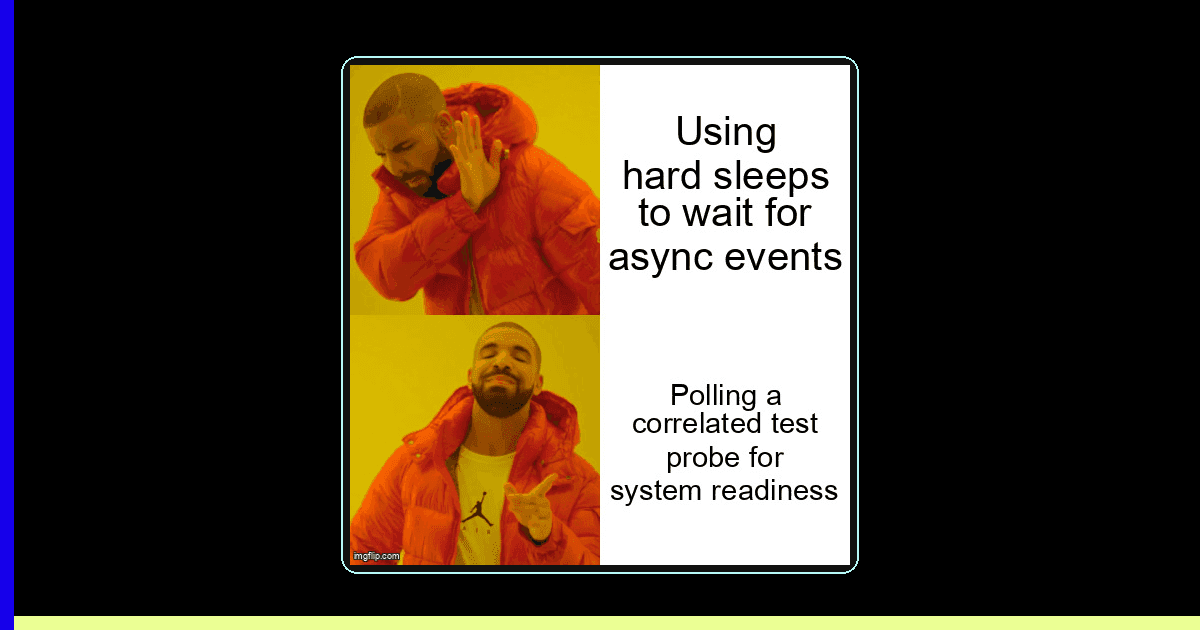
| Workflow completion | Hard wait, then assert final DOM state | Poll a correlated probe and assert UI after readiness |
| Payload shape | Infer from final UI text | Validate CloudEvents or domain schema with AJV |
| Downstream failure | Depend on real third-party outage behavior | Inject a controlled consumer or API failure |
| Duplicates | Assume exactly one event | Assert idempotent state with duplicate-safe checks |
This is also where framework choice matters less than topology. Playwright has excellent API request fixtures and tracing. Cypress has strong in-browser debugging and network interception. Selenium can still fit enterprise grids. None of them can make an eventually consistent system immediate. Your architecture has to expose the right signals.
Production example 1: Playwright waits on a correlated event probe
This Playwright test models a checkout flow. It does not sleep after payment. It extracts a correlation ID from the UI, polls a test harness endpoint, handles malformed probe responses, tolerates duplicate events, and fails with useful diagnostics when the expected event never appears. The harness endpoint should be read-only and enabled only in non-production environments.
import { test, expect, APIRequestContext } from '@playwright/test'

type ProbeEvent = {
  id: string
  type: string
  correlationId: string
  createdAt: string
  payload: Record<string, unknown>
}

async function waitForEvent(
  request: APIRequestContext,
  correlationId: string,
  expectedType: string,
  timeoutMs = 30000,
): Promise<ProbeEvent> {
  const deadline = Date.now() + timeoutMs
  const seenIds = new Set<string>()
  let lastError = 'no probe response yet'

  while (Date.now() < deadline) {
    const response = await request.get('/__test/events', {
      params: { correlationId, type: expectedType },
      timeout: 5000,
    })

    if (!response.ok()) {
      lastError = 'probe returned HTTP ' + response.status()
      await new Promise((resolve) => setTimeout(resolve, 500))
      continue
    }

    let events: ProbeEvent[]
    try {
      events = await response.json()
    } catch (error) {
      lastError = 'probe returned invalid JSON: ' + String(error)
      await new Promise((resolve) => setTimeout(resolve, 500))
      continue
    }

    for (const event of events) {
      if (seenIds.has(event.id)) continue
      seenIds.add(event.id)

      if (event.correlationId !== correlationId) {
        lastError = 'probe leaked event for correlation ' + event.correlationId
        continue
      }

      if (event.type === expectedType) return event
    }

    lastError = 'saw ' + seenIds.size + ' events, none matched ' + expectedType
    await new Promise((resolve) => setTimeout(resolve, 500))
  }

  throw new Error(
    'Timed out waiting for ' + expectedType +
      ' with correlationId=' + correlationId +
      '. Last observation: ' + lastError,
  )
}

test('checkout publishes payment captured and confirms order', async ({ page, request }) => {
  await page.goto('/checkout')
  await page.getByLabel('Card number').fill('4242424242424242')
  await page.getByLabel('Expiry').fill('12/30')
  await page.getByLabel('CVC').fill('123')
  await page.getByRole('button', { name: 'Pay now' }).click()

  const correlationId = await page.getByTestId('correlation-id').textContent()
  if (!correlationId || correlationId.trim().length < 12) {
    throw new Error('Checkout did not render a valid correlation ID')
  }

  const event = await waitForEvent(request, correlationId.trim(), 'payment.captured')
  expect(event.payload).toMatchObject({ status: 'captured', currency: 'EUR' })

  await expect(page.getByRole('heading', { name: 'Order confirmed' })).toBeVisible()
})
The important detail is not the endpoint name. It is the test boundary. The browser verifies what a user can do. The probe verifies what the distributed system observed. The final UI assertion remains, but only after the system has emitted the domain signal that should cause the UI to converge. That removes blind waiting without hiding real failures.
Can Cypress test event-driven workflows without arbitrary waits?
Yes. Move broker polling into cy.task, return structured diagnostics, and keep browser assertions focused on visible user outcomes.
Cypress runs test commands in the browser, but cy.task runs in Node. That makes it the right bridge for broker probes, database read models, and test harness APIs. The edge case to handle is Cypress command retrying: a failed cy.task does not automatically retry like cy.get. Build retry behavior inside the task or wrap it in a custom command.
// cypress.config.ts
import { defineConfig } from 'cypress'

type WaitArgs = { correlationId: string; type: string; timeoutMs?: number }

async function fetchEvents(baseUrl: string, args: WaitArgs) {
  const url = new URL('/__test/events', baseUrl)
  url.searchParams.set('correlationId', args.correlationId)
  url.searchParams.set('type', args.type)

  const response = await fetch(url, { signal: AbortSignal.timeout(5000) })
  if (!response.ok) throw new Error('probe HTTP ' + response.status)

  const body = await response.json()
  if (!Array.isArray(body)) throw new Error('probe body was not an array')
  return body as Array<{ id: string; type: string; correlationId: string; payload: unknown }>
}

export default defineConfig({
  e2e: {
    baseUrl: 'http://localhost:3000',
    setupNodeEvents(on, config) {
      on('task', {
        async waitForEvent(args: WaitArgs) {
          if (!args.correlationId) throw new Error('missing correlationId')
          const timeoutMs = args.timeoutMs ?? 30000
          const deadline = Date.now() + timeoutMs
          const seen = new Set<string>()
          let lastError = 'not started'

          while (Date.now() < deadline) {
            try {
              const events = await fetchEvents(String(config.baseUrl), args)
              for (const event of events) {
                if (seen.has(event.id)) continue
                seen.add(event.id)
                if (event.type === args.type && event.correlationId === args.correlationId) {
                  return { ok: true, event, duplicateCount: events.length - seen.size }
                }
              }
              lastError = 'matched correlation but not type ' + args.type
            } catch (error) {
              lastError = String(error)
            }
            await new Promise((resolve) => setTimeout(resolve, 500))
          }

          throw new Error('waitForEvent timed out: ' + lastError)
        },
      })
      return config
    },
  },
})

// cypress/e2e/checkout.cy.ts
describe('checkout events', () => {
  it('confirms checkout after the captured event is observed', () => {
    cy.visit('/checkout')
    cy.findByLabelText('Card number').type('4242424242424242')
    cy.findByRole('button', { name: 'Pay now' }).click()

    cy.findByTestId('correlation-id')
      .invoke('text')
      .then((text) => {
        const correlationId = String(text).trim()
        expect(correlationId, 'correlation id').to.have.length.greaterThan(11)

        cy.task('waitForEvent', {
          correlationId,
          type: 'payment.captured',
          timeoutMs: 30000,
        }).then((result) => {
          expect(result).to.have.property('ok', true)
        })
      })

    cy.findByRole('heading', { name: 'Order confirmed' }).should('be.visible')
  })
})
This is production-ready because it fails loudly. If the probe returns HTML from a proxy, the task says so. If duplicates arrive, they are tolerated. If the correlation ID is missing, the failure points at the UI boundary, not the broker. That diagnostic separation is the difference between a red build you can fix and a red build people rerun.
Production example 3: Validate event contracts outside the browser
Browser tests should not be your only schema validator. Contract tests run faster, fail closer to the producer, and catch breaking changes before a long UI flow reaches the broker. The example below validates a CloudEvents-style payment event with AJV. It handles invalid JSON, missing required fields, unsupported versions, and semantic edge cases like negative amounts.
// tests/contracts/payment-captured.contract.test.ts
import Ajv from 'ajv'
import addFormats from 'ajv-formats'
import { describe, expect, test } from 'vitest'

const ajv = new Ajv({ allErrors: true, strict: true })
addFormats(ajv)

const schema = {
  type: 'object',
  additionalProperties: false,
  required: ['specversion', 'id', 'source', 'type', 'time', 'data'],
  properties: {
    specversion: { const: '1.0' },
    id: { type: 'string', minLength: 12 },
    source: { type: 'string', pattern: '^/services/payments$' },
    type: { const: 'payment.captured' },
    time: { type: 'string', format: 'date-time' },
    data: {
      type: 'object',
      additionalProperties: false,
      required: ['orderId', 'amountCents', 'currency', 'status'],
      properties: {
        orderId: { type: 'string', minLength: 8 },
        amountCents: { type: 'integer', minimum: 1 },
        currency: { enum: ['EUR', 'USD', 'GBP'] },
        status: { const: 'captured' },
      },
    },
  },
} as const

const validate = ajv.compile(schema)

function parseEvent(raw: string) {
  try {
    return JSON.parse(raw)
  } catch (error) {
    throw new Error('Event was not valid JSON: ' + String(error))
  }
}

function assertPaymentCaptured(raw: string) {
  const event = parseEvent(raw)
  if (!validate(event)) {
    throw new Error('Contract failed: ' + ajv.errorsText(validate.errors, { separator: '; ' }))
  }
  if (event.data.amountCents % 1 !== 0) {
    throw new Error('amountCents must be an integer number of cents')
  }
  return event
}

describe('payment.captured contract', () => {
  test('accepts the current producer payload', () => {
    const raw = JSON.stringify({
      specversion: '1.0',
      id: 'evt_01J4Y7A9F8PK',
      source: '/services/payments',
      type: 'payment.captured',
      time: '2026-06-09T09:15:00.000Z',
      data: { orderId: 'ord_123456', amountCents: 2499, currency: 'EUR', status: 'captured' },
    })

    expect(assertPaymentCaptured(raw).data.currency).toBe('EUR')
  })

  test('rejects a breaking schema change with useful errors', () => {
    const raw = JSON.stringify({
      specversion: '1.0',
      id: 'evt_short',
      source: '/services/payments',
      type: 'payment.captured',
      time: 'not-a-date',
      data: { orderId: 'ord_123456', amountCents: -1, currency: 'BTC', status: 'captured' },
    })

    expect(() => assertPaymentCaptured(raw)).toThrow(/Contract failed/)
  })
})
This test should run before the browser suite. If the producer starts emitting amount as a decimal string instead of amountCents as an integer, the contract test fails in seconds. The browser suite does not need to discover that by waiting for a confirmation page that never arrives.
Edge cases and gotchas that matter in real suites
- At-least-once delivery: duplicate events are valid. Tests should assert idempotent final state, not exactly one broker message unless the broker contract explicitly guarantees it.
- Partition ordering: Kafka ordering is per partition. If two event types use different keys, global ordering assertions are usually wrong.
- Dead-letter queues: a test that only waits for success misses failures routed to DLQ. Probes should expose dead-letter records for the same correlation ID.
- Clock drift: avoid asserting exact timestamps across containers. Assert RFC 3339 shape and reasonable windows.
- Shared environments: always isolate by tenant, test run ID, and correlation ID. Otherwise parallel CI workers will read each other's events.
How should you debug a flaky event-driven test?
Start from the correlation ID, then inspect producer logs, broker lag, consumer retries, dead letters, and the browser trace in that order.
Debugging gets faster when every failure carries the same correlation ID through the browser, API logs, broker headers, consumer logs, and test probe. Without that ID, engineers search by timestamp and guess. With it, they can answer where the workflow stopped. Make the test print the correlation ID before polling. Attach Playwright traces or Cypress videos. Add probe responses to CI artifacts. A failure should show the last observed event type, duplicate count, DLQ status, and consumer retry count.
Common failure modes are predictable. If no event is produced, inspect the UI action, API response, and producer transaction boundary. If the event is produced but no final UI state appears, inspect consumer lag and read-model projection. If the test sees another worker's event, isolation is broken. If only CI fails, compare environment variables, feature flags, time zone, queue partitions, and broker retention settings. If reruns pass, check whether a retrying consumer eventually completed after the original test timed out.
Troubleshooting checklist: record correlation ID, capture browser trace, dump probe history, query DLQ, inspect consumer retries, compare test timeout to service SLO, and verify test data isolation.
When to keep the full integration test
You still need some full-path tests. Keep one or two smoke scenarios that touch the real broker, real consumers, and real read model for the highest-value journeys: checkout, signup, password reset, onboarding, or invoice payment. Run them after faster contract and component tests. Give them generous, explicit timeouts tied to system SLOs. Treat failures as release signals, not as routine flakes to rerun blindly.
The rest of the suite should use controlled seams: API-level setup, event probes, contract validators, and failure injection. That does not make tests less realistic. It makes them more precise. Realistic does not mean uncontrolled. It means the test exercises the risk you care about and provides enough evidence to diagnose the result.
The foundation rule
Architect distributed system tests around observable contracts, not sleeps. A browser test should prove the user journey. A contract test should prove the event shape. A probe should prove eventual progress. Once those responsibilities are separate, Playwright, Cypress, and Selenium become tools again instead of blame targets.
The teams that escape flaky integration hell are not the teams with the longest waits. They are the teams with the clearest boundaries: correlation IDs everywhere, contracts before UI, durable probes instead of direct broker spelunking, and failure messages that tell the next engineer exactly where to look.
Ready to strengthen your test automation?
Desplega.ai helps QA teams build robust test automation frameworks that make distributed workflows observable, debuggable, and stable in CI.
Get StartedFrequently Asked Questions
Should distributed system tests hit real queues in CI?
Use real queues for a small number of contract and smoke tests. For most browser flows, publish through a test harness and assert durable inbox records.
Can Playwright replace API contract tests?
No. Playwright proves the browser can complete a user journey. Contract tests prove producers and consumers agree on event shape, versioning, and semantics.
How long should event-driven tests wait?
Set timeouts from service SLOs plus CI variance, then log every poll attempt. A hard 5 seconds is usually arbitrary; use observable readiness instead.
Why do event-driven E2E tests pass locally and fail in CI?
CI changes clock speed, parallelism, worker isolation, network latency, and queue lag. Tests that assume immediate consistency usually expose those differences.
Related Posts
When I Reject v0 Code: Pattern-Matching Rules for Safer UI Generation
A practical v0 review gate for safer generated React UI: AST checks, Playwright smoke tests, accessibility rules, and rejection signals.
Cody's Repository Indexing: Does Cognitive Offloading Create Knowledge Gaps in Large Codebases? | Desplega AI
A practical deep dive into Cody repository indexing, context retrieval, and how indie hackers avoid AI-created knowledge gaps.
Hot Module Replacement: Why Your Dev Server Restarts Are Killing Your Flow State | desplega.ai
Stop losing 2-3 hours daily to dev server restarts. Master HMR configuration in Vite and Next.js to maintain flow state, preserve component state, and boost coding velocity by 80%.