
Why Your QA Team Hates Your "Move Fast and Break Things" Culture
Silicon Valley's favorite mantra is creating burnout, technical debt, and turnover in your quality team.
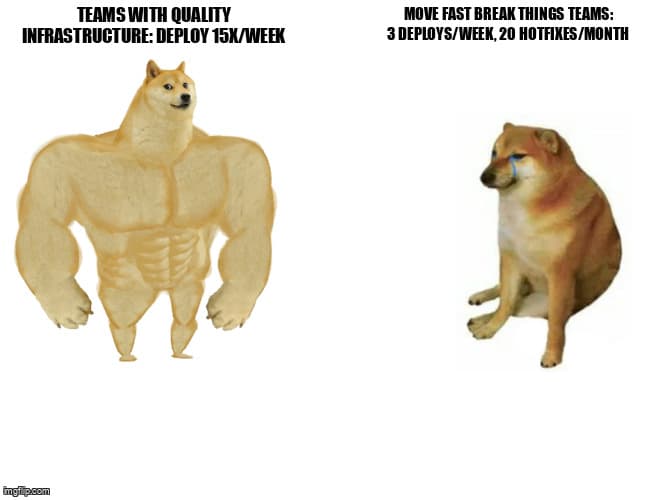
Your VP of Engineering just Slacked you: "We need to ship this feature by Friday. Can QA sign off by Thursday EOD?" It's Tuesday. The feature isn't code complete. Your QA lead looks at you with that familiar mixture of resignation and rage.
Welcome to "move fast and break things" culture, where QA teams are the designated scapegoats for leadership's inability to plan. Where "agility" means "we didn't think this through, so you get 48 hours to test three weeks of work."
What Does "Move Fast and Break Things" Really Mean for QA?
Move fast and break things culture treats QA as a cost center that slows velocity rather than a quality partner that enables sustainable speed through early bug detection and automated testing infrastructure.
Let's decode what this mantra actually means in practice for your quality team:
- "Move fast" - Skip test planning, ignore automation, pressure QA to approve releases without proper validation
- "Break things" - Ship bugs to production, blame QA for not catching them with inadequate resources, repeat cycle
- "Culture" - Normalize chaos, create toxic dynamics between engineering and QA, burn out your best people
According to the 2025 State of DevOps Report, organizations with poor quality practices spend 44% more time on unplanned work and rework than high-performing teams. The irony? Teams obsessed with "moving fast" are actually slower because they're constantly firefighting production issues.
The Hidden Economics of Treating QA as a Bottleneck
Your CFO loves talking about engineering cost per feature. But somehow, they never calculate the cost of production hotfixes, customer churn from buggy releases, and replacing QA engineers who leave after six months of being blamed for rushed releases.
Real Cost Analysis: Rushed Release vs. Quality-First Approach
Let's do the math your leadership team conveniently ignores:
| Cost Factor | Rush Culture | Quality Infrastructure |
|---|---|---|
| Initial Development | $50K | $60K (+20% for tests) |
| Production Hotfixes (Year 1) | $35K (7 incidents) | $8K (2 incidents) |
| Customer Churn | $120K (3 enterprise clients) | $15K (1 client, unrelated) |
| QA Turnover/Hiring | $80K (2 replacements) | $0 (stable team) |
| Total Year 1 Cost | $285K | $83K |
The "expensive" quality-first approach saves $202K in the first year alone. But sure, let's keep treating QA as a cost center.
Why Your Best QA Engineers Keep Leaving
You hired senior QA engineers with expertise in test automation, CI/CD integration, and quality metrics. Six months later, they're updating Jira tickets and manually clicking through regression tests because "we need to move fast."
The 2025 Stack Overflow Developer Survey found that 62% of QA engineers cite "insufficient time for proper testing" as their primary source of job dissatisfaction. Here's what your exit interviews aren't telling you:
- Responsibility without authority - QA is blamed for production bugs but excluded from sprint planning, architecture reviews, and feature scoping
- Impossible expectations - Asked to validate three weeks of development in 48 hours, then blamed when bugs slip through
- Technical stagnation - Hired to build automation frameworks, but 90% of time spent on manual testing because "automation takes too long"
- Toxic blame culture - Every production incident becomes "Why didn't QA catch this?" instead of "Why did we ship untested code?"
Senior QA engineers leave because they recognize your culture will never value quality. Your remaining team becomes junior manual testers drowning in technical debt.
How Modern CTOs Build Velocity Through Quality
The best CTOs understand that sustainable velocity comes from quality infrastructure, not from pressuring QA to rubber-stamp releases. Here's how they actually "move fast":
1. Shift Testing Left (Actually Left, Not Just Earlier Manual Testing)
- QA participates in design reviews before code is written
- Developers write unit tests and integration tests as part of feature work
- Automated tests run in CI before code reaches QA environment
- Quality gates block merges, not rushed "let's ship and see what happens"
# Example CI pipeline that enforces quality
name: Quality Gates

on: [pull_request]

jobs:
  test:
    runs-on: ubuntu-latest
    steps:
      - uses: actions/checkout@v3

      - name: Unit Tests
        run: npm test
        # Blocks merge if < 80% coverage

      - name: Integration Tests
        run: npm run test:integration

      - name: E2E Critical Path
        run: npm run test:e2e:critical
        # Only critical flows, < 5min runtime

      - name: Lighthouse Performance
        run: npm run lighthouse
        # Blocks if performance score < 90
2. Invest in Testing Infrastructure (Not "We'll Automate Later")
According to Google's State of DevOps research, elite performers spend 20-30% of engineering time on test infrastructure and automation. "Move fast" companies spend 5% then wonder why they're slow.
- Parallel test execution - Full E2E suite runs in 8 minutes, not 2 hours
- Visual regression testing - Automated screenshot comparison catches UI bugs before QA sees them
- Contract testing - API changes detected before integration testing phase
- Synthetic monitoring - Production issues caught in minutes, not after customer complaints
3. Feature Flags > "Ship It and Pray"
Want to move fast? Decouple deployment from release. Ship code to production behind feature flags, validate with internal users, then gradually roll out. This eliminates the "QA must approve by Friday" death marches.
// Progressive rollout with instant rollback
const newFeature = useFeatureFlag('new-checkout-flow', {
  defaultValue: false,
  rollout: {
    internal: 100,        // All employees
    beta: 10,             // 10% of beta users
    production: 0         // Not released yet
  }
});

// QA tests in production environment
// No "staging doesn't match prod" surprises
// Rollback is one click, not a 2AM hotfix
Case Study: Companies That Shifted from "Break Things" to "Ship Confidently"
Let's look at real transformations from chaos to sustainable velocity:
Series B SaaS Company (Anonymous, 80 Engineers)
Before (Move Fast Culture):
- Deploy to production 3x/week with manual QA signoff
- 15-20 production hotfixes per month
- QA team turnover: 60% annually
- Test coverage: 22% (mostly legacy unit tests)
- Average time from bug report to fix: 18 days
Transformation (6 Month Investment):
- $180K investment in Playwright E2E suite (3 QA engineers, 4 months)
- CI pipeline with quality gates enforced before merge
- Feature flags for progressive rollouts
- QA involved in design reviews (2-sprint advance notice)
After (Quality Infrastructure):
- Deploy to production 15x/week (continuous deployment)
- 3-5 production issues per month (70% reduction)
- QA team turnover: 10% (industry average)
- Test coverage: 78% (comprehensive integration + E2E)
- Average time from bug report to fix: 4 days
Result: 5x increase in deployment frequency, 70% reduction in production incidents, $400K annual savings in reduced hotfixes and churn.
What "Move Fast" Should Actually Mean
The problem isn't speed. The problem is confusing "recklessness" with "velocity." Real velocity comes from reducing friction in the deployment pipeline, not from eliminating quality checks.
Modern "move fast" means:
- Automated quality gates - Tests run in seconds/minutes, not days of manual QA
- Continuous deployment - Ship multiple times per day because you trust your tests
- Fast feedback loops - Bugs caught in CI/CD, not production customer complaints
- Progressive rollouts - Feature flags enable safe experimentation without "big bang" releases
- Blameless culture - Production incidents trigger process improvements, not scapegoating
If your version of "move fast" involves pressuring QA to skip testing, you're not building velocity. You're building technical debt and turnover.
Key Takeaways for CTOs Who Actually Want Velocity
- Sustainable velocity requires quality infrastructure - Automated testing, CI/CD quality gates, and progressive rollouts enable faster shipping than manual QA signoffs
- QA involvement in design phase reduces rework by 60% - Catching issues before code is written is 10x cheaper than production hotfixes
- Test automation ROI appears in months, not years - Initial investment pays back through reduced hotfixes, churn, and QA turnover within 6-9 months
- Feature flags eliminate rushed releases - Deploy anytime, release gradually, rollback instantly. This removes artificial QA deadlines
- Elite teams spend 20-30% of engineering time on test infrastructure - This investment enables 5-10x higher deployment frequency than "move fast" teams
The Bottom Line
Your QA team doesn't hate "move fast and break things" because they're risk-averse or slow. They hate it because it treats quality as an obstacle rather than a competitive advantage. CTOs who invest in quality infrastructure ship faster, more reliably, and with happier teams than those who confuse recklessness with agility.
Ready to strengthen your test automation?
Desplega.ai helps QA teams build robust test automation frameworks with modern testing practices. Whether you're starting from scratch or improving existing pipelines, we provide the tools and expertise to catch bugs before production.
Start Your Testing TransformationFrequently Asked Questions
Why does "move fast and break things" culture harm QA teams?
It creates pressure to approve releases without proper testing, leading to burnout, blame for production bugs, and turnover. QA becomes the bottleneck rather than a quality partner.
What is the real cost of prioritizing speed over quality?
According to the 2025 State of DevOps Report, teams with poor quality practices spend 44% more time on unplanned work and rework, ultimately shipping slower than quality-focused teams.
How do successful CTOs balance velocity and quality?
They invest in automated testing infrastructure, treat QA as partners in design, and measure quality metrics alongside velocity. This approach increases sustainable delivery speed by 2-3x.
When should I use feature flags instead of rushing releases?
Use feature flags when you need production validation without user exposure. They enable safe incremental rollouts and immediate rollback, reducing QA pressure while maintaining velocity.
Related Posts
Hot Module Replacement: Why Your Dev Server Restarts Are Killing Your Flow State | desplega.ai
Stop losing 2-3 hours daily to dev server restarts. Master HMR configuration in Vite and Next.js to maintain flow state, preserve component state, and boost coding velocity by 80%.
The Flaky Test Tax: Why Your Engineering Team is Secretly Burning Cash | desplega.ai
Discover how flaky tests create a hidden operational tax that costs CTOs millions in wasted compute, developer time, and delayed releases. Calculate your flakiness cost today.
The QA Death Spiral: When Your Test Suite Becomes Your Product | desplega.ai
An executive guide to recognizing when quality initiatives consume engineering capacity. Learn to identify test suite bloat, balance coverage vs velocity, and implement pragmatic quality gates.