
When Your QA Team Becomes Your Bottleneck: The Executive's Guide to Breaking the Testing Logjam
Why adding more QA engineers often slows shipping velocity rather than accelerating it—and what CTOs can do about it
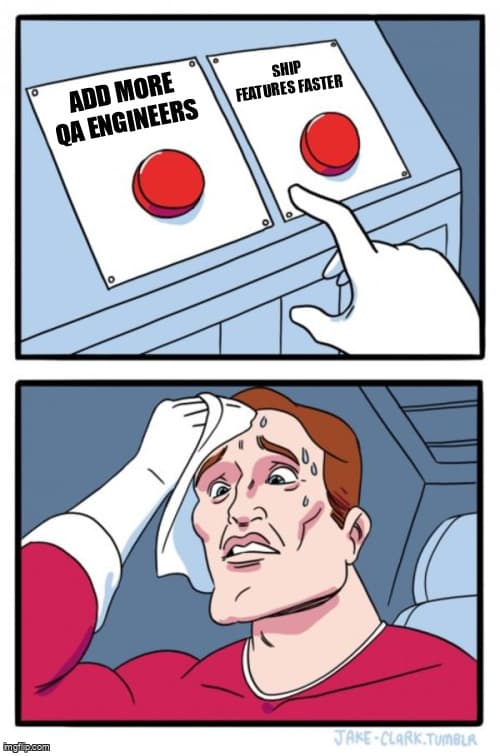
You hired three more QA engineers this quarter. Your testing infrastructure budget doubled. Yet somehow, features now take longer to reach production than they did six months ago. Welcome to the QA scaling paradox—where investing in quality creates the very bottleneck it was meant to eliminate.
According to the 2025 State of DevOps Report, organizations with dedicated QA gatekeepers ship 47% slower than teams with developer-owned quality practices. The uncomfortable truth? Your QA team isn't the problem. The gatekeeper model is.
Why Does Adding QA Capacity Slow You Down?
Adding QA engineers increases handoff overhead, creates deeper testing queues, and fragments quality ownership across team boundaries, turning testing into a sequential gate rather than a parallel workflow.
The traditional model treats QA as a post-development checkpoint. Developers finish features, create tickets, and throw code over the wall. QA triages incoming work, assigns tests, executes scenarios, files bugs, and waits for fixes. Each handoff adds latency.
| Team Size | Avg Handoff Latency | Queue Depth (Features) | Cycle Time Impact |
|---|---|---|---|
| 1-2 QA Engineers | 4-8 hours | 2-3 features | Baseline |
| 3-5 QA Engineers | 12-24 hours | 5-8 features | +40% cycle time |
| 6+ QA Engineers | 24-48 hours | 10-15 features | +85% cycle time |
The bottleneck compounds because QA teams organize around specialization. One engineer handles authentication flows, another owns payment tests, a third covers mobile scenarios. When features touch multiple domains, testing becomes a coordination nightmare requiring sequential handoffs between specialists.
The Hidden Costs of the "Throw It Over the Wall" Culture
Separating development from testing creates perverse incentives where developers optimize for feature completion rather than quality, and QA teams measure success by defects found instead of defects prevented.
When developers don't own quality, they ship code that "works on my machine" without considering edge cases, error states, or production environments. Why spend extra hours hardening a feature when QA will catch issues anyway? This mentality transforms QA from quality assurance into quality archaeology—excavating problems after they're baked into the codebase.
- Context loss costs 3-5x debugging time - QA finds a bug three days after code merge. The developer context-switches from a new feature, reads old code, reproduces the issue, and guesses at the fix. What took 20 minutes to write takes 90 minutes to debug.
- Bug ping-pong kills morale - Developer thinks they fixed the issue. QA retests and finds it still fails in a different scenario. Developer tries again. QA rejects again. Five iterations later, everyone is frustrated and the feature is a week late.
- Test coverage becomes a vanity metric - Teams chase 80% coverage targets with shallow tests that verify functions run without asserting meaningful behavior. Dashboards show green while production burns.
- Deployment becomes a batched, high-risk event - Features queue up waiting for QA sign-off. Releases happen weekly or monthly with 20+ changes bundled together. When production breaks, good luck identifying the culprit.
Real Cost Example: Payment Flow Bug
A developer implements a new payment provider integration. Code complete: Tuesday 2pm. QA picks up the ticket: Thursday 10am. QA discovers the integration fails for international cards: Thursday 3pm. Developer receives bug report: Friday 9am (after QA's daily triage). Developer debugs and pushes fix: Friday 2pm. QA retests: Monday 11am. Still fails for currencies with three decimal places. Final fix deployed: Tuesday afternoon.
Elapsed time: 7 calendar days. Actual development work: 4 hours. The rest was waiting in queues, context switching, and coordination overhead.
The gatekeeper model optimizes for finding defects rather than preventing them. QA teams are rewarded for high bug counts ("Look how many issues we caught!"), not for enabling developers to ship clean code on the first attempt.
How to Embed Quality Ownership Into Development Teams
Shifting quality left means developers write automated tests alongside code, own end-to-end feature quality, and treat QA as enablement partners who build testing frameworks rather than manual execution gates.
This doesn't mean eliminating QA roles. It means fundamentally redefining what QA teams do and how they interact with engineering. Here's the transformation roadmap:
1. Developers Own Test Automation
Every feature pull request must include automated tests before code review. Unit tests verify logic. Integration tests validate API contracts. End-to-end tests cover critical user flows. QA reviews test quality during code review, but developers write the tests.
// Developer-owned E2E test example (Playwright)
import { test, expect } from '@playwright/test';

test('international payment with 3-decimal currency', async ({ page }) => {
  await page.goto('/checkout');

  // Select payment provider
  await page.selectOption('#payment-method', 'stripe');

  // Enter test card for Bahraini Dinar (3 decimals)
  await page.fill('#card-number', '4000000000000077');
  await page.fill('#currency', 'BHD');
  await page.fill('#amount', '10.500');

  // Submit payment
  await page.click('#submit-payment');

  // Verify success with correct decimal handling
  await expect(page.locator('.payment-success')).toContainText('10.500 BHD');

  // Verify backend received correct precision
  const response = await page.request.get('/api/payment/last');
  expect(await response.json()).toMatchObject({
    currency: 'BHD',
    amount: 10500, // 10.500 BHD in minor units
    precision: 3
  });
});
This test catches the decimal precision bug during development, not three days later in QA. The developer has full context, fixes it immediately, and the feature ships correctly the first time.
2. QA Becomes Quality Engineering
Reposition QA engineers as quality enablement specialists. Their job is not executing tests—it's building testing infrastructure, defining standards, and coaching developers on quality practices.
- Build reusable test frameworks - Create page object models, API client libraries, and test data generators that developers can use without deep testing expertise.
- Define quality standards - Establish code review checklists, test coverage requirements, and performance benchmarks. Make quality expectations explicit and measurable.
- Perform exploratory testing - Focus QA time on scenarios that can't be automated: usability evaluation, edge case discovery, cross-browser compatibility, and security probing.
- Monitor production quality metrics - Track error rates, performance regressions, and user-reported bugs. Feed insights back to development teams to improve testing strategies.
3. Implement Test-Driven Code Review
Code review should validate test quality before functional correctness. Reviewers ask: "Do these tests cover edge cases? Will they catch regressions? Are assertions meaningful or superficial?"
Code Review Checklist: Test Quality
- Tests cover happy path, error states, and boundary conditions
- Test names describe behavior, not implementation details
- Assertions verify outcomes, not internal state
- Tests are deterministic (no flaky timing dependencies)
- Test data is isolated and cleaned up after execution
- Critical user flows have end-to-end coverage
4. Break the Batch Deployment Habit
Ship features individually as soon as automated tests pass. Use feature flags to decouple deployment from release. This reduces blast radius when issues occur and eliminates the QA approval queue.
A study by DORA (DevOps Research and Assessment) found that elite performers deploy 208 times more frequently than low performers, with 106 times faster lead times. The key differentiator? Automated quality gates that replace manual QA sign-off.
How to Measure QA Effectiveness Beyond Bug Counts
Effective QA teams optimize for fast feedback loops, production stability, and developer enablement rather than maximizing defects found during testing phases.
Traditional QA metrics (bugs filed, test cases executed, coverage percentages) measure activity, not outcomes. They incentivize busy work and miss the point: delivering quality software quickly.
Better QA Metrics
| Metric | What It Measures | Target |
|---|---|---|
| Test Feedback Latency | Time from code commit to test failure notification | < 15 minutes |
| Deployment Frequency | How often code ships to production | Multiple times per day |
| Change Failure Rate | Percentage of deployments causing production issues | < 15% |
| Mean Time to Recovery | How quickly you fix production problems | < 1 hour |
| Shift-Left Ratio | Bugs caught in development vs. QA vs. production | 70% / 25% / 5% |
These metrics focus on flow efficiency and production outcomes. A high deployment frequency with low change failure rate means your quality practices are working. Long test feedback latency means developers lose context and velocity suffers.
Practical Migration Strategies (Don't Blow Up Your QA Team Overnight)
Transitioning from gatekeeper QA to embedded quality ownership requires incremental change. Here's a phased approach that maintains stability while shifting culture:
Phase 1: Automate the Regression Suite (Months 1-3)
- QA engineers write automated tests for top 20 critical user flows
- Integrate tests into CI pipeline (block merges on failure)
- Measure baseline: current cycle time, test coverage, bugs found in production
- Goal: Eliminate 80% of manual regression testing burden
Phase 2: Developer Test Ownership (Months 4-6)
- Require automated tests in all new feature PRs
- QA reviews test quality during code review (coaching mode)
- Developers fix bugs found in their own code (no handoff back to QA)
- Track shift-left ratio: percentage of bugs caught by developer tests vs. QA testing
Phase 3: Continuous Deployment (Months 7-9)
- Deploy features individually as soon as automated tests pass
- Use feature flags to control release timing
- QA focuses on exploratory testing and production monitoring
- Measure deployment frequency, change failure rate, and MTTR
Phase 4: Quality Engineering (Months 10-12)
- QA engineers transition to quality engineering roles
- Build testing infrastructure (frameworks, tools, dashboards)
- Define and enforce quality standards
- Partner with product on risk assessment and testing strategy
This migration doesn't eliminate QA headcount—it redirects their effort from manual execution to high-leverage enablement work. You'll ship faster because developers own quality from the start, not because you're cutting corners.
Key Takeaways
- Adding QA engineers slows velocity when they act as gatekeepers - Handoff overhead, queue depth, and context loss compound as teams grow. The bottleneck is the model, not the people.
- The gatekeeper model creates perverse incentives - Developers optimize for feature completion, not quality. QA is rewarded for finding defects, not preventing them. Bug ping-pong and batch deployments kill morale and velocity.
- Shift quality ownership left to developers - Require automated tests in every PR. QA reviews test quality during code review. Developers own end-to-end feature quality, including production monitoring and bug fixes.
- Reposition QA as quality engineering - QA builds testing frameworks, defines standards, and performs exploratory testing. Their job is enablement, not manual execution.
- Measure flow metrics, not activity - Track deployment frequency, test feedback latency, change failure rate, and shift-left ratio. Optimize for fast feedback and production stability, not bug counts or test case volumes.
The Bottom Line for CTOs
Your QA team isn't slowing you down—your testing culture is. Break the gatekeeper model. Embed quality ownership in development teams. Reposition QA as enablement specialists. The result? You ship faster, with higher quality, and your QA engineers do more strategic work instead of manual test execution.
Ready to strengthen your test automation?
Desplega.ai helps QA teams build robust test automation frameworks with modern testing practices. Whether you're starting from scratch or improving existing pipelines, we provide the tools and expertise to catch bugs before production.
Start Your Testing TransformationFrequently Asked Questions
Why does adding more QA engineers slow down releases?
More QA staff increases handoff overhead, creates queue depth at the testing gate, and fragments ownership. Teams wait longer for test assignment, context transfer, and feedback loops.
What is the QA gatekeeper model?
The gatekeeper model positions QA as the final checkpoint before production, where developers hand off completed features. This creates batch processing delays and removes developer accountability for quality.
How do you measure QA team effectiveness beyond bug counts?
Track cycle time from code complete to production, test feedback latency, deployment frequency, and percentage of bugs caught in development versus production. Quality is a flow metric, not a volume metric.
Should we eliminate dedicated QA roles entirely?
No. Reposition QA as quality coaches and automation specialists who enable developers to own quality. QA builds frameworks, defines standards, and performs exploratory testing—not manual regression gates.
What is shift-left testing in practice?
Shift-left testing moves quality verification earlier in development through automated unit tests, integration tests in CI, and developer-owned test suites. QA focuses on test strategy and edge cases rather than manual execution.
Related Posts
Hot Module Replacement: Why Your Dev Server Restarts Are Killing Your Flow State | desplega.ai
Stop losing 2-3 hours daily to dev server restarts. Master HMR configuration in Vite and Next.js to maintain flow state, preserve component state, and boost coding velocity by 80%.
The Flaky Test Tax: Why Your Engineering Team is Secretly Burning Cash | desplega.ai
Discover how flaky tests create a hidden operational tax that costs CTOs millions in wasted compute, developer time, and delayed releases. Calculate your flakiness cost today.
The QA Death Spiral: When Your Test Suite Becomes Your Product | desplega.ai
An executive guide to recognizing when quality initiatives consume engineering capacity. Learn to identify test suite bloat, balance coverage vs velocity, and implement pragmatic quality gates.