
Why Your QA Team Is Secretly Running Your Company (And Your Developers Don't Want You to Know)
While you obsess over microservices architecture and AI integrations, your QA team holds the actual keys to your release schedule, customer satisfaction, and whether your Saturday gets ruined by a production incident.
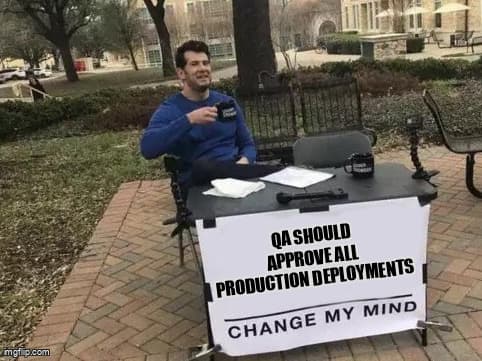
The Uncomfortable Truth About Your Org Chart
Let's start with a scenario you've definitely lived through: It's Thursday afternoon. Your star developer just merged the feature that'll close that enterprise deal. Sales is already drafting the press release. The CEO is mentally spending the commission. Then your QA lead walks into the room and says four words that make everyone's blood pressure spike:
"We found some issues."
Suddenly, your carefully orchestrated release timeline evaporates. That developer who was about to take Friday off? They're staying late. That weekend golf trip you planned? Canceled. The enterprise customer expecting Monday deployment? Getting a very awkward phone call.
Here's what nobody tells you in business school: Your QA team has veto power over every single revenue-generating decision your company makes. They just exercise it quietly, politely, and with a smile that says "I'm here to help" while holding a clipboard that determines whether you ship or slip.
Why does QA have veto power over software releases?
QA teams control deployment approval because they're the final checkpoint before production, and unlike peer code reviews or product sign-offs, their quality veto cannot be overridden without accepting documented risk.
Think about the actual power dynamics in your organization. Who can unilaterally decide that a feature doesn't ship? Not your product manager—developers can push back. Not your designers—product can override. Not even your developers—code review is peer-based.
But QA? When they say "this isn't ready," that feature doesn't ship. Period. End of discussion. You might argue, you might negotiate, you might promise to "fix it in the next sprint" (narrator: you won't), but ultimately, QA owns the deploy button. They're the Gandalf of your release pipeline, and they're not afraid to stand on that bridge and say "you shall not pass."
According to the 2025 State of DevOps Report, 68% of engineering leaders cite QA approval as the most frequent cause of release delays, yet organizations with empowered QA teams ship 2.5x faster than those where QA operates defensively.
The Three Kingdoms of QA Power
- Schedule Authority: They control when features actually reach customers. Your roadmap is a suggestion; their test plan is law.
- Quality Gatekeeping: They define what "good enough" means. Developers think it works. Product thinks it's shippable. But if QA says the edge cases aren't covered, you're not shipping edge cases.
- Risk Assessment: They're the ones who actually know where your technical debt lives. That "quick fix" your developer swears is safe? QA knows it touches 47 other components because they tested the blast radius last quarter.
What happens when companies bypass QA to ship faster?
Companies that fast-track deployments around QA typically face a five-stage death spiral: initial velocity gains, production incidents, bureaucratic overcorrection, talent exodus, and ultimately spending three times more on firefighting than prevention.
Now, some of you reading this are thinking: "This is exactly why we need to reduce QA bottlenecks! Shift-left! Automate! Empower developers to ship!"
Cool. Let's talk about what happens when you treat QA as an obstacle to be routed around rather than a partner to be empowered.
The Death Spiral Playbook
Stage 1: The Bypass
You implement a "fast-track" deployment process for "small changes" that skips QA review. It works great for two weeks. Developers love the autonomy. Velocity metrics go up. You present the numbers at the board meeting.
Stage 2: The Incident
A fast-tracked change takes down the payment system on a Friday at 5 PM. Your QA lead could have caught it—they've seen this exact failure mode twice before. But nobody asked them because this was "just a config change."
Stage 3: The Overcorrection
You implement "enhanced review procedures" that are actually more bureaucratic than the original QA process. Developers start secretly maintaining a shadow staging environment to test stuff before QA sees it. Your QA team becomes defensive, catching smaller and smaller issues to prove their value.
Stage 4: The Exodus
Your best QA engineers leave. Not because of the work—because you've made it clear you see them as a cost center, not a value multiplier. The people who knew where every skeleton was buried? Gone. The tribal knowledge of which "stable" features are actually held together with duct tape? Walking out the door.
Stage 5: The Realization
You're now spending 3x your old QA budget on production firefighting, customer support escalations, and "hotfix sprints" (which is just QA work that your developers are doing poorly while being paid senior engineering salaries). Your release cadence is actually slower than when QA was "the bottleneck." Congratulations, you've speedrun organizational failure.
According to Forrester's 2025 Quality Engineering Report, companies that eliminate QA gatekeeping without implementing shift-left practices experience 312% more critical production incidents in the first six months, with an average cost of $147,000 per incident.
How do effective CTOs leverage QA authority strategically?
Top engineering leaders embed QA in architecture decisions before code is written, create risk advisory boards for strategic technical debt discussion, and establish deployment councils with defined approval SLAs—transforming QA from bottleneck to force multiplier.
Here's the secret the top engineering orgs figured out: QA teams don't want to be bottlenecks. They want to be force multipliers. The problem is you keep treating them like a compliance checkbox instead of a strategic weapon.
The Co-Architect Model
The smartest CTOs I know bring QA leads into architectural decisions before code is written. Not to rubber-stamp the plan—to identify the blind spots that will become integration nightmares six months from now.
When your QA lead says "this design is going to be really hard to test," they're not being obstructionist. They're telling you that your customers are going to find it really hard to use, because guess what? Testing difficulty correlates almost perfectly with UX complexity.
The Risk Advisory Board
Create a weekly "risk sync" where QA presents the top three technical debt items that are most likely to cause a production incident. Not a bug triage meeting—a strategic discussion about where your system is brittle.
Treat these like an internal security advisory. When QA says "this payment integration is held together with string," that's your cue to allocate engineering time before it becomes a Saturday emergency.
The Deployment Council
Here's a radical idea: Make your QA lead a required approver for production deployments, but give them a service-level agreement. They have 24 hours to review, provide feedback, or explicitly approve. If they miss the window, deployment proceeds.
This does two things: (1) It gives QA formal authority, which means they take ownership instead of playing defense. (2) It creates accountability, which prevents "QA is testing it" from becoming an indefinite holding pattern.
How to Tell If You've Lost Control (A Self-Assessment)
Here are the warning signs that your QA team has evolved from strategic partner to shadow decision-making layer:
- The Byzantine Test Plan: Your QA team maintains a 47-page test plan that nobody fully understands, including QA. Every release requires executing 200+ manual test cases that haven't been reviewed in 18 months. You're not ensuring quality—you're performing security theater.
- The Eternal Sprint: Features routinely sit in "QA Testing" status for entire sprints. When you ask why, you get vague answers about "edge cases" and "integration concerns." The real answer? Your QA team is secretly redesigning the feature because they weren't involved in planning.
- The Friday Veto: QA consistently finds "critical" issues at 4 PM Friday that block releases. Not occasionally—consistently. This isn't bad luck. This is organizational dysfunction manifesting as calendar awareness.
- The Documentation Fortress: Your QA team has more process documentation than your entire engineering department. Every decision requires filling out a form, updating a spreadsheet, and getting three approvals. You're not building quality in—you're optimizing for CYA.
- The Separation Anxiety: QA and Development communicate exclusively through Jira tickets. They sit on opposite sides of the office (or opposite Slack channels). When they do interact, it's adversarial. Congratulations, you've recreated the worst aspects of waterfall development while claiming to be agile.
The Fix: Distributed Authority, Shared Accountability
The solution isn't to reduce QA power—it's to make QA power transparent and shared. Here's how:
1. Embed QA in Feature Teams (For Real This Time)
Not "QA attends standups." Not "QA gets a Jira ticket when dev is done." I mean QA is in the room when you're sketching the feature on a whiteboard. They're in the technical design review. They're pairing with developers on test harnesses.
This isn't about making QA feel included—it's about surfacing risks before they become code. The best QA engineers I know can predict integration nightmares from an API design. But only if you actually show them the API design.
2. Make Quality Metrics a Team Sport
Stop measuring QA on "bugs found" and start measuring teams on "production incidents prevented." When QA catches a critical bug, that's a win for the entire feature team—not a black mark on the developers who wrote it.
Similarly, when a bug escapes to production, that's a systemic failure, not a QA failure. Run a blameless post-mortem that asks "why didn't our process catch this?" instead of "why didn't QA catch this?"
3. Invest in QA Tooling Like You Invest in Developer Tooling
Your developers have CI/CD pipelines, feature flags, observability platforms, and ergonomic keyboards. Your QA team has... Selenium scripts that break every release and a shared spreadsheet of test cases.
If you want QA to stop being a bottleneck, give them the tools to scale. Visual regression testing. Contract testing. Production traffic replay. Chaos engineering platforms. Make testing as automated and delightful as shipping code.
The 2025 Test Automation ROI Study found that organizations investing equally in QA and developer tooling reduce release cycle time by 64% while maintaining 23% fewer production defects compared to dev-tooling-only investments.
4. Create Explicit Risk Acceptance Rituals
Sometimes you need to ship with known issues. That's fine—every organization does it. The problem is when this happens implicitly, through pressure and negotiation.
Instead, create a formal "risk acceptance" process. QA documents the known issues. Product and engineering leadership explicitly accept the risk. You deploy. If it blows up, nobody gets to say "I didn't know"—because it's documented in Slack with timestamps and emoji reactions.
This isn't about blame—it's about making trade-offs visible. Once leadership sees how often they're accepting risks, they either allocate more time for testing or accept that quality is a strategic choice, not a QA problem.
The Uncomfortable Question
Here's what this whole essay is really asking: Do you trust your QA team?
Not "do you think they're competent"—of course you do, or you wouldn't have hired them. I mean: Do you trust their judgment when they say something isn't ready? Do you trust that they understand the business impact of delays? Do you trust that they're trying to ship great software, not just cover their ass?
If the answer is no, you have a hiring problem, not a process problem. Fire your QA team and hire people you trust. Seriously. The organizational dysfunction of keeping people around that you don't trust will cost you 10x what it would cost to restart with the right people.
If the answer is yes, but your organization acts like the answer is no, you have a cultural problem. Your processes, your incentives, and your org structure are screaming "QA is the enemy" even though you consciously believe they're valuable.
Fix that. Because right now, your QA team is running your company—they're just doing it defensively, reactively, and with one hand tied behind their back. Imagine what they could do if you actually empowered them to lead.
The Bottom Line (Because CTOs Love Bottom Lines)
Your QA team isn't secretly running your company. They're obviously running your company—they control your release schedule, quality reputation, and production stability. The only "secret" is that you've been pretending they don't have this power while simultaneously making every strategic decision contingent on their approval.
Stop treating quality as a gate and start treating it as a capability. Stop organizing QA as a separate kingdom and start embedding them as architects. Stop measuring them on "bugs found" and start measuring them on "risks managed."
Because here's the truth: The best engineering organizations don't have powerful QA teams or weak QA teams. They have QA teams whose power is transparent, distributed, and aligned with shipping great software fast.
The worst engineering organizations? They have QA teams whose power is implicit, defensive, and exercised at the last possible moment to prevent disasters that everyone saw coming.
Which one are you building?
Want to build a QA culture that accelerates releases instead of blocking them? Desplega.ai helps Spanish tech companies implement autonomous testing strategies that scale with your ambitions—without turning QA into a bottleneck. Let's talk about how we can make quality your competitive advantage, not your constraint.
Frequently Asked Questions
Why does QA have veto power over software releases?
QA teams control deployment approval because they're the final checkpoint before code reaches customers. Unlike code reviews or product sign-offs which can be overridden, when QA flags critical issues, the deployment stops—giving them de facto veto authority over release schedules and business timelines.
What happens when companies bypass QA processes to ship faster?
Companies that fast-track deployments around QA typically experience a death spiral: initial velocity gains followed by production incidents, defensive overcorrection with more bureaucracy, QA talent exodus, and ultimately 3x spending on firefighting versus prevention—resulting in slower releases than before the bypass.
How can CTOs empower QA teams without creating bottlenecks?
Effective CTOs embed QA in architectural decisions before code is written, create formal risk acceptance processes with 24-hour SLA windows, invest in QA tooling at the same level as developer tools, and measure teams on production incidents prevented rather than bugs found—making quality a shared capability instead of a gate.
What are the warning signs that QA has become dysfunctional?
Red flags include 47-page test plans nobody understands, features sitting in QA Testing status for entire sprints, consistent Friday 4 PM critical vetoes, more process documentation than actual code, and adversarial QA-Development communication exclusively through tickets—indicating organizational dysfunction rather than quality assurance.
Related Posts
When I Reject v0 Code: Pattern-Matching Rules for Safer UI Generation
A practical v0 review gate for safer generated React UI: AST checks, Playwright smoke tests, accessibility rules, and rejection signals.
Cody's Repository Indexing: Does Cognitive Offloading Create Knowledge Gaps in Large Codebases? | Desplega AI
A practical deep dive into Cody repository indexing, context retrieval, and how indie hackers avoid AI-created knowledge gaps.
Hot Module Replacement: Why Your Dev Server Restarts Are Killing Your Flow State | desplega.ai
Stop losing 2-3 hours daily to dev server restarts. Master HMR configuration in Vite and Next.js to maintain flow state, preserve component state, and boost coding velocity by 80%.