
The Shift-Left Scam: Why Your Developers Writing Tests Still Ship Production Bugs
The uncomfortable truth about why 'developer-owned quality' is failing engineering leaders
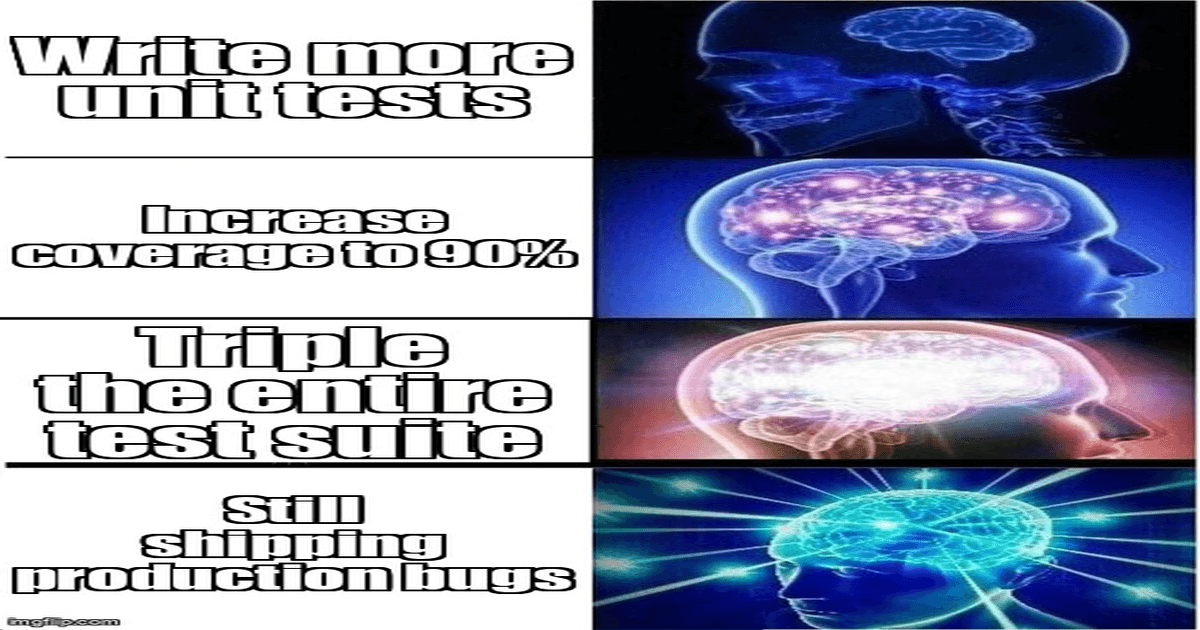
Every year, engineering leaders sit through the same all-hands slide: test coverage up 40%, shift-left is working. And every year, the production incident retrospectives don't get shorter. PagerDuty still wakes someone up on Friday night. The customer hotline still melts down after every major release. The post-mortems get longer, not shorter.
Here's the question your VP of Engineering isn't asking: what if the entire statistical foundation of shift-left testing is built on a made-up number?
Is the “100x Cost” Stat That Built Shift-Left Actually Real?
The central argument for shift-left has always been some version of: “bugs found in production cost 100x more than bugs found in development.” It's been in conference keynotes, vendor decks, and engineering blogs for three decades. In July 2021, researcher Laurent Bossavit — writing in The Register — traced that stat to its origin. It came from unverified IBM training materials written between 1967 and 1981. Never peer-reviewed. Never replicated. The bedrock of a $50 billion testing tools industry traces back to unverified notes from the Nixon administration.
The macro numbers tell the same uncomfortable story. The CISQ 2020 report put actual dollar figures on the table: $2.08 trillion in poor software quality costs in the US, with operational failures alone accounting for $1.56 trillion — a 22% increase from 2018. That's after two decades of shift-left evangelism. If shifting left were working as advertised, those numbers should be declining.
Three Numbers Your All-Hands Slide Doesn't Show
- $1.56 trillion in operational software failures in 2020 — up 22% since 2018, through the height of shift-left adoption (CISQ 2020)
- 67% of teams now have developers doing most testing; roughly half still report frequent production incidents (Katalon State of Software Quality 2024)
- Only 19% of teams reach DORA elite performance level — and even they accept a 0–15% change failure rate as normal (DORA 2024)
Does Increasing Unit Test Coverage Actually Reduce Production Incidents?
The honest answer: not in the way anyone promises. The most rigorous study on this — Microsoft Research's Nagappan et al. (2008) — found that genuine test-driven development (test-first, not “write tests after the fact”) reduced pre-release defect density by 40–90%. Important caveat: they measured pre-release defects, not production incidents. And teams took 15–35% longer to ship. Real TDD works. What most teams call shift-left is not real TDD.
The PractiTest State of Testing 2024 found that only 23% of practitioners actually practice TDD. The rest are writing tests after the fact — which, as any senior engineer will quietly admit, is documentation dressed up as quality practice. You're testing code you already understand, for behaviors you already know. That's not finding bugs. That's proving the obvious.
Google's own engineering book says the quiet part out loud: “Unit tests are limited by the imagination of the engineer writing them — they can only test for anticipated behaviors and inputs. However, issues that users find with a product are mostly unanticipated.”
What Bug Types Actually Kill Production? (The Table Your Vendors Don't Show You)
Unit tests run in isolation, against mocks, on clean environments, serially, with small datasets. Production is none of those things. The failure modes that cost real money live at the boundaries — and unit tests structurally cannot reach them.
| Bug Type | Caught by Unit Tests? | Causes Production Incidents? | What Actually Catches It |
|---|---|---|---|
| Function logic errors | Yes | Rarely | Unit tests |
| Integration seam failures (API contracts) | No | Yes — frequently | Contract / integration tests |
| Race conditions under concurrent load | No | Yes — catastrophically | Load / concurrency testing |
| Config / environment mismatches | No | Yes — expensively | E2E / deployment validation |
| Third-party API behavior changes | No (mocked out) | Yes | Contract tests against live stubs |
| Database migration edge cases | No | Yes — with data loss | Staging environment validation |
| Performance degradation under real data volume | No (tiny datasets) | Yes | Performance / chaos testing |
Six of the seven bug types that regularly cause production incidents are invisible to unit tests — not because your developers are bad at writing tests, but because unit tests were never designed to catch them. Coverage metrics measure code execution. They do not measure production fidelity.
The Knight Capital Rule: Your Most Expensive Bugs Are Environmental
Knight Capital Group had working, unit-tested code. On August 1, 2012, a deployment script silently failed to update one of eight production servers. That server retained deprecated “Power Peg” code that should have been deactivated. When the market opened, it started processing erroneous equity orders — 4 million orders in 45 minutes — before a human could intervene. Knight Capital lost $440 million. Roughly three times their annual earnings. In 45 minutes. The cause was a deployment environment mismatch. No unit test on earth could have caught it.
In October 2021, a routine BGP configuration change took down Facebook's entire DNS infrastructure for seven hours. At approximately $13 million per hour in advertising revenue, the outage cost the company roughly $80 million. The root cause was an infrastructure-level configuration change — the kind that exists nowhere in unit test coverage reports, and never will.
These aren't cautionary tales. They're the rule at scale. NIST's 2002 planning report found that over half of all software errors aren't found until downstream or post-sale — even with 50% of development budgets already going to testing. More testing of the wrong kind does not change that ratio.
Shift-Left Became Shift-Blame — And Your Engineers Are Burning Out
There's a structural problem with making developers responsible for all quality: the causal relationship between testing activity and production incidents doesn't change, but the blame does. When shift-left is the entire strategy, engineers under deadline pressure are now also expected to be expert testers, security analysts, and performance engineers simultaneously. One recent industry analysis described the result directly: “Developers — already under immense pressure to ship features — were asked to become expert testers, security analysts, and performance engineers. The result was a predictable set of new problems... a recipe for burnout.”
The Indeed case study is the clearest real-world data point. In March 2023, Indeed laid off 2,200 employees — 15% of staff — eliminating the QA function entirely. Developers assumed all testing responsibility. The result, from an anonymous engineer interviewed by The Pragmatic Engineer: “The overall quality of tests has nosedived.” The budget savings were real. So was the quality collapse.
What Do the Companies With the Lowest Production Incident Rates Actually Do?
DORA research doesn't show that elite-performing teams have more unit tests than average teams. It shows they have faster feedback loops across multiple quality layers — deployment automation, observability, fast rollback, and crucially, testing coverage that maps to actual production failure modes. The testing pyramid gets discussed endlessly. The testing coverage map almost never is.
Kent C. Dodds' “Testing Trophy” model made the point structurally: integration tests belong at the high-value center, not the top. His formulation is worth printing: “Write tests. Not too many. Mostly integration.” The emphasis on integration isn't anti-unit-test. It's a recognition that the seams between units are where production breaks.
A Tiered Quality Strategy That Maps to Actual Failure Modes
What teams with consistently low production incident rates do differently:
- Unit tests (developer-owned): Fast logic feedback. High volume, low anxiety. Don't confuse coverage here with production confidence.
- Contract tests: API boundary validation. Catches integration failures before they reach staging — the first layer of defense against the seam failures unit tests can't see.
- Integration tests: System seam validation. This is where the real bugs live. This layer is where most teams under-invest.
- E2E / deployment tests: Environment-level validation. The Knight Capital defense layer. Verifies deployment state, not just code correctness.
- Dedicated quality engineering at the system boundary: Catches the unanticipated — the class of bugs developers structurally cannot write tests for because they haven't imagined them yet.
This isn't a rejection of shift-left. It's a completion of what shift-left was supposed to be before it got reduced to a unit test metric. The original shift-left vision moved all quality practices earlier in the cycle — not just developer unit tests. What got cargo-culted was the coverage dashboard. What got dropped was the systems thinking.
The engineering leaders who figure this out stop celebrating green dashboards and start asking a simpler question: how many production incidents did we ship this quarter, and which bug categories caused them? If the answer doesn't map to your current test coverage categories, you don't have a test quality problem. You have a coverage map problem. And no amount of shift-left will fix what it was never designed to catch.
The shift-left scam isn't that shift-left doesn't work. It's that it got sold as a complete quality strategy when it was always just one layer of one. Your developers writing more tests is necessary. It's not sufficient. And the difference between those two words is where your production incidents live.
References
- The Register: "The 100x cost of production bugs stat may be BS" The Register, July 2021
- CISQ: Cost of Poor Software Quality in the US — 2020 Report CISQ 2020
- DORA 2024 State of DevOps Report DORA 2024
- Knight Capital: The $440M Software Error Henricodolfing, 2020
- CloudQA: The Shift-Right Revolution (Facebook outage analysis) CloudQA
- The Pragmatic Engineer: QA Across Tech The Pragmatic Engineer
- Software Engineering at Google: Chapter 14 (Large-Scale Testing) Google SWE Book
- Microsoft Research: Realizing Quality Improvement Through TDD Nagappan et al., Microsoft Research, 2008
- Katalon: State of Software Quality 2024 Katalon 2024
- Kent C. Dodds: Write Tests. Not Too Many. Mostly Integration. Kent C. Dodds
- NIST Planning Report 02-3: The Economic Impacts of Inadequate Infrastructure for Software Testing NIST 2002
Ready to strengthen your test automation?
Desplega.ai helps QA teams build robust test automation frameworks that go beyond unit test metrics — covering the integration seams where real production bugs live.
Start Your Testing TransformationFrequently Asked Questions
Why does shift-left testing still result in production bugs?
Shift-left catches logic errors developers anticipate. The bugs that cause production incidents — integration failures, race conditions, environment mismatches — are structurally invisible to unit tests by design.
Is shift-left testing a failure?
Not when done right. Genuine TDD reduces pre-release defects 40–90% (Microsoft Research, 2008). The failure is treating unit test counts as a quality proxy instead of building a layered test strategy.
What is the most expensive type of production bug?
Environmental and integration failures. Knight Capital lost $440M in 45 minutes from a deployment mismatch. Facebook lost ~$80M from a DNS config change. Neither was a logic error unit tests could catch.
What should CTOs do instead of pure shift-left?
Layer quality engineering: unit tests for logic, contract tests for API boundaries, integration tests for system seams, and dedicated QA at the production boundary — not replacing shift-left, completing it.
Does eliminating QA teams and shifting everything left save money?
Short-term yes, long-term no. Indeed eliminated QA in 2023 — engineers reported quality "nosedived." The headcount savings rarely survive the first major production incident, measured in customer trust and engineering hours.
Related Posts
Test Wars IX: The Code Wars - No-Code vs Vibe Coding
No-code platforms offer strategic escape from vibe coding chaos. Reduce technical debt, maintain quality, and achieve faster time-to-market in 2025's AI development era.
Test Wars Episode II: AI New Hope
Discover how AI is revolutionizing testing practices and bringing new hope to quality assurance teams worldwide.
The Compliance Testing Trap: Why Your SOC2 Audit Is Making Your Software Less Secure | desplega.ai
Your SOC2 badge helps close enterprise deals. It will not stop the breach that closes your company. Here is what the audit industry does not tell CTOs.