
Desplega Release Notes — Week of May 25–June 1, 2026
Desplega turned API validation into a native part of end-to-end testing while giving teams tighter operational control over checks and schedules.
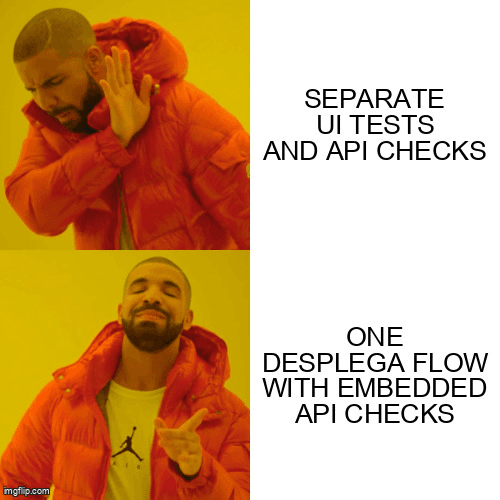
This week’s release is about reducing QA fragmentation. Desplega now lets teams run API validation inside UI-driven tests, while the expanding qa-use CLI gives engineering organizations a more operational way to manage checks, schedules, and live reporting from the same platform story.
Across 7 commits in 2 repositories, the release combines a flagship workflow improvement, a substantial CLI surface expansion, and a targeted reliability fix that protects browser-session diagnostics when teams need them most.
By the numbers: the embedded API-check feature landed in a 22-file PR with 1,961 additions and 196 new test lines. The checks CLI expansion added 48 files and 3,217 additions in qa-use, while the BrowserSession hygiene patch shipped with a dedicated 73-line regression test.
Why does combining UI and API validation matter for release gates?
One authored flow now covers browser intent and backend proof, sharply shrinking handoffs between QA, platform, and API owners.
For engineering leaders, the key shift is not just convenience. It is the removal of a structural blind spot that often appears between end-to-end UI coverage and API-level assertions. When those checks live in separate systems, release gates become slower to debug, harder to trust, and more dependent on cross-team coordination.
Desplega’s new embedded API-check step brings that validation directly into the business flow being tested. A sign-in journey can now assert the browser result and the backend contract in the same path, which means faster feedback loops, fewer orphaned checks, and a cleaner story for teams that need traceable release confidence.
name: api-check-step-example
variables:
  env:
    value: staging
    type: custom
    lifetime: test
    context: check
steps:
  - type: extended
    name: Run authentication API check
    step_id: run-auth-check
    action:
      action: api_check
      value:
        check_id: 00000000-0000-0000-0000-000000000000
Business value: critical-path tests become easier to author, easier to audit, and easier to scale because the release gate stays inside one workflow instead of being stitched together after the fact.
How does qa-use change operational QA for growing teams?
Checks and schedules can now be managed as first-class operational assets, making QA easier to standardize across environments.
The second theme in this release is operational control. qa-use moved further beyond test execution into day-to-day QA operations, adding first-class workflows for creating checks, building schedules, and triggering remote runs with seeded variables. That matters when teams want repeatable quality processes without forcing every workflow through the UI.
In practical terms, this gives platform and QA leads a cleaner way to operationalize routine validation, especially for shared environments, smoke chains, and recurring release checks. The CLI becomes the command surface for standardization, not just a utility for individual developers.
qa-use check create \
  --name "Auth token" \
  --app-config APP_CONFIG_ID \
  --config auth-check.json \
  --alias auth \
  --capture token=$.access_token

qa-use check-schedule run SCHEDULE_ID \
  --var env=staging \
--var claim_id=123- Teams can define checks and schedules from the CLI without inventing side-channel workflows.
- Remote schedule runs make repeatable QA easier to seed across staging and shared environments.
- Live checks QA reporting increases visibility into what is running and what needs attention.
Business value: when checks and schedules become operational assets, QA programs are easier to govern, automate, and hand off across teams without losing consistency.
Reliability hardening that protects production evidence
The BrowserSession console-log sanitation fix is a smaller change, but it is exactly the kind of reliability work mature teams look for. Stripping NUL bytes from stored console logs prevents edge-case corruption in a part of the system that often becomes important only when a release is under investigation.
Desplega backed that fix with dedicated regression coverage, which is the right signal for buyers evaluating whether a platform takes production quality seriously. New capabilities matter, but so does the integrity of the artifacts your team depends on when something breaks late in the release cycle.
What comes next for Desplega?
This release points in a clear direction: Desplega is converging test authoring, execution, and QA operations into one workflow model. Expect the next cycle to build further on that foundation with deeper operational surfaces, stronger release-gate ergonomics, and more ways to keep browser and API confidence inside the same system of record.
For CTOs and engineering leaders, that is the strategic takeaway. The platform is not just adding isolated features; it is reducing the number of places your team has to switch context in order to ship with confidence.
Ready to supercharge your testing?
Desplega.ai helps teams ship faster with AI-powered E2E testing, unified browser and API workflows, and production-ready QA operations.
Get Started FreeFrequently Asked Questions
What is the most important change in this week’s Desplega release?
Embedded API checks are now part of the UI test flow, so teams can validate browser journeys and backend behavior in one authored path instead of splitting ownership across multiple tools.
Why does the qa-use CLI expansion matter to engineering teams?
It turns checks and check schedules into operational resources teams can create, inspect, run, and clean up from the command line, making QA workflows easier to standardize.
Was this release focused only on new features?
No. Alongside feature work, Desplega shipped a BrowserSession console-log sanitation fix with dedicated regression coverage, strengthening trust in the evidence used during incident review.
How broad was the work shipped this week?
The release window covered 7 commits across 2 repos, combining a flagship platform capability, operational CLI improvements, and a reliability patch that reduces friction in QA programs.
Related Posts
When I Reject v0 Code: Pattern-Matching Rules for Safer UI Generation
A practical v0 review gate for safer generated React UI: AST checks, Playwright smoke tests, accessibility rules, and rejection signals.
Cody's Repository Indexing: Does Cognitive Offloading Create Knowledge Gaps in Large Codebases? | Desplega AI
A practical deep dive into Cody repository indexing, context retrieval, and how indie hackers avoid AI-created knowledge gaps.
Hot Module Replacement: Why Your Dev Server Restarts Are Killing Your Flow State | desplega.ai
Stop losing 2-3 hours daily to dev server restarts. Master HMR configuration in Vite and Next.js to maintain flow state, preserve component state, and boost coding velocity by 80%.