
Why Your QA Team Isn't Invited to Strategy Meetings (And Why That's Killing Your Product)
The real cost of treating quality as a cost center instead of a competitive advantage
TL;DR: Excluding QA from strategy meetings costs 10x more in post-launch fixes and creates competitive disadvantage. Companies that treat QA as strategic partners ship faster, not slower. Quality isn't a cost center—it's a competitive advantage that starts with inviting QA to the decision-making table.
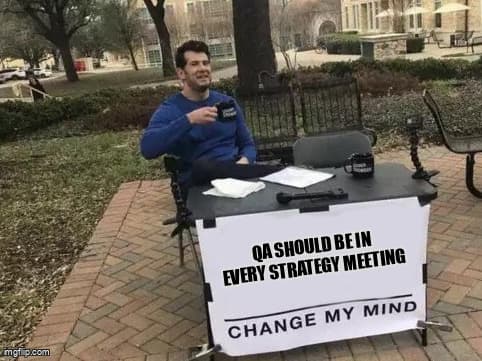
Let's play a game. Close your eyes and picture your last executive strategy meeting. Who was in the room? CEO, check. CTO, obviously. VP of Engineering, present. VP of Product, front and center. Head of Sales, definitely. VP of Marketing, making sure everyone knows about the rebrand.
Now, where was your Head of QA?
Oh right. They were busy writing test cases for the feature you already decided to ship next quarter. Without asking them if it was even testable.
The Emperor Has No Tests
Here's the uncomfortable truth that most C-suite executives refuse to acknowledge: your product strategy is being designed by people who have never written a test case, reviewed a bug report, or understood what "test coverage" actually means beyond a number on a dashboard.
You're making billion-dollar bets on market timing, feature prioritization, and competitive positioning while deliberately excluding the only people in your organization who know whether your product actually works.
It's like planning a transatlantic flight without inviting the engineer who maintains the engines. Sure, the pilots and navigators have opinions, but wouldn't you want someone who knows if the plane can actually make it across the ocean?
Why Does Excluding QA from Strategy Cost 10x More?
Defects discovered after launch cost 10 times more to fix than issues identified during planning—meaning every QA-excluded strategy decision multiplies your remediation bill tenfold.
Let me put this in terms that will make your CFO sweat: every quality decision made without QA input costs 10x more to fix post-launch. Not my opinion. Industry research. The kind your consultants bill you $500/hour to tell you.
According to the 2024 CISQ Report on the Cost of Poor Software Quality in the US, software failures cost organizations an estimated $2.41 trillion annually—with a significant portion attributable to defects that escaped quality gates.
Here's how it plays out in real life:
- Strategy meeting without QA: "Let's ship the new payment flow in 6 weeks for Black Friday."
- Engineering: "We can build it in 5 weeks, no problem."
- QA (not in the room): Would have said: "That payment flow touches 47 different edge cases across 12 international markets. We need 8 weeks minimum to test it properly, or you'll have cart abandonment issues in Germany and refund chaos in Spain."
- What actually happens: You ship on time. Black Friday hits. German customers can't complete checkout. Spanish refunds process twice. Your support team gets crushed. Engineering spends the next 3 months firefighting instead of building new features. Your competitor eats your lunch.
Congratulations. You just spent 10x what proper QA involvement would have cost, plus you missed your revenue target and damaged your brand. But hey, at least the strategy meeting was quick.
Do Companies That Treat QA as Strategic Partners Actually Ship Faster?
Yes—companies with QA embedded in strategic planning ship more frequently and with lower failure rates because they front-load risk decisions instead of discovering them in production.
Here's the plot twist that nobody expects: companies that treat QA as strategic partners don't ship slower. They ship faster.
The 2023 DORA State of DevOps Report found that elite-performing teams deploy 182 times more frequently than low performers and have a change failure rate of just 5%—capabilities that correlate directly with integrated quality practices across the full software lifecycle.
When QA leadership is in the room from day one, they can tell you:
- Which features are inherently risky and need more time vs. which can ship fast
- Where your existing test coverage is strong (ship with confidence) vs. weak (invest before shipping)
- Which technical debt is actually slowing you down vs. which is just ugly code that doesn't matter
- How to structure releases to minimize blast radius and maximize learning
- When you can skip manual testing because automation has you covered
Without QA in strategy meetings, you're flying blind. Every feature takes longer because you discover the hard stuff late. Every release is risky because you don't know what you don't know. Every sprint is disrupted by production fires that could have been prevented.
With QA in strategy meetings, you make better bets. You sequence work smarter. You invest in automation where it matters. You ship with confidence instead of crossing your fingers.
The Real Cost: Missed Market Windows
But the 10x cost multiplier isn't even the worst part. The worst part is the opportunity cost.
Every time you ship a buggy feature, you're not just fixing bugs. You're:
- Pulling engineers off new features to firefight
- Burning customer trust that takes months to rebuild
- Missing the market window while your competitor ships clean
- Creating technical debt that slows down everything else
- Demoralizing your team with preventable failures
You know what's worse than shipping 2 weeks late? Shipping on time with quality issues that take 3 months to clean up. Your competitor who shipped 2 weeks later with a solid product just won. And they're already working on the next feature while you're still fixing the last one.
Quality Strategy Should Drive Product Strategy
Here's the paradigm shift that high-performing companies have figured out: quality isn't something that follows product strategy. Quality IS product strategy.
Your QA team knows:
- Which parts of your product are actually reliable vs. held together with duct tape
- Where customers are experiencing friction that never makes it to user research
- What technical capabilities you can confidently build on vs. what needs refactoring first
- Which integrations are solid vs. which will cause problems at scale
- Where automation gives you speed vs. where you're still dependent on manual work
This is strategic intelligence. This should inform every product decision you make. But it can't, because QA isn't in the room.
The Action Plan for Leaders Who Actually Care
Alright, enough diagnosis. Here's the cure:
Step 1: Invite QA leadership to every strategy meeting. Not to take notes. Not to "provide updates." As an equal voice in decision-making. If you're planning the roadmap, QA should be in the room. If you're prioritizing features, QA should have input. If you're making go/no-go decisions, QA should have veto power.
Step 2: Change how you measure QA. Stop measuring QA by "bugs found" or "test cases written." Start measuring them by "issues prevented before production" and "time-to-confident-deploy." The best QA teams find fewer bugs because they help prevent them from being written in the first place.
Step 3: Invest in QA automation like it's infrastructure. Because it is. Your CI/CD pipeline is infrastructure. Your test automation is infrastructure. Fund it like you fund databases and cloud hosting, because without it, nothing else works reliably.
Step 4: Make quality metrics board-level KPIs. If you track ARR, CAC, and churn at the board level, you should track deployment frequency, change failure rate, and mean time to recovery. Quality metrics are business metrics. Treat them accordingly.
Step 5: Compensate QA leadership like you compensate engineering leadership. If your VP of Engineering makes $300K and your Head of QA makes $150K, you've just told your organization exactly how much you value quality. Don't be surprised when quality suffers.
The Bottom Line for CTOs and CEOs
You have a choice. You can keep excluding QA from strategy and keep paying the 10x tax on every quality issue that makes it to production. You can keep missing market windows while you firefight preventable problems. You can keep losing to competitors who figured this out years ago.
Or you can recognize that in 2025, software quality is not a technical concern. It's a competitive advantage. It's a market differentiator. It's the difference between companies that ship fast and companies that ship broken.
The companies winning in your market aren't winning because they have better developers. They're winning because they have better quality strategy. And that strategy starts by inviting QA to the table where decisions are made. This is exactly the kind of technical debt trap that can sink even the most promising startups.
Your QA team has been waiting for the invitation. The question is: how many more preventable failures will it take before you send it? For a deeper understanding of how to measure and manage these costs, see our analysis in Foundation Book IV: The Calculus of Compromise (COPQ).
Ready to Make Quality Strategic?
At Desplega AI, we help companies in Spain (Barcelona, Madrid, Valencia, Malaga) and across Europe build quality into their product strategy from day one. We work with CTOs and engineering leaders to transform QA from a bottleneck into a competitive advantage through intelligent automation, strategic testing, and quality-driven development practices.
We don't just find bugs. We prevent them. We don't just run tests. We build systems that make quality inevitable instead of accidental.
Because in the end, the companies that win aren't the ones that ship fastest. They're the ones that ship fastest with confidence. And confidence comes from having quality leadership at the strategy table.
Want to talk about how to make that happen in your organization? Let's have a conversation where QA gets a seat at the table from the start.
Related Posts
Foundation Book III: Fire Your QA Director
A provocative examination of why traditional QA leadership structures fail and how to reorganize quality assurance for modern development practices.
Test Wars Episode I: The Rise of Technical Debt
Discover how technical debt accumulates and becomes the silent killer of software projects. Learn strategies to prevent and manage technical debt before it's too late.
Foundation Book IV: The Calculus of Compromise (COPQ)
Learn how to measure the true cost of poor quality and make data-driven decisions about QA investment. Understand the hidden costs that kill profitability.
Frequently Asked Questions
Why should QA be included in executive strategy meetings?
QA leaders know which features are risky, where coverage is weak, and what technical debt will slow releases—strategic intelligence that prevents costly post-launch failures.
What is the 10x cost multiplier in software quality?
Defects found after launch cost 10 times more to fix than issues caught during planning. QA involvement in strategy decisions prevents the most expensive bugs from ever being written.
How does treating QA as a strategic partner help companies ship faster?
QA leadership identifies low-risk features that can ship quickly, flags gaps needing investment, and directs automation where it removes manual bottlenecks—reducing cycle time overall.
What metrics should CTOs track to measure software quality at the board level?
Deployment frequency, change failure rate, and mean time to recovery (MTTR) are the DORA metrics that translate quality into business outcomes boards can evaluate and act on.
Why do companies that invest in QA automation gain a competitive advantage?
Automated test suites let teams ship with confidence instead of crossing their fingers, freeing engineers from firefighting to build new features while competitors stall on bug fixes.
Related Posts
Hot Module Replacement: Why Your Dev Server Restarts Are Killing Your Flow State | desplega.ai
Stop losing 2-3 hours daily to dev server restarts. Master HMR configuration in Vite and Next.js to maintain flow state, preserve component state, and boost coding velocity by 80%.
The Flaky Test Tax: Why Your Engineering Team is Secretly Burning Cash | desplega.ai
Discover how flaky tests create a hidden operational tax that costs CTOs millions in wasted compute, developer time, and delayed releases. Calculate your flakiness cost today.
The QA Death Spiral: When Your Test Suite Becomes Your Product | desplega.ai
An executive guide to recognizing when quality initiatives consume engineering capacity. Learn to identify test suite bloat, balance coverage vs velocity, and implement pragmatic quality gates.