
The Great API Contract Theater: Why Your E2E Tests Keep Breaking on Fridays
Why backend teams treat API contracts like suggestions, frontend teams trust mocks like gospel, and QA teams debug production incidents every weekend.
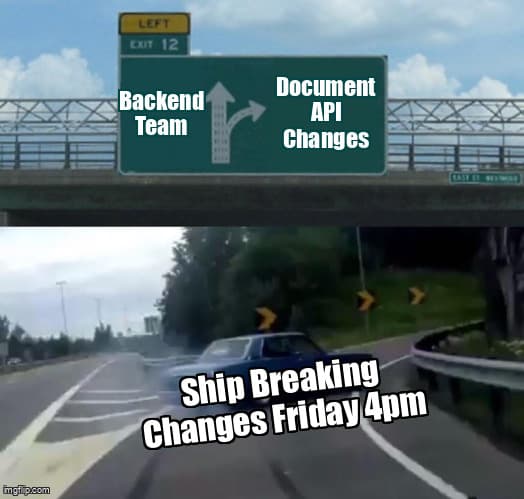
It's 4:47 PM on Friday. Your Slack lights up with 23 unread messages. The backend team just merged a "small refactor" that renamed userId to user_id across 40 endpoints. Your E2E test suite is now 87% red. The mobile team is demanding answers. The CEO is asking if the release can still ship tonight.
Welcome to the API Contract Theater—where backend teams perform elaborate pantomimes of coordination, frontend teams memorize fictional scripts (mocks), and QA teams are left translating between two groups who speak different languages. According to the 2025 State of API report by Postman, 64% of organizations experience API-related production incidents monthly, with contract mismatches causing 41% of these failures.
This isn't a tooling problem. It's an organizational dysfunction problem disguised as technical debt. Let's dissect why your company prefers expensive chaos over cheap discipline.
What is API contract testing?
API contract testing validates that API providers and consumers agree on request/response formats before integration. It catches breaking changes in development, not production.
Traditional integration testing waits until both services are deployed to verify compatibility. Contract testing flips this model: consumers define expectations (the contract), providers validate against those expectations, and breaking changes are caught in CI pipelines—before anyone merges to main.
The Three Pillars of Contract Testing
- Consumer-driven contracts: Frontend/mobile teams define what they need from APIs
- Provider validation: Backend teams verify they can fulfill consumer expectations
- CI/CD integration: Automated checks block breaking changes before deployment
Why Do Backend Teams Treat API Contracts Like Suggestions?
The answer is brutally simple: because they can. Without automated contract validation, breaking an API contract feels like changing internal implementation details. No tests fail in the backend repo. Code review passes. CI is green. Ship it.
The organizational incentives actively reward this behavior. Backend teams are measured on feature velocity and latency metrics, not integration stability. A breaking change that saves 200ms of processing time is a win on the backend scorecard, even if it causes 8 hours of debugging downstream.
| Backend Perspective | Frontend Perspective | Reality Check |
|---|---|---|
| "Just a minor field rename" | "5 screens need refactoring" | Contract test would flag in 2 minutes |
| "New validation rules improve data quality" | "Our forms now reject valid inputs" | Schema validation prevents deployment |
| "We deprecated v1, use v2" | "Mobile apps can't force-update users" | Consumer contracts track version usage |
The cultural barrier is even worse: backend teams often view contract testing as "extra work for frontend convenience." This framing is backwards. Contract tests protect backend teams from support escalations, incident war rooms, and emergency rollbacks that cost 10x more than writing the tests.
The Mock Gospel: Why Frontend Tests Lie
Frontend teams build intricate mock servers that return perfectly formatted responses. Unit tests pass. Integration tests (against mocks) pass. Code coverage hits 90%. Everyone celebrates—until production.
The mocks are fiction. They represent what frontend engineers wish the API would return, not what it actually returns. Field types mismatch. Enum values differ. Error response formats are completely wrong. The frontend team has been testing against a beautiful lie.
// Frontend mock (what we wish for)
const mockUser = {
  userId: 12345,
  name: "Jane Smith",
  createdAt: "2026-01-15T10:30:00Z",
  status: "active"
};

// Actual API response (reality)
const realUser = {
  user_id: "12345",           // String, not number
  full_name: "Jane Smith",    // Different field name
  created_at: 1705315800,     // Unix timestamp, not ISO string
  account_status: "ACTIVE"    // SCREAMING_SNAKE_CASE
};
This isn't a frontend competence issue—it's an information asymmetry problem. Frontend engineers write mocks based on outdated API documentation, verbal agreements, or pure speculation. Without consumer-driven contracts validated by the provider, there's no source of truth.
According to SmartBear's 2025 State of Software Quality report, teams using contract testing reduce integration defects by 73% compared to mock-only testing. The key insight: contract tests are validated by both sides of the integration, while mocks are one team's fantasy.
The QA Team's Weekend: Debugging the Gap
QA teams run E2E tests against real integrated environments. These tests are the only validation layer that uses actual APIs, not mocks. This makes QA the unfortunate messengers of bad news: "The backend changed, everything's broken, we can't ship."
The Friday afternoon deployment becomes a Saturday debugging marathon. QA engineers trace through network logs, compare responses to mock definitions, file bug tickets with insufficient context, and wait for Monday when backend engineers return from their weekend.
The Cost of Chaos: A Real Example
A Series B SaaS company tracked costs for one quarter before implementing contract testing:
- 11 integration incidents: Average 6 hours of engineer time each (66 hours total)
- 3 production hotfixes: Emergency weekend deployments (24 additional hours)
- Blended engineer cost: $150/hour × 90 hours = $13,500
- Lost revenue: Two incidents caused checkout failures ($47,000 estimated impact)
- Total quarterly cost: $60,500
Contract testing implementation took 2 engineers 3 weeks ($18,000). It prevented 9 of the 11 incidents in the following quarter. ROI: 236% in 6 months.
The Business Case for Contract Testing
Engineering leaders struggle to justify contract testing investment because the value is preventative. You're selling "incidents that didn't happen" to executives who measure outputs, not avoided disasters.
Reframe the conversation around three measurable costs:
- Incident response costs: Track engineer hours spent debugging integration issues (Jira time logs, incident retrospectives)
- Deployment delays: Calculate revenue impact of delayed feature launches caused by last-minute integration failures
- Technical debt accumulation: Quantify time spent maintaining brittle E2E tests that break on every API change
Present leadership with a simple equation: Cost of contract testing implementation vs. cost of next quarter's integration incidents. Use historical data. One prevented production outage typically covers 6-12 months of contract testing implementation.
How to Implement Contract Testing (Without Organizational Warfare)
Start with the highest-risk integration: the API that changes frequently and breaks things. Don't try to boil the ocean by contract-testing every endpoint on day one.
Step 1: Choose Your Tool Based on Architecture
| Tool | Best For | Key Features |
|---|---|---|
| Pact | Microservices, consumer-driven workflows | Broker for contract sharing, language-agnostic |
| Spring Cloud Contract | JVM-based backends (Spring Boot) | Provider-first contracts, auto-generates stubs |
| OpenAPI + validators | REST APIs with existing specs | Spec-driven validation (Spectral, Prism) |
Step 2: Frontend Defines Consumer Contract
// Pact consumer test (frontend)
describe('User API', () => {
  beforeEach(() => {
    const interaction = {
      state: 'user 12345 exists',
      uponReceiving: 'a request for user 12345',
      withRequest: {
        method: 'GET',
        path: '/api/users/12345',
      },
      willRespondWith: {
        status: 200,
        body: {
          userId: Matchers.integer(12345),
          name: Matchers.string('Jane Smith'),
          createdAt: Matchers.iso8601DateTime('2026-01-15T10:30:00Z'),
          status: Matchers.term({ generate: 'active', matcher: 'active|suspended' }),
        },
      },
    };
    provider.addInteraction(interaction);
  });

  it('fetches user successfully', async () => {
    const user = await fetchUser(12345);
    expect(user.userId).toBe(12345);
  });
});
Step 3: Backend Validates Against Contract
// Pact provider verification (backend)
const { Verifier } = require('@pact-foundation/pact');

describe('Pact Verification', () => {
  it('validates against frontend contracts', () => {
    return new Verifier({
      provider: 'UserAPI',
      providerBaseUrl: 'http://localhost:8080',
      pactBrokerUrl: 'https://pact-broker.company.com',
      publishVerificationResult: true,
      providerVersion: process.env.GIT_SHA,
    }).verifyProvider();
  });
});
Step 4: CI Pipeline Enforcement
- Frontend CI: Generate consumer contracts on every PR
- Pact Broker: Stores contracts as source of truth
- Backend CI: Verifies provider can fulfill all consumer contracts
- Can-I-Deploy check: Blocks deployment if contracts break
Why Most Companies Choose Chaos Over Discipline
Contract testing adoption is embarrassingly low despite clear ROI. The 2025 Postman API report found only 23% of organizations use contract testing, even though 64% experience monthly API incidents.
The blockers are organizational, not technical:
- Coordination overhead: Contract testing requires frontend and backend teams to collaborate before building features (gasp!)
- Slowed velocity perception: Writing contracts feels slower than merging code fast and fixing issues later (even though incidents cost 10x more)
- Lack of executive visibility: Integration incidents don't trigger escalation until they cause customer-facing outages
- Sunk cost fallacy: Teams have invested heavily in E2E tests and resist admitting they test the wrong things too late
The irony is painful: companies spend $200K/year on incident response, yet balk at a $30K contract testing implementation. They optimize for short-term velocity while bleeding money on preventable failures.
Key Takeaways
- API contract breaches cost 10x more than prevention - One prevented outage covers 6-12 months of contract testing implementation
- Mock-only testing creates false confidence - Mocks represent wishes, not reality. Contract tests validated by providers are the source of truth
- Organizational incentives reward chaos - Backend teams are measured on velocity, not integration stability. Change the metrics to change behavior
- Start with highest-risk APIs - Don't boil the ocean. Contract-test the API that changes most and breaks things regularly
- Reframe ROI around avoided incidents - Track historical incident costs, present leadership with quarterly comparison
The Hidden Truth
Your E2E tests aren't catching integration issues because they're designed wrong. They test happy paths in stable environments. Contract tests catch the subtle breakages—field type changes, enum mismatches, validation rule updates—that cause 80% of integration incidents. Stop testing if integrations work when nothing changes. Start testing if they work when everything changes.
The next time your backend team proposes a "small refactor" on Friday afternoon, ask them one question: "Did the contract tests pass?" If the answer is silence, you've found your problem.
Ready to strengthen your test automation?
Desplega.ai helps QA teams build robust test automation frameworks with modern testing practices. Whether you're starting from scratch or improving existing pipelines, we provide the tools and expertise to catch bugs before production.
Start Your Testing TransformationFrequently Asked Questions
What is API contract testing?
API contract testing validates that API providers and consumers agree on request/response formats before integration. It catches breaking changes in development, not production.
How much does contract testing save versus debugging production incidents?
Organizations implementing contract testing report 10x ROI. A 2-hour contract test setup prevents 20+ hours of weekend incident debugging and lost revenue from outages.
Why do backend teams break API contracts?
Without automated contract validation, backend teams lack visibility into consumer dependencies. Organizational silos reward speed over coordination, making breaking changes the path of least resistance.
Should we use Pact, Spring Cloud Contract, or OpenAPI for contract testing?
Pact excels for microservices with consumer-driven contracts. Spring Cloud Contract fits JVM ecosystems. OpenAPI specs work for REST APIs but require additional validation tooling.
How do we convince leadership to invest in contract testing?
Present incident cost data (engineer hours × hourly rate + revenue loss). One prevented production outage typically covers 6-12 months of contract testing implementation.
Related Posts
When I Reject v0 Code: Pattern-Matching Rules for Safer UI Generation
A practical v0 review gate for safer generated React UI: AST checks, Playwright smoke tests, accessibility rules, and rejection signals.
Cody's Repository Indexing: Does Cognitive Offloading Create Knowledge Gaps in Large Codebases? | Desplega AI
A practical deep dive into Cody repository indexing, context retrieval, and how indie hackers avoid AI-created knowledge gaps.
Hot Module Replacement: Why Your Dev Server Restarts Are Killing Your Flow State | desplega.ai
Stop losing 2-3 hours daily to dev server restarts. Master HMR configuration in Vite and Next.js to maintain flow state, preserve component state, and boost coding velocity by 80%.