Level Up Your Asset Lifecycle: Architecture Patterns from the Apple iPhone Upgrade Program for Enterprise Device Testing
Borrow the best idea from upgrade programs: every device needs a contract for how it enters, works, returns, and leaves.
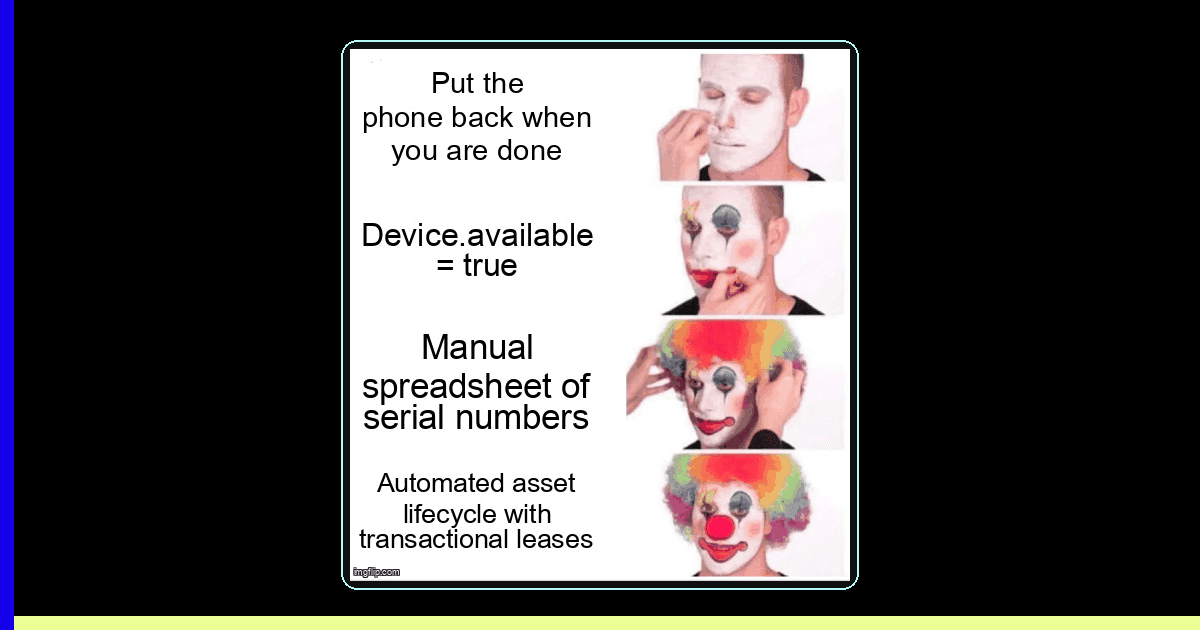
Your first mobile test lab probably starts with a spreadsheet, a USB hub, and a heroic rule: “put the phone back when you are done.” That works until a CI worker crashes, a beta OS appears overnight, or a test account remains signed in for the next person. The problem is no longer test syntax. It is asset lifecycle architecture.
The Apple iPhone Upgrade Program offers a useful mental model. Customers do not simply receive hardware; they enter a managed cycle with identity checks, recurring payments, eligibility rules, device condition requirements, and a return or replacement step. We are borrowing the public shape of that lifecycle—not claiming to reproduce Apple's internal systems—and applying it to enterprise testing fleets.
One current-context note matters: Apple's live program page now says the iPhone Upgrade Program is coming to an end. Existing members can continue payments, while Apple points customers toward its newer Apple Upgrade lease. That makes this a retrospective architecture lesson, not enrollment advice. The program's published terms still document a particularly clear state machine.
The professional move is simple: stop modeling a phone as a row with available: true. Model it as an asset moving through explicit, auditable states under a time-bounded lease.
Why does a test device need a lifecycle instead of an available flag?
A lifecycle makes ownership, expiry, cleanup, health, and retirement explicit, so crashed jobs cannot silently poison the next test run.
A Boolean cannot explain whether a device is unavailable because it is running a test, charging, disconnected, awaiting a wipe, or unsafe. Those cases require different recovery actions. Collapsing them into one flag creates race conditions and invites operators to “fix” the fleet by flipping database values.
Upgrade programs teach a more durable pattern: eligibility is computed from several facts, and handoff happens through a contract. In a test lab, that contract is a lease with an owner, purpose, start time, expiry, requested capabilities, and cleanup policy. The asset has a separate lifecycle state and health record.
- Lifecycle state: intake, ready, leased, sanitizing, quarantined, repair, or retired.
- Lease state: active, released, expired, or revoked.
- Health: battery, connectivity, storage, screen, attestation, and recent failure signals.
- Capabilities: model family, OS version, locale, carrier profile, sensors, and installed build.
Keep those dimensions independent. A healthy phone can be busy. An idle phone can be unhealthy. If you are also migrating browser suites into professional CI, this Playwright test infrastructure guide is a useful companion.
Pattern 1: Make the state machine reject impossible transitions
The state machine is your first quality gate. Put transition rules in one domain module instead of scattering them across API routes, cron jobs, and UI buttons. The following Node.js TypeScript file is runnable with npx tsx lifecycle.ts. It handles duplicate callbacks, refuses an unsafe return, and records why a device was quarantined.
type State =
  | "intake" | "ready" | "leased" | "sanitizing"
  | "quarantined" | "repair" | "retired";

type Event =
  | { type: "INSPECTION_PASSED" }
  | { type: "LEASE_STARTED"; leaseId: string }
  | { type: "LEASE_ENDED"; leaseId: string }
  | { type: "SANITIZATION_PASSED" }
  | { type: "CHECK_FAILED"; reason: string }
  | { type: "RETIRED"; reason: string };

type Asset = {
  id: string;
  state: State;
  activeLeaseId?: string;
  lastEventKey?: string;
  quarantineReason?: string;
};

export function transition(asset: Asset, event: Event, eventKey: string): Asset {
  if (!eventKey.trim()) throw new Error("eventKey is required for idempotency");
  if (asset.lastEventKey === eventKey) return asset; // duplicate webhook

  if (event.type === "CHECK_FAILED") {
    if (!event.reason.trim()) throw new Error("quarantine requires a reason");
    return { ...asset, state: "quarantined", activeLeaseId: undefined,
      quarantineReason: event.reason, lastEventKey: eventKey };
  }
  if (event.type === "RETIRED") {
    if (asset.state === "leased") throw new Error("cannot retire an actively leased asset");
    return { ...asset, state: "retired", activeLeaseId: undefined,
      lastEventKey: eventKey };
  }

  const next: Partial<Record<State, Partial<Record<Event["type"], State>>>> = {
    intake: { INSPECTION_PASSED: "ready" },
    ready: { LEASE_STARTED: "leased" },
    leased: { LEASE_ENDED: "sanitizing" },
    sanitizing: { SANITIZATION_PASSED: "ready" },
  };
  const target = next[asset.state]?.[event.type];
  if (!target) throw new Error(`invalid transition: ${asset.state} + ${event.type}`);

  if (event.type === "LEASE_STARTED" && asset.activeLeaseId) {
    throw new Error(`asset already leased by ${asset.activeLeaseId}`);
  }
  if (event.type === "LEASE_ENDED" && asset.activeLeaseId !== event.leaseId) {
    throw new Error("stale or foreign lease cannot return this asset");
  }

  return {
    ...asset,
    state: target,
    activeLeaseId: event.type === "LEASE_STARTED" ? event.leaseId
      : event.type === "LEASE_ENDED" ? undefined : asset.activeLeaseId,
    lastEventKey: eventKey,
  };
}

try {
  let phone: Asset = { id: "iphone-042", state: "ready" };
  phone = transition(phone, { type: "LEASE_STARTED", leaseId: "run-901" }, "evt-1");
  phone = transition(phone, { type: "LEASE_ENDED", leaseId: "run-901" }, "evt-2");
  phone = transition(phone, { type: "SANITIZATION_PASSED" }, "evt-3");
  console.log(phone);
} catch (error) {
  console.error("Lifecycle update rejected", error);
  process.exitCode = 1;
}
Notice the return path: leased → sanitizing → ready. A finished test does not make a device reusable. Only verified cleanup does. That small distinction blocks leaked sessions, stale push tokens, screenshots, downloaded files, and altered accessibility settings from crossing job boundaries.
Pattern 2: Allocate capabilities with a transactional lease
Professional schedulers allocate what a test needs, not a hard-coded serial number. A checkout flow might require iOS 18+, a biometric-capable physical phone, Spanish locale, and a healthy battery. A visual test may accept any matching simulator. Those are capability predicates.
Allocation must also be atomic. Two CI workers can read the same “ready” device at the same millisecond. PostgreSQL's FOR UPDATE SKIP LOCKED lets each transaction lock a different eligible row without serializing the whole queue. The runnable example below uses pg, rolls back on every failure, excludes expired health reports, and returns a typed “no match” error instead of waiting forever.
// npm i pg && npm i -D @types/pg tsx
import { Pool } from "pg";
import { randomUUID } from "node:crypto";

const pool = new Pool({ connectionString: process.env.DATABASE_URL });

type Request = { workerId: string; minOs: number; locale: string; ttlSeconds: number };
type Lease = { leaseId: string; assetId: string; expiresAt: string };

export async function allocate(req: Request): Promise<Lease> {
  if (!req.workerId.trim()) throw new Error("workerId is required");
  if (!Number.isInteger(req.minOs) || req.minOs < 16) throw new Error("unsupported minOs");
  if (req.ttlSeconds < 60 || req.ttlSeconds > 3600) throw new Error("ttl out of range");

  const client = await pool.connect();
  try {
    await client.query("BEGIN");
    const candidate = await client.query<{ id: string }>(`
      SELECT id FROM assets
      WHERE lifecycle_state = 'ready'
        AND health_state = 'healthy'
        AND os_major >= $1
        AND locale = $2
        AND health_checked_at > now() - interval '15 minutes'
        AND NOT EXISTS (
          SELECT 1 FROM leases
          WHERE leases.asset_id = assets.id AND leases.status = 'active'
        )
      ORDER BY last_leased_at NULLS FIRST
      FOR UPDATE SKIP LOCKED
      LIMIT 1`, [req.minOs, req.locale]);

    if (candidate.rowCount !== 1) {
      throw new Error("NO_ELIGIBLE_DEVICE");
    }

    const leaseId = randomUUID();
    const inserted = await client.query<{ expires_at: Date }>(`
      INSERT INTO leases (id, asset_id, worker_id, status, expires_at)
      VALUES ($1, $2, $3, 'active', now() + ($4 * interval '1 second'))
      RETURNING expires_at`,
      [leaseId, candidate.rows[0].id, req.workerId, req.ttlSeconds]);

    await client.query(`
      UPDATE assets SET lifecycle_state = 'leased', last_leased_at = now()
      WHERE id = $1`, [candidate.rows[0].id]);
    await client.query("COMMIT");

    return {
      leaseId,
      assetId: candidate.rows[0].id,
      expiresAt: inserted.rows[0].expires_at.toISOString(),
    };
  } catch (error) {
    await client.query("ROLLBACK").catch((rollbackError) =>
      console.error("rollback failed", rollbackError));
    throw error;
  } finally {
    client.release();
  }
}

allocate({ workerId: "ci-17", minOs: 18, locale: "es-ES", ttlSeconds: 900 })
  .then(console.log)
  .catch((error) => {
    console.error("allocation failed", error);
    process.exitCode = 1;
  })
  .finally(() => pool.end());
The health_checked_at predicate is deliberate. “Healthy last Tuesday” is not good enough after a cable swap or OS update. Tune freshness by fleet behavior, then let the health service renew it. Also add a partial unique index on active leases per asset; application code is not a substitute for a database invariant.
What does the Apple upgrade model teach a small test team?
Separate eligibility, handoff, condition checks, and renewal; each deserves evidence, ownership, and a failure path before automation scales.
Apple's public program makes several boundaries visible. The U.S. iPhone Upgrade Program terms describe a 24-month, 0% APR installment structure, with upgrade eligibility after the equivalent of 12 payments, continuous AppleCare+ coverage, an account in good standing, and a device that passes inspection. If an online upgrade's old phone is not returned within 14 days, the old loan can be reinstated. Those are product terms, not our architecture, but the separation is instructive: payment status, eligibility, protection, inspection, and physical return are related without being the same fact.
Your fleet needs the same separation. A test finishing successfully does not prove the phone is clean. A phone being physically connected does not prove WebDriver can create a session. A lease expiring does not prove the worker stopped touching the device. Each transition needs its own evidence.
Two real scale signals put this discipline in context. Apple reports that, among iPhones transacting on the App Store on June 7, 2026, 86% of models introduced in the previous four years used iOS 26, versus 79% across all iPhones. Your supported matrix still needs older versions. Separately, the ITU and UNITAR's Global E-waste Monitor 2024 reports 62 million tonnes of e-waste generated in 2022, with only 22.3% documented as formally collected and recycled. Lifecycle decisions eventually become disposal decisions.
From vibe-coded scripts to a professional control plane
You do not need a giant platform on day one. You need boundaries that survive the next failure. The table shows the code-level migration.
| Concern | Starter code | Professional pattern |
|---|---|---|
| Availability | device.available = false | lease(asset, owner, expiresAt) |
| Selection | devices[0] | match(capabilities, health, freshness) |
| Cleanup | afterEach(() => reset()) | sanitizing → verify → ready | quarantine |
| Crash recovery | ask in Slack | reconcileExpiredLeases() |
| Audit | console.log() | appendEvent(assetId, eventKey, evidence) |
Start with a single service and PostgreSQL. Split services only when ownership or load demands it. The important boundary is conceptual: tests request leases; they do not edit asset state directly. Operators invoke controlled commands; they do not patch rows. If you need a practical route from local automation to managed runs, see how Playwright and Selenium behave in CI.
Pattern 3: Make Playwright release devices even when tests explode
A fixture is the right boundary between test intent and fleet mechanics. The test asks for capabilities; the fixture acquires a lease, supplies the endpoint, and releases the lease in a finally-style teardown. Cleanup failure must fail or quarantine the asset, not merely print a warning.
// device-fixture.spec.ts — run with: npx playwright test
import { test as base, expect, request } from "@playwright/test";

type Lease = { id: string; assetId: string; endpoint: string; expiresAt: string };
type Fixtures = { deviceLease: Lease };

const test = base.extend<Fixtures>({
  deviceLease: async ({}, use, testInfo) => {
    const api = await request.newContext({
      baseURL: process.env.DEVICE_API_URL,
      extraHTTPHeaders: { authorization: `Bearer ${process.env.DEVICE_API_TOKEN ?? ""}` },
    });
    let lease: Lease | undefined;
    try {
      if (!process.env.DEVICE_API_TOKEN) throw new Error("DEVICE_API_TOKEN is missing");
      const response = await api.post("/leases", {
        data: { owner: testInfo.testId, capabilities: { os: ">=18", locale: "es-ES" }, ttlSeconds: 1200 },
        timeout: 30_000,
      });
      if (response.status() === 409) test.skip(true, "No matching healthy device is currently available");
      if (!response.ok()) throw new Error(`lease failed: ${response.status()} ${await response.text()}`);
      lease = await response.json() as Lease;
      if (Date.parse(lease.expiresAt) <= Date.now()) throw new Error("API returned an expired lease");

      await use(lease);
    } catch (error) {
      testInfo.annotations.push({ type: "device-infra", description: String(error) });
      throw error;
    } finally {
      if (lease) {
        const release = await api.post(`/leases/${lease.id}/release`, {
          data: { outcome: testInfo.status, sanitize: true }, timeout: 60_000,
        }).catch(() => undefined);
        if (!release?.ok()) {
          await api.post(`/assets/${lease.assetId}/quarantine`, {
            data: { reason: "lease release or sanitization failed", leaseId: lease.id },
          }).catch((quarantineError) => console.error("quarantine failed", quarantineError));
          throw new Error(`device ${lease.assetId} could not be safely released`);
        }
      }
      await api.dispose();
    }
  },
});

test("checkout survives an interrupted payment retry", async ({ deviceLease }) => {
  const session = await request.newContext({ baseURL: deviceLease.endpoint });
  try {
    const result = await session.post("/run", {
      data: { app: "shop", scenario: "payment-retry", network: "lossy" },
    });
    expect(result.ok()).toBeTruthy();
  } finally {
    await session.dispose();
  }
});
A 409 means capacity, not product failure, so the example skips with a precise reason. Authentication errors, malformed leases, and cleanup failures remain hard failures. Decide whether your CI queue should retry capacity misses, but cap retries and preserve the original request ID.
Pattern 4: Reconcile reality after workers disappear
Teardown is necessary but insufficient. Processes are killed, runners lose power, and networks partition. A reconciliation loop compares desired state with observed reality. It claims expired leases, probes the device, sanitizes it, and moves it to ready or quarantine. The job must be idempotent because two scheduler ticks can overlap.
// reconcile.ts — run on a scheduler with: npx tsx reconcile.ts
type ExpiredLease = { id: string; assetId: string };

async function api<T>(path: string, init?: RequestInit): Promise<T> {
  const response = await fetch(`${process.env.DEVICE_API_URL}${path}`, {
    ...init,
    headers: { "content-type": "application/json", authorization: `Bearer ${process.env.DEVICE_API_TOKEN}` },
    signal: AbortSignal.timeout(30_000),
  });
  if (!response.ok()) throw new Error(`${path}: ${response.status()} ${await response.text()}`);
  return response.json() as Promise<T>;
}

export async function reconcile(limit = 25): Promise<void> {
  if (!Number.isInteger(limit) || limit < 1 || limit > 100) throw new Error("invalid limit");
  const leases = await api<ExpiredLease[]>(`/leases/expired?limit=${limit}`);

  for (const lease of leases) {
    const eventKey = `reconcile:${lease.id}`; // server deduplicates this key
    try {
      const claim = await api<{ claimed: boolean }>(`/leases/${lease.id}/recovery-claim`, {
        method: "POST", body: JSON.stringify({ eventKey }),
      });
      if (!claim.claimed) continue; // another reconciler owns it

      await api(`/assets/${lease.assetId}/sanitize`, {
        method: "POST", body: JSON.stringify({ eventKey, verifyBaseline: true }),
      });
      await api(`/leases/${lease.id}/recovered`, {
        method: "POST", body: JSON.stringify({ eventKey }),
      });
    } catch (error) {
      console.error("recovery failed", { lease, error });
      await api(`/assets/${lease.assetId}/quarantine`, {
        method: "POST",
        body: JSON.stringify({ eventKey, reason: "expired lease recovery failed" }),
      }).catch((quarantineError) => console.error("quarantine also failed", quarantineError));
    }
  }
}

reconcile(Number(process.env.RECOVERY_BATCH ?? 25)).catch((error) => {
  console.error("reconciler crashed", error);
  process.exitCode = 1;
});
Edge case: a late worker may resume after its lease expires. Every device command should carry the lease ID, and the gateway must reject commands from expired or revoked leases. Recovery is not safe if stale owners can still operate hardware.
Troubleshooting and debugging the lifecycle
Debug state transitions from evidence, not intuition. For every incident, collect the asset ID, lease ID, event key, worker ID, lifecycle version, and monotonic timestamps. Then follow the boundary that failed.
- Device is “leased” forever: compare lease expiry with scheduler time, inspect reconciler claims, and verify database time rather than runner time. Clock skew is a classic gotcha.
- Two tests touch one phone: look for missing row locks or a missing unique constraint. Reproduce with concurrent requests, not a sequential loop.
- No device matches: log the rejected predicates—OS, locale, health freshness, or capability—not just “none available.” A stale health check often masquerades as zero capacity.
- Cleanup passes but state is dirty: verify the baseline with observable checks such as installed app version, account state, permissions, proxy profile, storage, and screenshot hash. A successful command is not proof of outcome.
- Duplicate return webhook fails: persist event keys and return the prior result. Webhooks and queues provide at-least-once delivery in many real systems.
- Quarantine keeps growing: group by failure reason, cable/hub, model, OS build, and last updater. Never bulk-release quarantine without rerunning the health contract.
Your emergency rule: when state and reality disagree, make the asset less available. Quarantine is a safety valve, not an admission of defeat.
Gotchas you should design for now
- Identity drift: serial number, UDID, MDM ID, and USB path are different identifiers. Store mappings and quarantine conflicts.
- OS upgrades: an automatic update changes capabilities. Detect it during health checks before scheduling version-specific tests.
- Battery and heat: charging does not imply readiness. Thermal throttling and low battery health can make timing tests misleading.
- Local state: locale, time zone, permissions, VPN, certificates, accessibility options, and keyboard settings all survive longer than expected.
- Privacy: screenshots, logs, notification previews, and test credentials are data. Define retention and erasure alongside sanitization.
- Retirement: remove MDM enrollment, revoke certificates, erase data, record disposition, and use a responsible recycling or resale channel.
A practical migration plan
Week one: inventory every asset and normalize identity. Week two: add lifecycle states and an append-only event log. Week three: put allocation behind transactional leases. Week four: make sanitization a required transition and ship the reconciler. Only then add a dashboard.
Keep the first version boring. PostgreSQL, a small TypeScript API, a health agent, and Playwright fixtures are enough. The sophistication belongs in invariants: one active lease per asset, no ready state without recent health evidence, no release without sanitization evidence, and no commands from expired owners.
That is the real level-up. You are not replacing a spreadsheet with a prettier spreadsheet. You are turning a pile of fragile hardware into test infrastructure that can explain who owns each device, why it is trusted, what happens next, and how the system recovers when a human or machine disappears.
Ready to level up your dev toolkit?
Desplega.ai helps developers transition to professional tools smoothly...
Get StartedFrequently Asked Questions
Why use leases instead of assigning devices directly to test jobs?
A lease has an owner, expiry, and cleanup contract. That lets the platform recover phones after crashed jobs without guessing whether another worker still owns them.
Should device health and availability be the same status?
No. Health describes whether hardware is trustworthy; availability describes whether it can be allocated now. Separating them prevents busy devices from looking broken.
How do I stop tests leaking accounts and data onto shared phones?
Make sanitization a verified lifecycle transition, not an afterthought. Revoke credentials, clear app data, confirm baseline state, and quarantine on any failed check.
When should a device be quarantined automatically?
Quarantine after failed sanitization, conflicting identifiers, repeated disconnects, unexpected OS changes, or attestation drift. Require evidence before returning it.
Related Posts
When I Reject v0 Code: Pattern-Matching Rules for Safer UI Generation
A practical v0 review gate for safer generated React UI: AST checks, Playwright smoke tests, accessibility rules, and rejection signals.
Cody's Repository Indexing: Does Cognitive Offloading Create Knowledge Gaps in Large Codebases? | Desplega AI
A practical deep dive into Cody repository indexing, context retrieval, and how indie hackers avoid AI-created knowledge gaps.
Hot Module Replacement: Why Your Dev Server Restarts Are Killing Your Flow State | desplega.ai
Stop losing 2-3 hours daily to dev server restarts. Master HMR configuration in Vite and Next.js to maintain flow state, preserve component state, and boost coding velocity by 80%.