Shadow DOM Testing: Piercing the Veil in Playwright and Cypress
Your selectors aren't broken — they just can't see through the shadow boundary. Here's how to fix that.
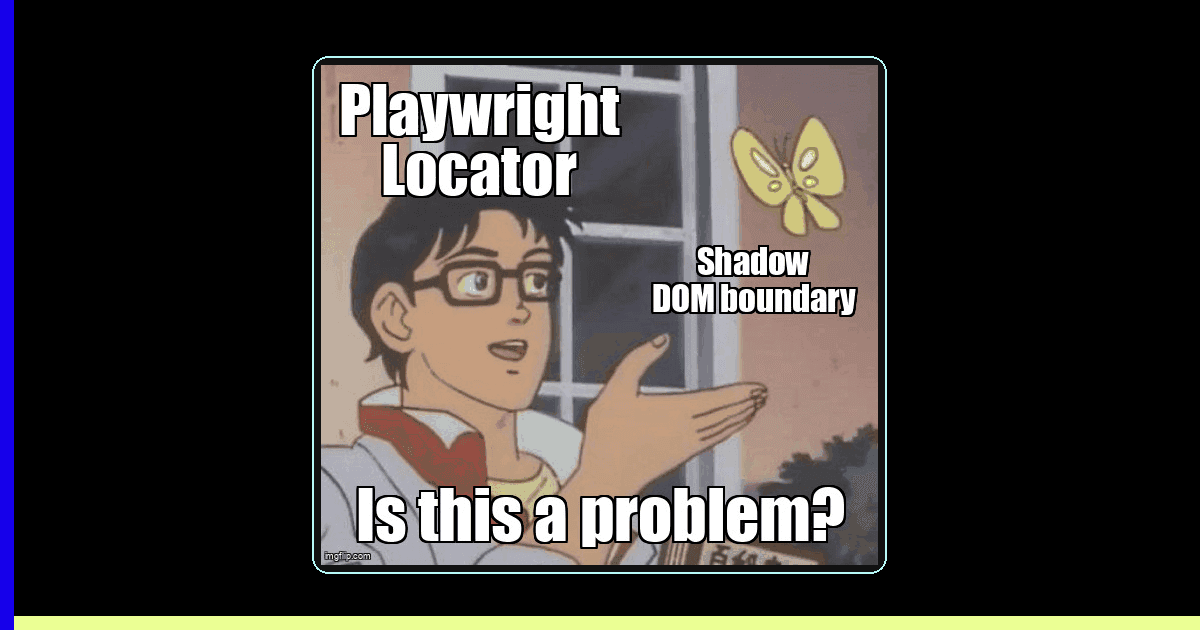
You write a perfectly valid CSS selector. You run your test. It returns null. You stare at DevTools, confirm the element exists, and wonder if you're losing your mind. You're not — you just ran headfirst into Shadow DOM.
Shadow DOM is the encapsulation layer that makes modern web components work. It's also one of the most consistent sources of test automation pain in 2026. This guide gives you the complete picture: what Shadow DOM is, why your selectors fail, and exactly how to fix them in Playwright, Cypress, and Selenium.
What Is Shadow DOM and Why Do Selectors Fail?
Shadow DOM is an encapsulated subtree attached to a host element, isolated from the main document. Standard querySelector and CSS selectors cannot cross the shadow boundary by design — they stop at the shadow root and return null.
The browser intentionally enforces this boundary. When a component author writes <my-datepicker>, they attach a shadow root and render internal markup inside it. From the main document's perspective, that internal markup is invisible to document.querySelector.
There are two shadow DOM modes:
- Open mode —
element.shadowRootis accessible from JavaScript. Most design system libraries use this. - Closed mode —
element.shadowRootreturns null. Rare in userland components, common in browser-native elements (file inputs, date pickers, video controls).
According to the 2025 State of Testing report by Tricentis, 43% of QA engineers list Shadow DOM as a top-three source of selector brittleness in component-heavy applications. The problem compounds when components nest shadow roots inside other shadow roots — which design systems do routinely.
How Does Playwright Handle Shadow DOM?
Playwright's locator engine pierces open shadow roots automatically. When you call page.locator('input[type="email"]'), Playwright searches the entire composed DOM tree — including all open shadow roots — without any extra configuration.
This automatic piercing covers the majority of real-world cases. Here is what it looks like in practice:
// Playwright auto-pierces open shadow roots
// This works even if the input lives inside a shadow root
const emailInput = page.locator('input[type="email"]');
await emailInput.fill('user@example.com');

// Works across nested shadow roots too:
// <my-form> (shadow root) → <my-field> (shadow root) → <input>
await page.locator('input[placeholder="Email address"]').fill('user@example.com');
When you need to be explicit — for debugging, documentation, or scoping — Playwright also supports the >> CSS combinator and chained locator() calls:
// Explicit shadow piercing with >> combinator
await page.locator('my-datepicker >> input[type="text"]').fill('2026-02-23');

// Equivalent using locator chaining (preferred for readability)
const picker = page.locator('my-datepicker');
const input = picker.locator('input[type="text"]');
await input.fill('2026-02-23');

// Scoped to a specific shadow host before piercing
const form = page.locator('my-checkout-form');
await form.locator('button[type="submit"]').click();
Playwright Shadow DOM Selector Priority
Playwright evaluates selectors in this order: role → text → test ID → CSS (with auto-piercing). Prefer getByRole and getByLabel — they pierce shadows automatically and are more resilient to DOM restructuring than CSS selectors.
// Most resilient: accessibility-based locators (also pierce shadows)
await page.getByRole('button', { name: 'Submit order' }).click();
await page.getByLabel('Email address').fill('user@example.com');
await page.getByPlaceholder('Search products...').type('widget');

// These work even when the elements are deep inside shadow roots
How Do You Test Shadow DOM in Cypress?
Cypress does not auto-pierce shadow roots by default. You have two practical paths: the includeShadowDom global option, or targeted shadow traversal using .shadow().
The global option is the fastest way to enable piercing across your entire suite:
// cypress.config.ts — enable shadow DOM piercing globally
import { defineConfig } from 'cypress';

export default defineConfig({
  e2e: {
    includeShadowDom: true,   // ← pierce all open shadow roots
  },
});

// Now standard cy commands work across shadow boundaries:
cy.get('my-datepicker input[type="text"]').type('2026-02-23');
cy.get('my-button button').click();
When you need surgical control — or when only specific selectors should pierce — use the .shadow() command:
// Targeted shadow traversal with .shadow()
cy.get('my-datepicker')
  .shadow()
  .find('input[type="text"]')
  .type('2026-02-23');

// Chaining through nested shadow roots
cy.get('my-checkout-form')
  .shadow()
  .find('my-address-field')
  .shadow()
  .find('input[name="zip"]')
  .type('28001');
For deep, reusable traversal across your test suite, encapsulate the logic in a custom command:
// cypress/support/commands.ts

// Recursively pierce shadow roots to find a selector
Cypress.Commands.add(
  'shadowGet',
  { prevSubject: 'optional' },
  (subject, selector: string) => {
    const getFromShadow = (
      $el: JQuery<HTMLElement>,
      sel: string
    ): JQuery<HTMLElement> => {
      const shadowRoot = $el[0].shadowRoot;
      if (!shadowRoot) return $el.find(sel);

      const found = Cypress.$(shadowRoot).find(sel);
      if (found.length) return found;

      // Recurse into nested shadow hosts
      let result = Cypress.$();
      $el.find('*').each((_, child) => {
        if ((child as HTMLElement).shadowRoot) {
          result = result.add(
            getFromShadow(Cypress.$(child), sel)
          );
        }
      });
      return result;
    };

    const root = subject ?? Cypress.$('body');
    return cy.wrap(getFromShadow(root, selector));
  }
);

// Usage in tests:
cy.get('my-datepicker').shadowGet('input[type="text"]').type('2026-02-23');
cy.shadowGet('button[data-testid="submit"]').click();
What About Selenium and Browser-Native Shadow Elements?
Selenium's standard findElement() cannot cross shadow boundaries. You must use JavaScript execution or Chrome DevTools Protocol (CDP) to reach shadow root elements.
For open shadow roots, JavaScript execution is the most portable approach:
// Python — Selenium JavaScript shadow DOM traversal
from selenium import webdriver
from selenium.webdriver.common.by import By

driver = webdriver.Chrome()
driver.get("https://example.com")

# Single level: reach into one shadow root
shadow_host = driver.find_element(By.CSS_SELECTOR, "my-datepicker")
shadow_input = driver.execute_script(
    "return arguments[0].shadowRoot.querySelector('input[type=text]')",
    shadow_host
)
shadow_input.send_keys("2026-02-23")

# Helper for nested shadow roots
def shadow_query(driver, *selectors):
    """Chain querySelector through multiple shadow roots."""
    script = "return document.querySelector(arguments[0]).shadowRoot"
    for i, sel in enumerate(selectors[:-1]):
        if i == 0:
            script = f"return document.querySelector('{sel}').shadowRoot"
        else:
            script += f".querySelector('{sel}').shadowRoot"
    script += f".querySelector('{selectors[-1]}')"
    return driver.execute_script(script)

zip_field = shadow_query(
    driver,
    "my-checkout-form",
    "my-address-field",
    "input[name='zip']"
)
zip_field.send_keys("28001")
Browser-native Shadow DOM elements — file inputs, date pickers, video controls — are almost always in closed mode. Standard JavaScript cannot reach them. Use CDP via Playwright (which handles this natively) or WebDriver BiDi for cross-browser support:
// Playwright handles native shadow elements transparently
// File input inside a closed shadow root — Playwright just works:
await page.locator('input[type="file"]').setInputFiles('report.pdf');

// Native date picker — Playwright fills the value directly:
await page.locator('input[type="date"]').fill('2026-02-23');

// Video controls — accessible via role locators:
await page.getByRole('button', { name: 'Play' }).click();
Playwright's internal use of CDP gives it privileged access to closed shadow roots in Chromium. For Firefox and WebKit, it uses browser-specific protocols. This is one of the strongest arguments for choosing Playwright when your app uses native browser elements heavily.
Tool Comparison: Shadow DOM Support
| Capability | Playwright | Cypress | Selenium |
|---|---|---|---|
| Auto-pierce open shadows | ✅ Built-in | ⚙️ Config flag | ❌ Manual only |
| Closed shadow roots | ✅ Via CDP | ❌ Not supported | ❌ Not supported |
| Nested shadow roots | ✅ Auto | ⚙️ Manual chain / flag | ⚙️ JS recursion |
| Native browser elements | ✅ Transparent | ⚠️ Limited | ⚠️ Limited |
| Role/label locators pierce shadows | ✅ Yes | ✅ With flag | ❌ No |
When Should You Pierce vs. Test in Isolation?
Piercing the shadow boundary in E2E tests is correct for integration behavior. But testing component internals through a full browser is expensive and brittle. Apply this decision framework:
Decision Framework: Pierce or Isolate?
- Pierce in E2E tests when validating user flows — form submission, navigation, data binding — where the component is one part of a larger interaction.
- Test in isolation (Playwright Component Testing, Storybook, or web-test-runner) when validating component states, slot rendering, custom events, and accessibility attributes internal to the component.
- Mock the component in E2E tests when it is a third-party widget (chat, payments, maps) and you control neither its internals nor its shadow mode.
- Use JavaScript injection as a last resort — when you need to set internal state that has no public attribute or method API. Document why so future maintainers understand the bypass.
According to Playwright's 2025 engineering blog, teams that adopted component-level isolation testing for design system components reduced their E2E suite execution time by 35% while increasing component defect detection. Piercing everywhere is not the goal — the right test at the right level is.
Real-World Patterns for Common Scenarios
Here are production-ready patterns for the Shadow DOM scenarios teams encounter most frequently:
Design System Components (e.g., Shoelace, FAST, Lion)
// Playwright — Shoelace sl-input component
// sl-input renders a native <input> inside its shadow root
const emailField = page.locator('sl-input[name="email"]');
// getByLabel pierces shadow automatically
await page.getByLabel('Email').fill('user@example.com');
// Or target the internal input directly
await emailField.locator('input').fill('user@example.com');

// Shoelace sl-select dropdown
const select = page.locator('sl-select[name="country"]');
await select.click(); // opens the listbox
await page.getByRole('option', { name: 'Spain' }).click();

// Shoelace sl-checkbox
await page.locator('sl-checkbox').locator('input').check();
// Or by accessible label:
await page.getByLabel('Accept terms').check();
Native Browser Date Picker
// Playwright — bypass the closed shadow root entirely
// Fill the input value directly (cross-browser)
await page.locator('input[type="date"]').fill('2026-02-23');

// Verify the value was accepted
await expect(page.locator('input[type="date"]')).toHaveValue('2026-02-23');

// For custom date picker web components (open shadow):
await page.locator('my-date-picker').locator('input').fill('02/23/2026');
// Then confirm selection if needed:
await page.keyboard.press('Enter');
Third-Party Chat/Support Widgets
// Strategy: mock or stub the widget in tests — don't pierce it
// In playwright.config.ts, block the third-party script:
export default defineConfig({
  use: {
    // Block Intercom/Drift/HubSpot in tests
    extraHTTPHeaders: {},
  },
});

// Or use route interception to stub the widget:
await page.route('**/widget.intercom.io/**', route => route.abort());

// If you must interact with an open-shadow chat widget:
const chatFrame = page.locator('#intercom-frame');
await chatFrame.locator('button[aria-label="Open chat"]').click();
await chatFrame.locator('textarea[placeholder="Write a message"]').fill('Hello');
Debugging Shadow DOM Selector Problems
When a selector fails and you suspect Shadow DOM, use this diagnostic checklist before writing any test code:
- Open DevTools. Inspect the element. Look for
#shadow-root (open)or#shadow-root (closed)in the element tree. - In the DevTools console, run
document.querySelector('your-selector'). If it returns null and the element is visible, it is inside a shadow root. - Run
document.querySelector('my-component').shadowRoot.querySelector('input'). If this works, the root is open and Playwright/Cypress will handle it. - If
.shadowRootreturns null, the root is closed. Use Playwright (which uses CDP internally) or fall back to filling input values directly. - Count the nesting depth. Each additional shadow root layer requires one more traversal step in Cypress manual mode, but Playwright handles all depths automatically.
// Playwright debug helper — log the full composed DOM tree
// Add to a test temporarily to inspect what Playwright sees:
const shadowContent = await page.evaluate(() => {
  const host = document.querySelector('my-component');
  if (!host || !host.shadowRoot) return 'No shadow root';
  return host.shadowRoot.innerHTML;
});
console.log('Shadow root contents:', shadowContent);

// Or use Playwright Inspector (PWDEBUG=1) which shows shadow-pierced elements
// PWDEBUG=1 npx playwright test --headed my-test.spec.ts
Key Takeaways
- Shadow DOM is intentional encapsulation — selectors fail because the boundary is working as designed, not because your selectors are wrong.
- Playwright is the path of least resistance — its locator engine auto-pierces open shadow roots and CDP access handles closed roots in Chromium. Prefer
getByRoleandgetByLabelas your first choice. - Cypress requires configuration — set
includeShadowDom: trueglobally, or use.shadow()for surgical traversal. Write a recursive custom command for nested shadow roots. - Selenium needs JavaScript or CDP —
driver.executeScriptwith manual shadow root traversal is the only portable option. Consider migrating to Playwright for shadow-heavy applications. - Test at the right level — pierce shadows in E2E tests for integration behavior; use component testing tools for validating component internals. Do not pierce third-party widgets — mock them instead.
- Closed shadow roots are rare but real — native browser elements (file inputs, date pickers) use closed mode. Fill their values directly via the input element or rely on Playwright's CDP-backed internals.
Ready to strengthen your test automation?
Desplega.ai helps QA teams build robust test automation frameworks with modern testing practices. Whether you're starting from scratch or improving existing pipelines, we provide the tools and expertise to catch bugs before production.
Start Your Testing TransformationFrequently Asked Questions
Why do CSS selectors fail inside Shadow DOM?
Shadow DOM creates an encapsulated subtree isolated from the main document. Standard querySelector and CSS selectors cannot cross the shadow boundary by design, returning null instead of the element.
Does Playwright support Shadow DOM natively?
Yes. Playwright's locator engine pierces open shadow roots automatically. You can also use the >>> combinator in CSS selectors or chain locator() calls to traverse nested shadow roots explicitly.
How do I select Shadow DOM elements in Cypress?
Use the cypress-shadow-dom plugin or write a custom command using Cypress.$.find() with shadowRoot traversal. The cy.shadow() command from the plugin provides a clean chainable API.
When should I test web components in isolation vs. through the full UI?
Test component internals (slots, states, events) in isolation using component testing tools. Test integration behavior—user flows, data binding, accessibility—through the full UI with Playwright or Cypress.
Can Selenium test Shadow DOM elements?
Selenium's standard findElement() cannot cross shadow boundaries. You must execute JavaScript (driver.executeScript) or use Chrome DevTools Protocol via BiDi to interact with shadow root elements.
Related Posts
When I Reject v0 Code: Pattern-Matching Rules for Safer UI Generation
A practical v0 review gate for safer generated React UI: AST checks, Playwright smoke tests, accessibility rules, and rejection signals.
Cody's Repository Indexing: Does Cognitive Offloading Create Knowledge Gaps in Large Codebases? | Desplega AI
A practical deep dive into Cody repository indexing, context retrieval, and how indie hackers avoid AI-created knowledge gaps.
Hot Module Replacement: Why Your Dev Server Restarts Are Killing Your Flow State | desplega.ai
Stop losing 2-3 hours daily to dev server restarts. Master HMR configuration in Vite and Next.js to maintain flow state, preserve component state, and boost coding velocity by 80%.