
Is Your Agent's Brain Just a Folder? Architecting Versioned Markdown Systems for Deterministic Long-Term Memory
A folder can remember facts, but only a versioned Markdown system can make an AI testing agent explain what it knew, when it knew it, and why it changed.
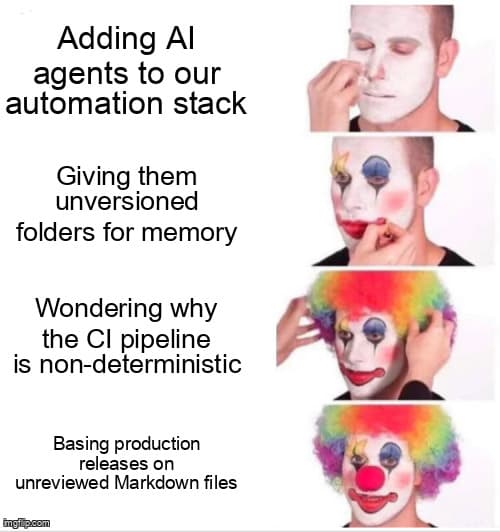
Your test automation agent already has memory. The question is whether that memory behaves like engineering infrastructure or like a messy folder of notes. For QA teams adopting AI-assisted Playwright, Cypress, or Selenium workflows, this distinction matters. A browser agent that remembers a login edge case, a flaky selector, or a compliance rule can save hours. The same agent can also silently reuse stale instructions, leak production credentials into prompts, or make a false assumption impossible to trace.
AI adoption is no longer a niche experiment. The Stack Overflow 2025 Developer Survey reports that 84% of respondents are using or planning to use AI tools in their development process. In quality engineering specifically, the World Quality Report 2024-25 says 68% of organizations are actively using GenAI or have roadmaps after successful pilots, and 72% of respondents report faster automation processes from GenAI integration. Those numbers do not prove agents are reliable. They prove teams need memory architectures that can be reviewed, tested, and rolled back.
This article focuses on one practical design: versioned Markdown as deterministic long-term memory. It is intentionally boring. Plain files, frontmatter, Git history, schema validation, and runner hooks. Boring is useful when your CI pipeline has to explain why an AI agent skipped a checkout test or retried a failing assertion. Pair this with our Playwright flaky test debugging guide and the deep dive on agent runtime patterns.
Is a Markdown Folder Enough for Agent Memory?
Yes, if the folder is treated as a versioned memory database with schemas, review gates, provenance, expiry, and deterministic retrieval.
A folder by itself is not memory. It is storage. Long-term memory needs three properties: persistence across runs, retrieval under constraints, and update discipline. QA engineers already understand this pattern. A screenshot folder is not evidence until it is tied to a test run, timestamp, browser version, and assertion. A Markdown note is not memory until it is tied to a schema, owner, source, and lifecycle.
The advantage of Markdown is not that language models love text. The advantage is that humans can review it with the same workflows they use for tests. You can diff it, require code owner approval, link it to a defect, and ask why a rule changed. Vector stores are useful for recall, but their operational surface is harder for QA teams to inspect. A deterministic system can still index Markdown into embeddings later. The canonical truth stays in a small set of auditable files.
Memory is production configuration. If a remembered fact can change what an automated agent does in CI, it deserves the same review discipline as test data, feature flags, and deployment scripts.
The Architecture: Canonical Files, Derived Indexes
A robust file-based memory system separates canonical memory from derived search artifacts. Canonical files live in Git. Derived indexes can be rebuilt from those files. That separation prevents a common failure mode: a vector index says one thing, the repo says another, and no one knows which source is authoritative.
- Canonical memory: Markdown files with frontmatter, stored under a reviewed directory such as
agent-memory/. - Schema gate: A CI check validates required metadata, IDs, expiry dates, tags, and source links.
- Retrieval manifest: A generated JSON index lists file hashes, scopes, and allowed consumers.
- Runtime loader: Test runners request only the memories needed for a scenario, never the entire folder.
- Write path: Agents propose memory updates as pull requests or append-only drafts, not silent self-edits to production truth.
This is especially important for browser testing. An agent might remember that a marketing banner can cover the checkout button, that Safari needs a slower animation wait, or that a test user must accept a consent modal before payment. Those facts are useful only if they stay scoped. A remembered workaround for one test environment can become a production blind spot if it leaks into every run.
Markdown Memory Versus Common Alternatives
| Approach | Best use | What breaks | QA control |
|---|---|---|---|
| Versioned Markdown | Policies, facts, test heuristics, known defects | Needs schema discipline and retrieval limits | High: diffs, reviews, rollbacks |
| Vector database only | Semantic lookup over large corpora | Harder to audit stale or conflicting memories | Medium: requires index inspection tools |
| Prompt snippets | Short-lived instructions and one-off experiments | No durable provenance or expiry | Low: often hidden in orchestration code |
Code Example 1: Validate Memory Files Before They Reach CI
The first production rule is that malformed memory should fail before an agent can use it. This Node.js script validates frontmatter, duplicate IDs, path traversal through symlinks, expiry format, and content size. It is intentionally dependency-free so it can run in GitHub Actions, GitLab CI, or a pre-commit hook.
#!/usr/bin/env node
// scripts/validate-agent-memory.mjs
import { lstat, readFile, readdir, realpath } from 'node:fs/promises';
import path from 'node:path';

const root = path.resolve(process.argv[2] ?? 'agent-memory');
const maxBytes = 64 * 1024;
const ids = new Map();
const errors = [];

function parseFrontmatter(file, text) {
  if (!text.startsWith('---\n')) throw new Error('missing YAML frontmatter');
  const end = text.indexOf('\n---\n', 4);
  if (end === -1) throw new Error('unterminated YAML frontmatter');
  const raw = text.slice(4, end).trim();
  const meta = {};
  for (const line of raw.split('\n')) {
    const match = line.match(/^([a-zA-Z0-9_-]+):\s*(.*)$/);
    if (!match) throw new Error('invalid frontmatter line: ' + line);
    meta[match[1]] = match[2].replace(/^['"]|['"]$/g, '');
  }
  for (const key of ['id', 'scope', 'owner', 'source', 'expires']) {
    if (!meta[key]) throw new Error('missing required field: ' + key);
  }
  if (!/^mem_[a-z0-9_-]{8,80}$/.test(meta.id)) throw new Error('invalid id: ' + meta.id);
  if (!['test', 'product', 'security', 'workflow'].includes(meta.scope)) {
    throw new Error('invalid scope: ' + meta.scope);
  }
  if (!/^\d{4}-\d{2}-\d{2}$/.test(meta.expires)) throw new Error('expires must be YYYY-MM-DD');
  return meta;
}

async function walk(dir) {
  for (const name of await readdir(dir)) {
    const file = path.join(dir, name);
    const stat = await lstat(file);
    if (stat.isSymbolicLink()) {
      const target = await realpath(file);
      if (!target.startsWith(root + path.sep)) errors.push(file + ': symlink escapes memory root');
      continue;
    }
    if (stat.isDirectory()) await walk(file);
    if (!stat.isFile() || !name.endsWith('.md')) continue;
    if (stat.size > maxBytes) {
      errors.push(file + ': file exceeds ' + maxBytes + ' bytes');
      continue;
    }
    try {
      const text = await readFile(file, 'utf8');
      const meta = parseFrontmatter(file, text);
      const previous = ids.get(meta.id);
      if (previous) errors.push(file + ': duplicate id already used by ' + previous);
      ids.set(meta.id, file);
      if (new Date(meta.expires + 'T00:00:00Z') < new Date()) {
        errors.push(file + ': expired memory must be renewed or deleted');
      }
    } catch (error) {
      errors.push(file + ': ' + error.message);
    }
  }
}

try {
  const rootStat = await lstat(root);
  if (!rootStat.isDirectory()) throw new Error(root + ' is not a directory');
  await walk(root);
  if (errors.length) {
    console.error('Agent memory validation failed:\n' + errors.map((e) => ' - ' + e).join('\n'));
    process.exit(1);
  }
  console.log('Validated ' + ids.size + ' memory files in ' + root);
} catch (error) {
  console.error('Cannot validate memory: ' + error.message);
  process.exit(2);
}
The edge case worth calling out is symlinks. Without a realpath guard, a malicious or accidental symlink can make the validator read files outside the memory directory. That is not just a security concern. It can make CI pass locally and fail in a runner with a different filesystem layout.
How Should an Agent Write Memory Without Corrupting It?
Use append-only drafts, atomic renames, lock files, and review gates. Never let the runtime agent overwrite canonical memory in place.
Runtime writes are where many memory systems become nondeterministic. Two agents discover the same flaky selector. Both update the same Markdown file. One write wins, the other disappears, and the next test run sees a half-true state. The fix is to write drafts atomically, include provenance, and let review promote drafts into canonical memory.
Code Example 2: Append a Reviewed Memory Draft Atomically
This script creates a new memory draft from a verified test result. It handles stale locks, empty observations, oversized notes, and unsafe filenames. It writes to a temporary file and renames it, which is atomic on the same filesystem.
#!/usr/bin/env node
// scripts/propose-memory.mjs
import { mkdir, open, rename, rm, writeFile } from 'node:fs/promises';
import path from 'node:path';
import crypto from 'node:crypto';

const draftsDir = path.resolve('agent-memory-drafts');
const lockFile = path.join(draftsDir, '.lock');
const lockTtlMs = 30_000;

function safeSlug(value) {
  return value.toLowerCase().replace(/[^a-z0-9]+/g, '-').replace(/^-|-$/g, '').slice(0, 70) || 'memory';
}

function requiredEnv(name) {
  const value = process.env[name];
  if (!value || !value.trim()) throw new Error('missing required env var ' + name);
  return value.trim();
}

async function acquireLock() {
  await mkdir(draftsDir, { recursive: true });
  try {
    const handle = await open(lockFile, 'wx');
    await handle.writeFile(String(Date.now()));
    return async () => {
      await handle.close();
      await rm(lockFile, { force: true });
    };
  } catch (error) {
    if (error.code !== 'EEXIST') throw error;
    throw new Error('another memory proposal is in progress; retry later');
  }
}

try {
  const title = requiredEnv('MEMORY_TITLE');
  const source = requiredEnv('MEMORY_SOURCE');
  const observation = requiredEnv('MEMORY_OBSERVATION');
  if (observation.length > 4000) throw new Error('observation too large; link to an artifact instead');
  if (/password|secret|token/i.test(observation)) {
    throw new Error('possible secret detected; redact before storing memory');
  }

  const release = await acquireLock();
  try {
    const id = 'mem_' + crypto.randomBytes(8).toString('hex');
    const expires = new Date(Date.now() + 90 * 24 * 60 * 60 * 1000).toISOString().slice(0, 10);
    const slug = safeSlug(title);
    const target = path.join(draftsDir, id + '-' + slug + '.md');
    const temp = target + '.tmp-' + process.pid;
    const body = [
      '---',
      'id: ' + id,
      'scope: test',
      'owner: qa-automation',
      'source: ' + source,
      'expires: ' + expires,
      'status: proposed',
      '---',
      '',
      '# ' + title,
      '',
      observation,
      '',
      '## Promotion checklist',
      '- [ ] Reproduced in CI or reviewed by a human',
      '- [ ] No credentials, personal data, or environment-only assumptions',
      '- [ ] Linked to test, trace, bug, or incident source',
      '',
    ].join('\n');
    await writeFile(temp, body, { flag: 'wx', mode: 0o600 });
    await rename(temp, target);
    console.log('Created memory draft: ' + target);
  } finally {
    await release();
  }
} catch (error) {
  console.error('Could not propose memory: ' + error.message);
  process.exit(1);
}
This is not meant to replace review. It gives the agent a safe place to put candidate knowledge. In practice, teams wire this to failed-test triage: if a Playwright trace confirms a recurring modal, the agent can propose a memory that a QA engineer later promotes or rejects.
Code Example 3: Load Scoped Memory Into Playwright Tests
The runtime loader should be strict. It should select memories by scope and tag, cap total prompt size, and fail closed for protected tests. This example creates a Playwright fixture that loads only checkout-related memories and exposes them to tests as structured data rather than a giant prompt blob.
// tests/fixtures/memory-fixture.ts
import { test as base, expect } from '@playwright/test';
import { readFile, readdir } from 'node:fs/promises';
import path from 'node:path';

type Memory = { id: string; scope: string; tags: string[]; body: string; source: string };
type Fixtures = { agentMemory: Memory[] };

function parseMemory(file: string, text: string): Memory {
  const end = text.indexOf('\n---\n', 4);
  if (!text.startsWith('---\n') || end === -1) throw new Error(file + ' has invalid frontmatter');
  const meta = Object.fromEntries(
    text
      .slice(4, end)
      .split('\n')
      .filter(Boolean)
      .map((line) => {
        const index = line.indexOf(':');
        if (index === -1) throw new Error(file + ' has invalid metadata line: ' + line);
        return [line.slice(0, index).trim(), line.slice(index + 1).trim()];
      }),
  );
  const tags = (meta.tags || '').split(',').map((tag) => tag.trim()).filter(Boolean);
  if (!meta.id || !meta.scope || !meta.source) throw new Error(file + ' is missing id, scope, or source');
  return { id: meta.id, scope: meta.scope, source: meta.source, tags, body: text.slice(end + 5).trim() };
}

async function loadMemories({ tag, required }: { tag: string; required: boolean }) {
  const dir = path.resolve(process.env.AGENT_MEMORY_DIR || 'agent-memory');
  try {
    const files = (await readdir(dir)).filter((name) => name.endsWith('.md'));
    const selected: Memory[] = [];
    let bytes = 0;
    for (const file of files) {
      const text = await readFile(path.join(dir, file), 'utf8');
      const memory = parseMemory(file, text);
      if (memory.scope !== 'test' || !memory.tags.includes(tag)) continue;
      bytes += Buffer.byteLength(memory.body, 'utf8');
      if (bytes > 12_000) throw new Error('selected memories exceed 12KB prompt budget');
      selected.push(memory);
    }
    if (required && selected.length === 0) throw new Error('no required memories found for tag ' + tag);
    return selected;
  } catch (error) {
    if (required) throw error;
    console.warn('Running without optional agent memory: ' + error.message);
    return [];
  }
}

export const test = base.extend<Fixtures>({
  agentMemory: async ({}, use, testInfo) => {
    const required = testInfo.project.name.includes('release');
    const memories = await loadMemories({ tag: 'checkout', required });
    testInfo.annotations.push({ type: 'agent-memory-count', description: String(memories.length) });
    await use(memories);
  },
});

export { expect };

test('checkout handles remembered consent modal', async ({ page, agentMemory }) => {
  await page.goto('/checkout');
  const modalMemory = agentMemory.find((memory) => memory.body.includes('consent modal'));
  if (modalMemory) {
    await page.getByRole('button', { name: /accept/i }).click({ timeout: 3000 }).catch(() => {});
  }
  await expect(page.getByRole('button', { name: /pay now/i })).toBeVisible();
});
The key design choice is that memory affects test setup, not assertions. A memory can tell the test to dismiss a known consent modal. It should not tell the test to ignore a missing Pay Now button. The moment memory changes the oracle, you need a stronger approval path.
Troubleshooting and Debugging Memory Failures
Deterministic memory systems fail in recognizable ways. Treat them like test infrastructure: isolate the source, reproduce with a minimal fixture, and preserve enough evidence to debug later.
- Wrong memory retrieved: print selected memory IDs, file hashes, and retrieval filters into the test report. If the wrong file appears, the manifest is stale or the tags are too broad.
- Agent follows stale guidance: check
expires, source links, and last Git commit. Expired memories should block promotion, and high-risk memories should require shorter lifetimes. - CI passes but local fails: compare
AGENT_MEMORY_DIR, branch, and generated manifest. Derived indexes must be rebuilt from canonical Markdown during CI. - Prompt budget overflow: cap total bytes before the model call and fail with the selected IDs. Do not silently truncate; truncation often removes the source or caveat.
- Conflicting memories: detect duplicate scopes and overlapping tags. A login workaround for staging should not share the same retrieval tag as production checkout policy.
- Secret exposure: scan proposed drafts before write and before promotion. If a secret enters Git, rotate it; deleting the file is not enough because history remains.
A good debugging artifact says: these memory IDs were loaded, from these file hashes, under this retrieval query, for this test run. Without that chain, you are guessing.
Edge Cases QA Teams Usually Hit First
Multi-tenant products need tenant-scoped memory. A selector workaround for one customer theme may be wrong for another. Localized products need language-aware memories; a Spanish checkout flow in Madrid may not use the same accessible names as an English flow. Privacy-sensitive systems need redaction at write time, not after a reviewer notices a leaked email in a diff. Parallel CI needs lock files or append-only draft paths. Long-lived release branches need clear merge rules so old memories do not reappear after a hotfix branch is merged.
The hardest edge case is contradiction. One memory says the app shows a consent modal. Another says the modal was removed. Do not ask the model to resolve that conflict from prose. Make the schema carry status, expiry, source, and environment. Then make validation fail when two active memories claim different facts for the same scope and tag.
A Practical Rollout Plan
Start small. Pick one test suite where remembered context already lives in people's heads: checkout, onboarding, authentication, or billing. Create ten to twenty Markdown memories with strict frontmatter. Add the validator to CI. Add a Playwright, Cypress, or Selenium loader that can print exactly what it loaded. For the first month, make all writes draft-only and require human promotion.
After the system earns trust, add derived retrieval. Generate a JSON manifest. Optionally index memory bodies into a vector store, but keep Markdown as the source of truth. Add a weekly expiry report. Delete memories aggressively. Long-term memory should not mean permanent memory; it should mean durable memory with an owner and a retirement path.
Conclusion: Make Memory Reviewable Before You Make It Clever
Agent memory is becoming part of the QA stack because agents are becoming part of test creation, execution, and triage. The mistake is to treat memory as a magical model feature. For engineering teams, memory is a data system. It has write paths, read paths, schemas, stale records, security boundaries, and failure modes.
A versioned Markdown system is not the only valid architecture, but it is a strong foundation. It gives QA engineers the controls they already trust: diffs, reviews, CI gates, source links, and rollbacks. Once those controls exist, you can layer semantic retrieval and automation on top. Without them, your agent's brain is just a folder, and eventually someone will have to debug what it thought it remembered.
Ready to strengthen your test automation?
Desplega.ai helps QA teams build robust test automation frameworks that turn browser behavior, test evidence, and AI assistance into repeatable quality signals.
Get StartedFrequently Asked Questions
Why use Markdown instead of only a vector database for agent memory?
Markdown gives reviewers diffable, human-readable intent. A vector database can help retrieve context, but Markdown is easier to audit, version, approve, and roll back.
How often should an AI testing agent update long-term memory?
Update memory only after verified outcomes: passing tests, confirmed bug fixes, or reviewed incidents. Treat unverified observations as session notes, not durable truth.
Can this pattern work with Playwright, Cypress, and Selenium?
Yes. The memory layer is test-runner independent. Use runner-specific hooks to pass selected memories into fixtures, setup files, or capability builders.
What is the biggest risk in file-based agent memory?
The biggest risk is stale confidence: an agent retrieves an old note and treats it as policy. Schema validation, expiry dates, and test-backed provenance reduce that risk.
Related Posts
Cody's Repository Indexing: Does Cognitive Offloading Create Knowledge Gaps in Large Codebases? | Desplega AI
A practical deep dive into Cody repository indexing, context retrieval, and how indie hackers avoid AI-created knowledge gaps.
Hot Module Replacement: Why Your Dev Server Restarts Are Killing Your Flow State | desplega.ai
Stop losing 2-3 hours daily to dev server restarts. Master HMR configuration in Vite and Next.js to maintain flow state, preserve component state, and boost coding velocity by 80%.
The Flaky Test Tax: Why Your Engineering Team is Secretly Burning Cash | desplega.ai
Discover how flaky tests create a hidden operational tax that costs CTOs millions in wasted compute, developer time, and delayed releases. Calculate your flakiness cost today.